| SELF | 36 |
S.B. Karavashkin and O.N. Karavashkina |
|
|
|
In its turn, this causes the
trice-fold narrowing of the frequency band of periodical regime for the third harmonic,
with retaining the general number of resonance peaks which are located now on the lower
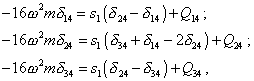
one third of the band of the first harmonic. At the frequency higher than that boundary To reveal the general regularities of the next harmonics, determine the fourth harmonic. On the basis of (13), the system of equations for its finding has the following form |
|
|
(36) |
| where | |
|
(37) |
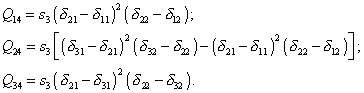
| The first what we are noting is that the structure of the system (37) fully coincides with the structure of the system (20) for the third harmonic. However the equivalent forces Qi4 have another form. Their amplitude is determined by the pattern of vibration of both the first and second harmonics. So, if the equality (19) was true, the equality | |
|
(38) |
is also true. However if the equality (19) was not true,
then due to the general structure of systems of equations (20) and (36) the solution of
the system (36) is similar to (30), with the substitution of Qi3
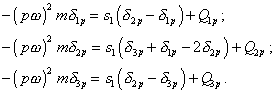
into Qi4 and changing the coefficient at Generalising the investigation of four harmonics, we can affirm that for all the following harmonics the structure of systems of equations will remain, and we can present it in the following form: |
|
|
(39) |
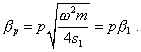
The parameter  p will be p will be |
|
|
(40) |
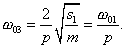
| The boundary frequency of the pth harmonic will be p times less than that of the first harmonic: | |
|
(41) |
Contents: / 28 / 29 / 30 / 31 / 32 / 33 / 34 / 35 / 36 / 37 / 38 /


 03 the
vibrations of the third harmonic correspond to the aperiodical damping along the line
vibration regime and are localised in the regions of application of the equivalent forces.
At the same time, the periodical vibration regime of the first harmonic remains and
effects on the vibration amplitude of the third harmonic through the value of equivalent
forces Qi3 in accordance with (31)- (33). Owing to this, in the
present case, despite the non-resonant vibration pattern in the aperiodical vibration
regime, at the overcritical range of the third harmonic there arise the resonances,
introduced to it from the first harmonic. These resonances are limited by the regions of
equivalent forces affection, because they arise on the background of vibrations of the
third harmonic effectively damping in space, which is typical for the aperiodical regime.
03 the
vibrations of the third harmonic correspond to the aperiodical damping along the line
vibration regime and are localised in the regions of application of the equivalent forces.
At the same time, the periodical vibration regime of the first harmonic remains and
effects on the vibration amplitude of the third harmonic through the value of equivalent
forces Qi3 in accordance with (31)- (33). Owing to this, in the
present case, despite the non-resonant vibration pattern in the aperiodical vibration
regime, at the overcritical range of the third harmonic there arise the resonances,
introduced to it from the first harmonic. These resonances are limited by the regions of
equivalent forces affection, because they arise on the background of vibrations of the
third harmonic effectively damping in space, which is typical for the aperiodical regime.