
| V.2 No 2 | 31 |
| Investigation of elastic constraint non-linearity | |
|
|
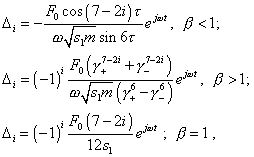
3. Solution seeking technique In order to identify the way of seeking the solution for (3), note that in case s3 = 0 this system reduces automatically to that linear whose solutions we know [3]: |
|
|
(6) |
| where i = 1, 2, 3 , | |
|
(7) |
However if we substitute, e.g., the
periodical solution (at This feature gives us the reason to seek the general solution as a series beginning with the fundamental harmonic corresponding to the external force frequency |
|
|
(8) |
where As we see, the absence of the condition, of non-linearity
smallness in the elastic constraints, has led us to the essential change of the form of
the sought solution. In particular, the parameter |
|
|
(9) |
By its shape, (8) looks more like an expansion of a
complex function into the Fourier series that usually is inapplicable in solving the
non-linear mechanic problems by the conventional methods. However the summation in (8) is
carried out only in the positive values of p, and even the zero term is
absent. Should we actually seek the solution in the form of the Fourier expansion, we
would have no right to narrow the summation region without limiting the generality of the
solution. However, as we will show below, the coefficients  ip are the
resonance-type analytical functions depending on the parameters of the studied elastic
line and external force frequency ip are the
resonance-type analytical functions depending on the parameters of the studied elastic
line and external force frequency  . And each of the coefficients of (8) will be the solution
of its own system of algebraic equations; therefore it will have its own functional
dependence. At the same time we know (see, e.g., [20, p. 214] or [21, p. 143]) that in the
expansion into the Fourier series . And each of the coefficients of (8) will be the solution
of its own system of algebraic equations; therefore it will have its own functional
dependence. At the same time we know (see, e.g., [20, p. 214] or [21, p. 143]) that in the
expansion into the Fourier series |
|
|
(10) |
| the coefficients ak and bk are real numbers, and the coefficients ck are complex numbers that are determined from the equality | |
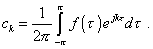 |
(11) |
Contents: / 28 / 29 / 30 / 31 / 32 / 33 / 34 / 35 / 36 / 37 / 38 /



 < 1) from (6) into the general system (3) at s3
 0, then on
the right part of each equality an additional summand corresponding to the third harmonic
will appear and violate the correspondence of (6) to (3). If we try to take into account
the appeared additional harmonic, then in substituting the refined solutions to (3) there
will appear the terms of the next, higher harmonics, etc. This corroborates the known fact
that "due to the presence of non-linear terms, in the solution of forced vibrations
equation the harmonics with the frequencies approximately equal to n
0, then on
the right part of each equality an additional summand corresponding to the third harmonic
will appear and violate the correspondence of (6) to (3). If we try to take into account
the appeared additional harmonic, then in substituting the refined solutions to (3) there
will appear the terms of the next, higher harmonics, etc. This corroborates the known fact
that "due to the presence of non-linear terms, in the solution of forced vibrations
equation the harmonics with the frequencies approximately equal to n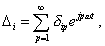
 indicating, for example, the smallness
of function
indicating, for example, the smallness
of function 
