
 Home  Introduction Physics Ideas Society Conclusion Bibliography
| Discussion of Physics
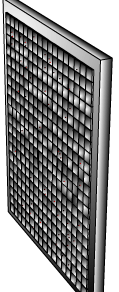 A CCD illustration
 The major difference in a color photograph is that the shades are defined in three different components; red, green, and blue. It then has several degrees of brightness for each color which means it is able to produce many colors. The process of splitting the image into colors is called trichromacy. The different colors in the process are then broken down into saturation which allows us to see colors such as brown and orange. The image is then transferred to data storage and able to be viewed from a computer. The process through which the image is concieved is now clear, but how does physics relate to it? Easy, physics is involved in the process in a lot of different ways. The refraction of light through the lens to the digitizer has to do with optics. The transfer of energy throughout the process is related to physics as well. We go mainly to technological concepts once the image goes through the calculations in the computer. The light that goes through the lens is the main physical part of the process. The light is reflected through the small hole in the lens and exposed to the film. If the lens was too big then too much light would go through and the image would not appear. However, if the lens was smaller the image would be very sharp and clear but also very dim and difficult to see. After this process takes place then the rest of the digitizing happens and in the end we come up with a beautiful picture.
 This is a photo Cheryl took with a digital camera; the detail that can be acchieved by using one is evident here :)
|
