Behind the Scenes
Production began on a brooding, overcast morning at Verdugo Hills High School ... perfect weather for The Craft. But soon the sun magically appeared over the campus, a good omen for all on the set which would double in the film for Saint Benedict's Academy.
Filming commenced with the four leads Sarah (Robin Tunney), Nancy (Fairuza Balk), Bonnie (Neve Campbell) and Rochelle (Rachel True) wearing their regulation green plaid skirts, navy blazers (with Saint Benedict's Academy religious crest) and striped green ties. In a small commons area, beneath the magnolia trees of Verdugo Hills High, Chris Hooker (Skeet Ulrich) puts the moves on St. Benedict's shy newcomer, Sarah Bailey (Robin Tunney).
 In
the background, behind the couple, blazed a mural of the Virgin
Guadalupe wreathed by fire. This dramatic mural, painted by the
scenic artists on a textured concrete facade, was researched by
production designer Marek Dobrowolski from a compilation of religious
art from Mexico. Dobrowolski notes that the fiery mural "combines
the religious tone of the Catholic girls school with the Hispanic
influence of Los Angeles, which is apparent in all the art and
architecture featured in the film. The element of fire was also
useful with the mural because one of the elements of witchcraft
is fire."
In
the background, behind the couple, blazed a mural of the Virgin
Guadalupe wreathed by fire. This dramatic mural, painted by the
scenic artists on a textured concrete facade, was researched by
production designer Marek Dobrowolski from a compilation of religious
art from Mexico. Dobrowolski notes that the fiery mural "combines
the religious tone of the Catholic girls school with the Hispanic
influence of Los Angeles, which is apparent in all the art and
architecture featured in the film. The element of fire was also
useful with the mural because one of the elements of witchcraft
is fire."
Dobrowolski also allocated color schemes to the four leads based on the symbols of their four elements (north, east, south, west). "Sarah in earth tones, sepia, olive brown and orange," he says. "Nancy in black and red, Bonnie in pale blues and lavender, and Rochelle in sage and gray browns." Dobrowolski worked closely with the art department, costumes, props and even vehicles so he could control the colors. For instance, he tried to eliminate red and only use it when it was very significant, representing evil or danger and, of course, Nancy's character.
"Their home environments will also carry their colors," explains Dobrowolski adding, "Sarah's house has dominant, wild, cadmium yellow and ochre colors and Nancy's home has a lot of black and red, for example."
Director of photography Alexander Gruszynski filmed almost all of The Craft with Kodak's brand new 5287 film stock, the first feature to use it so extensively which, "gives the film a wonderful stone-washed look."
 The next setup was the interior
hallway of Saint Benedict's Academy. The hardwood floors, archways,
wooden doors and mission tiles of Verdugo Hills High School, built
in the 1930s by Don Verdugo, gave the perfect ambiance. The art
department added statues of religious icons, banners and 'school
made' posters promoting various school events. Also set dressed
in this theme was a homeroom, French classroom, biology room and
math class. The art department also placed a sculpture of Saint
Benedict and the Virgin Mary in the front of the school. Outside,
in the quad, they created a statuary of various religious figures.
The next setup was the interior
hallway of Saint Benedict's Academy. The hardwood floors, archways,
wooden doors and mission tiles of Verdugo Hills High School, built
in the 1930s by Don Verdugo, gave the perfect ambiance. The art
department added statues of religious icons, banners and 'school
made' posters promoting various school events. Also set dressed
in this theme was a homeroom, French classroom, biology room and
math class. The art department also placed a sculpture of Saint
Benedict and the Virgin Mary in the front of the school. Outside,
in the quad, they created a statuary of various religious figures.
The art department again used red bougainvillea to cover Sarah's house. A two-story Spanish mansion built in the early thirties, guarded by a giant saguaro cactus, was selected for its Hispanic influence and, explains Dobrowolski, because, "it has a lot of atmosphere, looks abandoned and spooky. Most importantly, it isn't what moviegoers are used to seeing in horror films, i.e. the typical cliche of an imposing Victorian home with peeling paint."
The Spanish mansion was recreated in painstaking detail on a sound stage on the Sony lot, replete with architectural detail, 1920s tile work, hardwood floors and wood beam arched ceilings.
 The location of Sarah's house was
also animal wrangler Boone Narr's opportunity to unleash an army
of creepy crawlers, amassing "the largest quantity of reptiles
that will be seen on screen in years." That's a lot coming
from a man who has been in the business for over twenty-five years
and counts Indiana Jones and the Last Crusade among his
hundred or so credits. For The Craft, Narr imported three
thousand snakes including: pythons, boas, water snakes, garter
snakes, rat snakes, a ten foot long Amazon constrictor, even rare
albino snakes.
The location of Sarah's house was
also animal wrangler Boone Narr's opportunity to unleash an army
of creepy crawlers, amassing "the largest quantity of reptiles
that will be seen on screen in years." That's a lot coming
from a man who has been in the business for over twenty-five years
and counts Indiana Jones and the Last Crusade among his
hundred or so credits. For The Craft, Narr imported three
thousand snakes including: pythons, boas, water snakes, garter
snakes, rat snakes, a ten foot long Amazon constrictor, even rare
albino snakes.
He also employed parrots, lizards, fifty large rats, dozens of tarantulas, five hundred monarch butterflies, two thousand lady bugs, three thousand maggots, ten thousand German cockroaches and giant, hissing Madagascar cockroaches, fifteen thousand mealy worms and twenty thousand sterile flies.
 Another visual location was Lirio's
candle shop which Dobrowolski describes as "a combination
of occult stores, botanicas and the type of iconography you see
in these kinds of shops (witchcraft, voodoo, santeria, etc.),
a realism to indicate the powers that lie in the different objects
and rituals -- not to scare people but to explore fantasy."
The candle shop location was on Hollywood Boulevard in a Spanish
style 1920s-era home which today is the El Adobe Marketplace.
Another visual location was Lirio's
candle shop which Dobrowolski describes as "a combination
of occult stores, botanicas and the type of iconography you see
in these kinds of shops (witchcraft, voodoo, santeria, etc.),
a realism to indicate the powers that lie in the different objects
and rituals -- not to scare people but to explore fantasy."
The candle shop location was on Hollywood Boulevard in a Spanish
style 1920s-era home which today is the El Adobe Marketplace.
Murals were painted on the exterior of the market by the scenic artists, honoring a combination of Indian cultures (Aztec, Mayan) and different religious ceremonies (Day of the Dead and others.) An 'all seeing' eye which symbolizes the store and the movie (used in the personification of Manon) was also featured in the murals.
What was once the market's flower
store, now an apartment, was transformed into Lirio's candle shop.
The room was gutted, repainted and enhanced with architectural
details such as arches and molding. jars of brightly colored powders,
herbs, oils, votive candles, stigmas, religious statues, masks,
tribal dolls and assorted artwork featuring witches, snakes, skulls,
skeletons added by the prop department to create the authentic
and magical look of the shop.
"You can worship just about anything in this store,"
notes Dobrowolski with a wry smile.
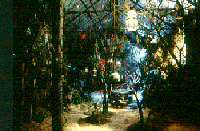
The construction team broke down the rear wall of the apartment and created an atrium with a glass greenhouse roof. "The set represents an old greenhouse with a well in the center," explains Dobrowolski, "The further you go away from the well, surrounded by greenery and life, the more plants are dead." Animal wrangler Boone Narr added a few exotic birds to the atrium such as parrots and ravens in bird cages, also a few snakes, lizards and tarantulas.
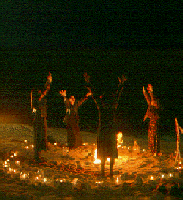 At
the final, and arguably most magical, location for the film, the
crew assembled at Leo Carillo State Beach (north of Los Angeles)
where the four aspiring witches chant around a fire pit circled
with candles set at positions north, east, south and west. The
crew had to return to the location a second time to complete filming
interrupted by several weird occurrences that even caused witch
consultant Pat Devin to raise an eyebrow. As the fog rolled in
at midnight, the four actresses used actual Wiccan rites and language
to invoke powerful forces. Then, as Fairuza Balk's character
Nancy attempts to invoke the deity Manon, a flock of bats hovered
over the set and the tide rose dramatically, extinguishing the
circle of candles. Witchcraft consultant Devin recalls that "Manon,
a fictitious creation for the film, sounds very close to Mananan,
the Gaelic God of the Sea. Luckily, we weren't all swept to sea!"
At
the final, and arguably most magical, location for the film, the
crew assembled at Leo Carillo State Beach (north of Los Angeles)
where the four aspiring witches chant around a fire pit circled
with candles set at positions north, east, south and west. The
crew had to return to the location a second time to complete filming
interrupted by several weird occurrences that even caused witch
consultant Pat Devin to raise an eyebrow. As the fog rolled in
at midnight, the four actresses used actual Wiccan rites and language
to invoke powerful forces. Then, as Fairuza Balk's character
Nancy attempts to invoke the deity Manon, a flock of bats hovered
over the set and the tide rose dramatically, extinguishing the
circle of candles. Witchcraft consultant Devin recalls that "Manon,
a fictitious creation for the film, sounds very close to Mananan,
the Gaelic God of the Sea. Luckily, we weren't all swept to sea!"
Director Andrew Fleming recalls the night this way: "Every time the girls started the ceremony, and only when they would start the ceremony, the waves would start coming up tremendously fast, pounding heavily. Then, right when Nancy says her line, 'Manon, fill me,' right at that exact moment, we lost power. It was a very strange thing."