|

|
 Headcrab Headcrab
The lowly headcrab is the first enemy you'll encounter, and it's by
far the most common. These guys love to dwell in dark corners and other
out-of-sight areas, trying to surprise victims. The sharp limbs of the
headcrab can easily tear through your hazard suit, if you're not careful.
Never take headcrabs for granted. They're the most hated, most annoying,
and least understood of all xenofauna. Headcrabs move clumsily but quickly.
Its leap - if not dodged - is not precisely fatal to its prey, for once
the headcrab has attached itself to the skull of a human host, there commences
a swift and horrible process of "zombification" which gives the host a
continued existence of the most objectionable sort. If you or a companion
are ever unavoidably headcrabbed, you would be well advised to put a bullet
through the affected brain as soon as possible, for only massive and irreversible
damage to cerebral tissue has any apparent effect on the headcrab's ability
to "drive" its victim. |

|
Zombie
Want to know what happens after you've been headcrabbed? Take a look.
It sure isn't pretty, but don't gawk too long: these guys would just love
rip you open and play jumprope with your intestines. Although slow and
dimwitted (as zombies tend to be), their long, sharp, claws are deadly.
Put zombies out of their misery by attacking them between swipes. |

|
Alien Slave
While many of the alien species collected and studied by the Department
of Xenotheric Husbandry exhibit a lifestyle that might be characterized
as "undesirable" in human terms, the honors for most wretched existence
must certainly be granted to the slave-class of alien, xenotherium subservilia.
These pathetic creatures, bred for submissive behavior and unswerving loyalty,
will attack and kill without mercy when so ordered by their superiors.
In such instances they will wage war with an insect-like vigor, heedless
of personal risk, fearing the wrath of their masters more than any possible
harm an enemy may inflict. On the other hand, in the rare situations where
the alien slaves are out of the direct protection and supervision of an
overlord, they will flee without shame and may be considered harmless.
The slave species is hardy, impervious to discomfort, and due to the requirements
of its breeders, undoubtedly possessed of extremely low intelligence. It
is all the more remarkable, therefore, given a breed incapable of conceiving
the idea of revolt, that the alien overlords find it necessary to burden
their slaves with a metallic torque or slave-collar, which torments and
eventually executes any slave that unwisely attempts to remove its yoke.
Beware of the slaves' slow-charging energy attack, which is powerful enough
to fry you extra crispy with a single blast. |

|
Houndeye
The common "houndeye" or "sound dog" is a pack-animal par excellence.
A houndeye apart from its pack is an unhappy and vulnerable creature, but
in groups of three or more they will exhibit resonant behavior, emitting
destructive harmonics capable of rupturing the internal organs of their
prey. Deafness and migraine headaches are only two of the symptoms reported
by survivors of houndeye attacks. However, if well-fed, they will not engage
in harmonic behavior except when threatened and during their seasonal mating
spree. |

|
Bull Squid
The natural range and habitat of this supreme predator remain uncertain.
While bearing signs of aquatic specialization, the bullsquid's powerful
limbs and characteristic neurotoxic (and reportedly psychoactive) "venom-squirt"
suggest it has adapted to a terrestrial environment. It is possessed not
only of a ferocious appetite (necessary to support its immense bulk) but
also of an overwhelming libido. In short, the bullsquid will attempt to
eat or mate with almost anything that crosses its path, without regard
for species or any apparent reproductive necessity, since dissection clearly
indicate that every gastropolypus is hermaphroditic. Additionally, it has
been speculated that to fauna of its native environment, the bullsquid's
phlegm might have aphrodisiac qualities; but in terrestrial mammalian creatures,
it is uniformly lethal. |
|
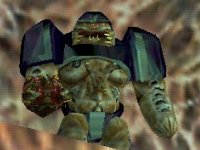
Alien Grunt
Footsoldier of the invading army, this alien myrmidon relies on telepathy
for coordination with its troops, but is no less dangerous when encountered
in isolation. Like many inhabitants of the Portal Dimension, it appears
to be a colonial creature, harboring several varieties of organic parasites
which complement its destructive nature. Most dangerous are swarms of "thornets,"
heat-seeking autonomous "insects" which breed in their host's paracoelomic
cavity and are only too happy to attack and consume the first thing they
see upon release. The gleaming partial body armor at first appeared to
be the product of an advanced weapons technology; but closer examination
of the occasional moribund specimen has shown it to be a biologically extruded
exoskeleton, synthesized from a diet rich in certain xenotic minerals.
This suggests that long separation from the Portal Dimension, and a diet
deficient in alien ores, might lead to the eventual weakening and demise
of the alien troops. It is not, however, recommended that Earth rely on
poor nutrition to repel the invaders. |
|
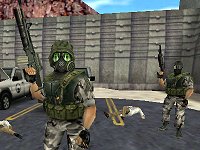
Grunts
These guys are here to clean up that little mess you made, and they
aren't exactly happy to see you. Grunts are usually armed with a 9mm Assault
Rifle and a healthy supply of grenades, but you'll encounter some packing
shotguns, rocket launchers, or operating turrents. These guys aren't kamikaze
morons; they're experienced troops. They'll work together to take you down.
Listen to their radio chatter carefully, as their communications may contain
clues. |
|


