
My Garden, My Heaven on Earth
'The 'Veggie' Patch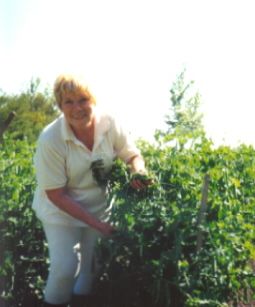
Lady J and Her Garden
However, it's my 'Veggie garden' that holds the most fascination for me. Once my seeds are planted I can hardly wait for those first new shoots to put in an appearance. Oh, the thrill I feel as I watch 'my crops come to fruition, and I spend hours pulling every tiny weed that dares to put in an appearance.
When it's time to gather the harvest, I become almost maniacal. First the radishes, then the lettuce, mmm, mmm, just the thought of freshly washed lettuce, especially when it has been allowed to 'crisp up' for a while in the fridge, sprinkled with a light vinegary dressing and a slice of home made bread. I can hardly wait.
And peas!! There is nothing so thrilling than seeing the vines positively dripping with those little green marvels. Not a one escapes my eagerly picking fingers. Runner beans, bush beans, broad beans. I grow and love them all, and always plant far too many dill cucumbers, just because I get such a thrill out of watching them grow. I have enough dill pickles and relishes to last till the next millenium.
Here's a tip: If you have a grape vine, and I do, add a grape leaf to the jar when pickling your dills. You'll be amazed how it adds to their crispness.
Oh, those wonders of color and creation. The glorious carrots and beets, I always grow far too many to use. I know most people always enjoy baby carrots and beets, but me, no way. I like to leave them growing till they're huge. What a charge I get when I then pull them out of the ground. Oh, now don't get me wrong, I love the new ones too, but for me there is something positively primeval about pulling those beautiful orange sceptres and red orbs from the ground. I go right back to me very basic roots. I do however love new potatoes, and there is nothing my husband and I enjoy more, than devouring freshly picked and lightly steamed platefuls of new potatoes and home grown produce. Dripping with our own churned butter, and seasoned with spices from our herb garden. Can't you just taste them all right now ?
For those of you who grow too many beets and carrots like I do. Here is a really yummy relish recipe.
Cook Beets. Peel and chop to make 8 cups.
Boil together with :
4 cups sugar
2 cups vinegar
Boil for 20 minutes
Add
2 packages strawberry Jello
2 large grated onions
2 large grated carrots
Pour into sterilized jars and seal.
Oh! It's stopped raining and the sun is shining. I'm going into my garden right now.
The next installment of 'My Garden, My Heaven on Earth' will be 'The Absolutely, Incredibly Awesome Zucchini'
Don't miss it!!!
'The Absolutely, Incredibly Awesome Zucchini'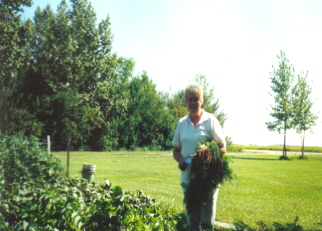
Lady J and Her Garden
However, that following spring, I could hardly wait to get my first country garden planted and I made sure I included the zucchini in my seed purchases. I was surprised, and a little disappointed, to find there was only about fifteen seeds inside the package. Still, I followed the planting instructions, made five good sized 'hills' and planted three seeds in each hill. They probably won't all germinate anyway was what I thought to myself.
The next day we had company for supper.
Alex, an avid gardener, lived in town and raised a small veggie patch each year. Just enough for himself and Thelma, his wife. He was most impressed when he saw the size of the garden plot I'd created.
"Good Lord Jude," he said, "You'll be able to feed a small emerging African nation with all that. Have you any idea how much stuff your going to have?" I laughed and told him that I would enjoy every minute of it and could hardly wait to see it start growing. I then told him what veggies I'd planted, and that I was trying zucchini for the first time. "Well," he said, " I hope you've given them lots of room. Zucchini need a lot of space." I told him that I'd planted them right at the end of the patch, there was more than enough room and in any case, I'd only planted fifteen seeds.
"You've planted how many?" he exclaimed, "Lordy, lordy, Jude, there's no way you'll be able to harvest that much."
"Have I planted too many?" I asked. Alex laughed. "All you need is one, maybe two plants at most, pull some of them out, otherwise your gonna be feeding half a dozen small emerging African nations."
Well, I didn't take Alex's advice, and needless to say, I ended up being inundated with lush healthy
vines that crawled over the garden, the lawn, and eventually spilled onto the driveway. I was totally enthralled with them, and watched with interest their prolific growth. I didn't have the heart to pull any of these massive plants out of the earth, and I let every one come to full fruition. Oh, the sheer thrill I felt once the enormous bright yellow flowers changed overnight into perfectly formed zucchini. I was totally amazed at the rapidity of their growth. And Alex was right. I could hardly keep up with the harvest. Fortunately I had lots of city friends who appreciated my abundant offerings of 'free veggies' and I was able to get rid of all that I grew.
I still plant a garden every year, and still get an incredible lifting of spirit when I see the Absolutely, Incredibly Awesome Zucchini growing so prolifically. Mind you, I don't think I will ever need to make any Zucchini relish ever again. My cupboards and my friends cupboards are well stocked with my yearly offerings, and the versatility of this enormous vegetable never ceases to amaze me. I'm convinced it must have been this vegetable that John Wyndham based his book 'The Day Of the Triffids' on. I have included a delicious relish recipe with this story, but, just to keep everyone waiting in suspense, will add more at future dates. Don't miss my next adventure in the veggie patch.
'The Colorful, Crunchy, Crazy, Carrots'
Grind 10 cups unpeeled zucchini
chop 4 large white onions
chop 1 large red pepper
1/4 cup Pickling salt
Cover chopped veggies with salt and let stand overnight.
Rinse and drain well.
In large pot bring to the boil:
5 cups white sugar
2 1/2 cups vinegar
1 tsp celery seed
1 tsp dry mustard
4 tbsp cornstarch
' The Colorful, Crunchy, Crazy, Carrots '
by Angel Lady J
The reason I'm sharing this little story is simple, it was here that my granddad first introduced me to the wonders that grew below the soil, and was where my own love of gardening was born.
"Come and help me with this babie,"
pronounced ' babee ' he would say, as my small hands grasped the tops of some veggie or other as he loosened the soil beneath. "Now pull hard, watch you don't fall," which I inevitably did when the huge whateveritwas cleared the ground. It was in such a way that I first pulled my first carrot, and can even to this day remember the amazement and thrill I felt when that beautiful bright orange monster was pulled from the ground. It was huge, at least in my eyes it was. Granddad knocked the loose soil off it and rubbed it clean on the side of his pants. "There now," he said, "isn't that a beauty?" He snapped it in half, "Here, babie, you try that," and I bit into my first freshly pulled carrot. "What d'ya think to that then lass?" granddad asked, "crunchy eh?" Together we sat on upturned buckets and we crunched away, "you be careful you don't choke now," he said, "Chew it good." He studied the carrot carefully, "This babie," he said with pride, " is a perfect carrot. It's crunchy, it's got a good color, and the buggers grow like crazy."
Judi Whittaker copyright 2002
TIP
This is one of the best ways of storing carrots I've ever found. You do need an extra fridge though. I was lucky because I had one in my mud room. An old fashioned thing, but it did the job well and was great not only for storing extra produce, but also the many left overs we had after holidays and such.
Wash, then top and tail each carrot. Pack into large freezer bags with a sheet or two of paper towel. Remove as much air as possible a close tightly with a twist tie. Store in the bottom part of the refrigerator.
Carrots will stay fresh for a year as long as the bags are not opened, and I mean fresh. They taste just like they do when just picked. Much better than canning or freezing believe me. Toward the spring they will start 'rooting' but they can still be eaten and will taste as fresh as ever.
(delicious and my own recipe)
2 teaspoons vegetable oil
1 tables poon black mustard seeds
1/2 cup shredded coconut
2 Large grated carrots
1 medium white onion grated
1/2 cup sultanas
1/4 cup lemon juice
2 tablespoons brown sugar (or to taste)
2 tablespoons vinegar
1 Tablespoon flour
1/2 teaspoon salt
1/4 cup brown sugar
1/4 cup maple syrup
1/2 teaspoon mace
1/2 teaspoon ginger
1/2 teaspoon nutmeg
1 tablespoon melted butter
1 cup whole milk
2 eggs well beaten
2 cups cooked carrots packed
TIP
To prevent soggy pie crust place uncooked pie crust in the refrigerator
for at least two hours before filling. This allows evaporation of
moisture from the shell.
' The Portly Potato '
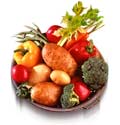
'The Poor Portly Potato '
Ireland, the beautiful 'Emerald Isle 'which, even as I write, is getting ready to celebrate it's very own patron Saint, Patrick.
Lovingly known the world over as St Paddy's Day, this time honored tradition is celebrated with much frivolity, celtic music, and green beer, not only here in North America, but throughout the civilized world where all God fearing Irishmen who can raise a glass to their lips, are gathered. Land of the shamrock, Irish Eyes, pots of gold, Leprechauns, the 'Blarney Stone' Danny Boy, Guinness Stout, and the oh so lowly potato.
Ireland, a land of agriculture, had long depended on this unpretentious tuber as part of it's staple diet, and the failure of the crop in 1845 was disastrous. The crop failed again in 1846, 1847, and 1848. By 1851, the population of Ireland had been reduced by more than two million people due to starvation, and disease. A terrible human tragedy.
So, how do we redeem this most infamous member of every garden lovers 'veggie plot.'
Very easily it would seem, for today, the potato, after rice, has become the most often consumed vegetable in the world. Unfortunately the potato, unlike rice, has the undeserved reputation of also being the most fattening addition to our diets. A pity, because when boiled in a little salty water with a sprig of fresh mint, or baked in it's jacket, sprinkled with garlic salt and a serving almost calorie free salsa, the potato, is a very healthy and nutritious addition to any meal.
One serving-a 5.3 ounce, medium potato-provides:
45 percent of the Daily Value for vitamin C
21 percent of the Daily Value for potassium
Three grams of fiber
and Only 100 calories
Of course, we, the consumer, are not satisfied with the sometimes plain offerings of mother nature. Oh no, we have to gussy it up, add this, that, and the other, until finally we end up with one of the most fattening and probably unhealthy foods on the market today.
The 'french fry ' alone, is eaten in vast and unimaginable tons in every fast food outlet and restaurant in the world, not to mention the amounts eaten at home in our own kitchens. The once lowly 'spud' is now chipped, crisped, crinkled, cut, wedged, shoe stringed, hashed, mashed, smashed, baked, with copious amounts of sour cream and butter, (yum! I did not say that ! )In their jackets, out of there jackets, julienned, duchessed, scalloped, skinned, and of course plain old boiled. Who would ever think of serving them in such an ordinary way any more? Me for one!
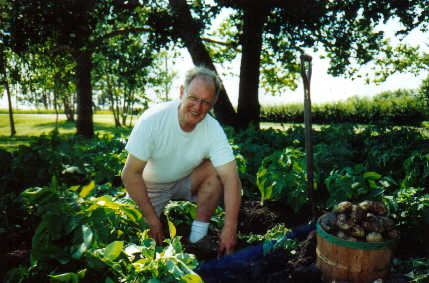
So, our poor portly potato, how low do you go? As low as the depth of a shovel into the ground, or so they say. Once the green leaves start appearing, cover them with soil, 'hilling' them as new growth appears. Once the flowers appear, stop hilling. Potatoes are ready for digging once the foliage dies back. And that's when the fun begins. No matter how much I've managed to malign this incredibly versatile veggie, so called, although it's actually a tuber, I have to admit that I still get a perverse sense of joy when I am able to dig up those first little yukon golds, russets, or tasty reds. Don't you just love them too?
I also have to admit that this is the one thing in my garden that I never seem to grow enough of. I always run out sometime in February, and oh boy, do I ever dislike having to buy them.
It would seem then, that the not "just plain old brown potato anymore then," has come into it's own at last.
Alleluia for that. I love 'em all.
ã Judi Whittaker
2002
Those Nippy Little Nippers
Of course, we weren't the only family who went through these hard times. The world was at war, and food was in short supply. Everyone just did the best they could I guess. I do remember having things like baked beans or scrambled eggs on toast, tomato or vegetable soup, and occasionally canned corned beef mashed into potatoes with 'mushy peas.' For those of you who have never eaten or tried mushy peas your missing out on a tasty treat.
Dried peas, are soaked overnight then cooked in salty water with a tablespoon of sugar and a pinch of baking soda. A tablespoon of malt vinegar added after the peas are cooked enhances the flavor. I loved them then and still do, but they sure can give you gas, and usually send me into total orbit. As you can imagine, I don't have them too often anymore, they're far too dangerous.
Sometimes we had pancakes, not at all like the monster thick pancakes served in North America but little thin things, sprinkled with lemon juice and sugar. More like crepes I suspect. I remember that I didn't liked them very much, and I'm still not a great lover of pancakes even today.
I also remember having some weird things to eat too, like bread and warm milk covered with condensed milk. Brown sugar sandwiches with lard instead of butter. We even ate lard on toast sprinkled with a little salt, and I can clearly remember sitting on the front step of my Aunty Floss's house with my cousin John, both of us tucking into a sandwich of cocoa and sugar, sprinkled on bread, and spread no doubt, with the inevitable lard. Why I should remember this incidence I don't know, as it's of little consequence, but for some reason I do, and I remember John was making me laugh over something. He was a couple of years older than me and I thought he was wonderful. I guess it was just one of those jolly little memories that stay in the mind.
My granddad raised chickens too, so I imagine we were lucky and always had eggs, a luxury during those war time years. Egg and chips was a favorite dinner choice for us all. Sprinkled with salt and pepper, smothered with tomato ketchup, and eaten with slices of bread and butter, it was delicious. Later, when the war was over, baked beans and big fat sausages was added to this dish and it is still a favorite with my family today, and, I still make the chips (french fries) with fresh potatoes. Nowadays of course, we fry them in a light oil, but during the war that was unheard of, and we used slabs of melted lard instead. We don't have this meal too often nowadays, as I imagine it's very fattening, and not an altogether healthy food choice. You should try it though, it sure is good, and a quick, easy, and very tasty meal. By the way, if you decide to give it a try, you must definitely use Heinz baked beans in tomato sauce and of course Heinz tomato ketchup. At one time that was the only choice we had in Britain. Other brands came on the market after the war was over. At least that's how I remember it.
Unfortunately the English are well known for being very poor cooks, serving tasteless unseasoned food and often relying on tomato ketchup or Daddies Sauce spread over the cooked dish to add the needed oomph. We were lucky, as my mom was an excellent cook and always prepared meals which were full of flavor with lots of seasoning in them. There is one dish that my mom would prepare that does stick in my mind, and it's one that still makes my mouth water when I think of it. Creamed potatoes and buttered nips, a combination of swede, parsnips, and turnips, served with either canned corned beef or Spam and covered with what I thought was then, a delicious onion gravy. Made with a powdered gravy mix, very different from what we use today, now I think it's gross, but back then it was a treat. I think my mom added the onions to gussy the flavor up a bit. The corned beef I'm sure was a luxury, but I think we had canned Spam quite often as I remember we had it lots of times.
It was however the buttered nips that I enjoyed so much, although I doubt if there was much butter in them, especially during the war. When I was finally able to have my own veggie garden I couldn't wait to grow some of these wonderful little gems. Not so little though, the ones I grew always turned out quite large.
I planted rutabagas, parsnips, and turnips. Rutabagas are called swedes in England and I think it is this particular vegetable that adds so much flavor to casserole dishes and stews. When they are picked fresh, and not too big, they are quite a treat eaten raw and are great sliced thinly in a salad.
The instructions on the seed package informed me that parsnips are best harvested after a frost, and as we nearly always got frost in September in Alberta I did not have to wait too long. Would you believe that I had to get Terry to give me a hand to dig the bally things out of the ground. I swear they had grown clear down to Australia. They were huge. At first I thought they might be too 'woody' but fortunately I was wrong. They were sooo good, and there was oodles of them. In fact I not only had enough for the whole year, I was able to freeze them too. I just dry froze them, simply peeling, cutting them into cubes, and then putting them into airtight plastic bags. I never grew any last year and still have some in the deep freeze. They've probably lost some of their nutritional value but taste as good as ever.
Well, that's my story for this week, next week I'll write a little piece about.
Click on The Long Distance runner to read More
'The Long Distance Runner'
|
|
|
|
|
|
|
|
|
|
|
|
|
|
|
