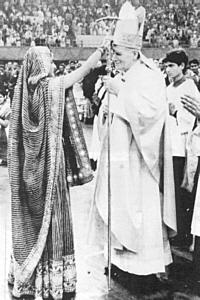
THE VENERABLE UER-DRUUIS GOBANNOGENOS GOES TO INDIA
("World Congress for the Preservation
for Religious Diversity 2002"):

Gobannogenos (Alain Le Goff), the Uer-Druuis (Over-Druid) of the Kredenn Geltiek Hollvedel had the immense honour to represent the druids at the invitation of Sri Swamiji Dayananda Sarasvati for the World Congress for the Preservation of Religious Diversity.
Given that, this was a privileged and historical reunion for both Druids and Brahmans after such a long separation.
The September 11th tragedy was still fresh to remind us all that, even with the great international institutions such as the United Nations and UNESCO, that no one was sheltered from extreme fanatism.
Just to mention the impressive decorum, although threatened by the fundamentalist menace, the Congress went on its course with great determination and good organisation.
So as Uer-Druuis Gobannogenos summed it:
"It was a beautiful sight to see the many delegations in their various traditional attires distinctive of their different statuses and religious denominations.
Especially endearing to me were those of brahmanic affiliations - shaved heads and bare footed, long haired and floating, white tunics and pants… same as ours which curiously reminded me of our own traditional druidic dress; the harmonious and rough sounds of the Sanskrit prayers, the mantras, as well as certain addresses made in that idiom vibrated the hearts of those for the prime attachment of these proud ancestral aryanic sacred speeches.
Summary of the World Congress for the Preservation of Religious Diversity
The World Congress for the Preservation of Religious Diversity, which took place between the 15th and the 17th of November 2001, was the first international event of its kind. The Prime Minister of India Honourable Shri Atal Behari Vajpayee inaugurated World Congress, and stressed the need for such conferences, especially at this crucial time in world history. His Holiness, the Dalai Lama also addressed the Congress, and encouraged all religious leaders of the world to come together and work towards promoting peace and harmony. Sri Swami Dayananda gave the aims and objectives of the Congress in his speech. The main emphasis of the Congress, Swamiji said, is the preservation of religious diversity. Swamiji also pointed out that it was the first time that representatives from all these diverse religious traditions congregated with a commitment for the preservation of diversity.
Indigenous and ethnic groups world-wide represented the Congress very well. Each of the religious leaders from Guatemala, El Salvador, Native Americans and African Americans from the United States, and indigenous communities from Brazil unanimously reiterated the need for preserving their cultures that are on the brink of extinction. Each leader that spoke at the Congress acknowledged the fact that colonialism and increased missionary activity were the primary reasons why their religious and cultural traditions became endangered. The Congress was a dynamic forum for both international as well as Indian religious leaders and scholars. Of the more than 150 delegates from India, leaders of many religious traditions, including Buddhism, Jainism, Zoroastrianism, Tibetan Buddhism, and Hinduism, had an opportunity to share their views with the leaders from the international community as well as with local Indian scholars.
Chief Nana Osei Yiadon from Ghana gave a fiery speech on the proselytisation of Africans by Christian missionaries for a period of 500 years. Chief Nana also spoke on how this process of colonisation had destroyed native cultures, languages and religious traditions in Africa. Kaka Wera Jecupe, an indigenous native from Brazil, spoke on similar lines. Dorothy Randall Gray from the United States talked about the condition of African American populations who had been inducted into slavery and whose culture had been destroyed by missionary activity and colonisation. Lighning Bear, Akatl Ortega, and Alexandro Perez, representing North and South American indigenous traditions, also reiterated the role of missionary activity in the extinction of their respective cultures. Many individuals from India also concurred with this assessment. In this way, there was a unanimous consensus that ethnic religion and cultures are in need of protection for religious diversity to exist in the world.
One of the highlights of the Congress was a grand public meeting and speak-out organised at the Siri Fort auditorium in New Delhi on the 16th of November 2001. Jagadguru Sri Sankaracharya of Kanchi Kamakoti Peetham presided over the function. The Sankaracharya gave an eloquent address about the need for individuals to follow their own dharma, and not come under the pressure of monetary or political inducements to convert to other religions. The Sankaracharya emphasised the need for ancient religions world-wide to be protected, and announced that the Kanchi Peetham would donate a sum of 5 lakhs for this worthy cause.
The Congress recognised that indigenous religious traditions have, historically, been at risk of extinction due to variety of reasons. Recent events, such as the destruction of 2000-year-old Bamiyan Buddha statues in Afghanistan, have demonstrated the vulnerability of non-proselytising religions and cultures. It is therefore, our responsibility to preserve religious and cultural traditions, which have survived despite great odds, so that they can be handed down as a legacy for future generations. The World Congress was convened as an historic opportunity for leaders of indigenous religious and cultural traditions to assemble and share views on preserving the richness of their cultural heritage, and easing conflicts and tensions among various religious groups.
In recent years, there has been a global focus on convening "interfaith dialogues" and "inter-religious summits." The World Congress will serve as an important precursor to such meetings by providing a safe space for indigenous religious leaders to express their views on preservation of diversity and cultivation of harmony among all religions. The aim of this conference is to create an international body that will work for dialogue and mutual respect and harmony among all religions. This body will be called the "Global Commission for the Protection of Religious Diversity," and will work constructively with many religious groups to promote harmony and protect religious diversity in the world.
|