Tim Allison: A Virtual Portfolio
Science and Tech Design

Tech design is a concept which changes frequently and unpredictably. Like science, it relies to a great extent on the social and cultural context in which it is conceived (as discussed by Hodson). Group and individual experiences with the chemical car activity illustrate these notions, and also demonstrate the role of collaboration (promoted by Roth), imagination, and experimentation (encouraged by Gallas) in science and in tech design. As discussed in the class with Larry Bencze, these are important parts of the nature of science. Science is, in turn, an important part of technological design, which then contributes to progress in science.
At the beginning of the activity, many groups started by following the instructions, and quickly discovered the unpredictable nature of the problem...although some of us expected that the cars wouldn't work. All groups likely had members who disagreed with one another's views on how best to approach the activity. This demonstrated the idiosyncrasies of technological design -- that different people will approach a given problem from different angles, because people -- even science-oriented people -- are all different. Roth puts an emphasis on the collaborative nature of science and technological design, particularly in the context of 'horizontal interactions' -- the interactions which occur between peers. Those teams that did get our cars to work had to deal with friction, explosions, spin-outs, etc. While we might have been able to predict that such variables would affect the functioning of our cars, the extent to which this occurred was somewhat surprising. Friction (both inside the vehicle and against the ground) played an enormous role in the design processes of both teams – at times it seemed as though no amount of WD-40 would get the car working…and in the end, it turned out that WD-40 was not actually required (although it may have helped).
Roth claims that there is a strong relationship between science and technology; I feel, in general, that that reality supports that idea. Scientific principles are necessary for technological advancement; and technological advancements, in turn, assist the progress of science. The two are therefore intertwined in such a way that they may, in many cases, be indistinguishable. During class activities, we have often used one of these factors to assist in another. Take the chemical car activity, for instance. In order to get the car running (a technological advancement), we needed to use our scientific knowledge. Without a knowledge of the processes behind the activity, the activity would simply have been hit-and-miss. School science classes should incorporate both science and technological design, as in the chemical car activity, so that students can see how these two fields work together in the real world to generate productivity.
In order to solve the problem of the chemical car activity, groups used their knowledge of science and of the nature of science to solve the problem of the chemical car. Many of us faced difficulties which we had not anticipated, in order to get the cars working; and those who effectively combined these skills, as individuals and as teams, got our cars to move, and were left to determine what was the most efficient mixture to run the cars. Unfortunately, however, the time available for this task was not unlimited and so this final goal was not achieved.
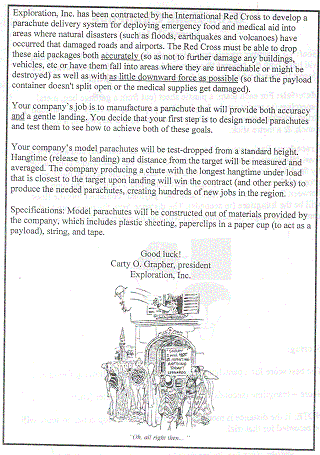
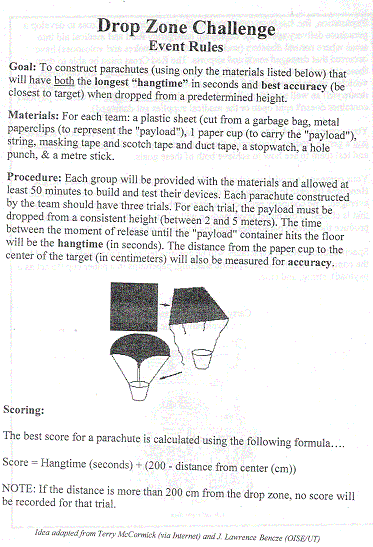
The parachute activity was similar in many respects to the chemical car activity. There was an important factor which was different, though. Whereas in the chemical car activity, parameters were given (we were required to use 5% acetic acid and Sodium Bicarbonate; the cars were given as they were); in the parachute activity, it was necessary to design a parachute from scratch. The main problem was in trying to break out of the traditional image that we held of what a parachute looks like.
Roth discusses this determinism at length -- that traditional design of an item makes it difficult to conceive a way in which it could be different. By allowing our students to use their imaginations, as Gallas suggests (among others), and by promoting collaboration as a part of the nature of science (as proposed by Khishfe, as well as by Roth), our students may be able to break out of these boxes of determinism, and to see things as they have not previously considered.
By promoting the true nature of science and of technological design in our classrooms, our students may be able to understand how these phenomena feed into one another, and how they can use both in their lives as scientists, whether in the lab, in public, or at home.