Tim Allison: A Virtual Portfolio
The Arts in Science
For students whose main interests lie outside of science, science can prove to be an incredibly challenging experience. Putting scientific terms or concepts to music, or poetry, gives arts students a form with which they are familiar, and makes science more accessible for all students.
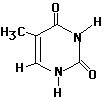
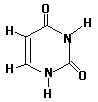
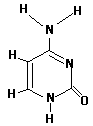
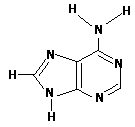
The poem below is one which I wrote several years ago, when I had to learn the structures of the nucleic acids. By the time I was done writing it, I had memorized the structures, but for many students, learning the words down the centre of the page and relating those to a structure would be far easier than rote memorization of the structure itself. Hodson makes a strong argument for the culturally specific nature of science. What might be even more important is that science is something of a culture in and of itself: it has its own language; its own measurements; and its own practices. This culture is frightening to the 'foreigners' -- those from the culture of the arts -- and adapting science to their needs presents unique challenges. Poetry and/or music might be an effective way of doing this.
Another suitable alternative might be the sort of activity which Juan, the new teacher in Volkmann's article, used. Students discussed not only the scientific implications, but the social implications of problems, as well. Arts students might be more comfortable debating points from a sociological perspective; and by allowing students to make arguments from a social perspective, we may be able to make non-science students more comfortable and thus better able to learn in our science classrooms.
Linking science with activities that are traditionally not associated with the study of science has potential to assist the learning of many students; and is something that I will try, as a science teacher, so that all students have opportunities to learn the material and to become interested in science.
The Nucleic Acids Poem
|
|
there’s T and U and cytosine. They each have 6-membered rings, which are attached to different things. At position number two, there’s oxygen on C, T, U. At position number four, T and U have one ‘O’ more. On that carbon, cytosine replaced his ‘O’ with an amine. The difference between U and T on carbon five is plain to see: while thymine has a methyl group, there’s just a lonely ‘H’ on U.
Now, purines are a little tough – for them, one ring ain’t quite enough. They number one ring 1 through 6, and then to play a nasty trick, they make the other blow your mind, ‘cause it goes 4-5-7-8-9! The difference between A and G can be a little hard to see, but it will quite plain if you just look at carbons six and two. You’ll find they both have NH2s; on guanine it’s on carbon two; whereas, on adenine it sticks Straight out from carbon number six. At that position, G alone will have a double-bonded ‘O’.
These bases form the basis of the DNA in you; and I guess you’d better face this: they make up RNA, too.
Tim Allison, 1999. |
|