Tim Allison: A Virtual Portfolio
Applications of Hay Infusions to the Ontario Curriculum
Millar and Driver (p. 58) suggest that "Science in schools has an enabling rather than an alienating function and has a critical role to play in a liberal education." This is the goal towards which we all must strive, as science teachers: to make school science an enabling subject, and to give it a critical role in our schools. Hay infusions, such as the one used for this assignment, are an activity which enables students to further understand scientific concepts and the relation of these concepts to the world around them. A hay infusion provides students with exciting opportunities to view life of which they had never previously thought. It allows them to engage in "such activities as observing…classifying, hypothesizing…inferring, experimenting, problem-solving…[and] modeling" (Millar and Driver, p. 56). Through the experiences which they have in their execution of the rotting grass lab, students will be able to make further inferences to aspects of science that they had previously not considered. Gilbert, Osborne, and Fensham suggest that this kind of development "will only occur in a genuine and nonsuperficial way if the scientific perspective appears to be at least as logical, coherent, useful, and versatile a way of viewing the world as their present viewpoint." (p. 631) The rotting grass lab activity provides students with this sort of activity; as it is a genuine activity in which they can become deeply involved. If they manipulate variables in a logical way, to relate it to the class material, the results which they achieve will be coherent and useful to their understanding of interactions which occur in the world around them. This will occur best if students "test their own ideas…[and to perform] self-analysis, collection of real evidence to support ideas, and reformation of ideas in light of new experiences and evidence," as Yager (p. 3) suggests. These are activities which students will easily be able to perform, because of the student-directed nature of the rotting grass lab. This sort of self-evaluation, as Black and Harrison suggest, leads to changes in the roles of learners and teachers, and to improved relationships between these parties.
Teachers, for their part, should be functioning, not as conductors, but as facilitators, guiding their students through the learning process. That being said, it is their responsibility to find defensible activities for students to pursue. Relating the 'rotting grass lab' to the Ontario Curriculum forces us to defend its use in the classroom, as a learning activity. It was also useful for seeing how it might apply. I do not believe, however, that it would be a wise activity to use for every class. Some students (like some of my colleagues) would quickly get bored with the activity, and would be struggling to invent data for submission at the last minute. This obviously negates the purpose of the experiment, and would not be helpful to the students, even if they met the expectations.
Teachers conducting this activity in their classrooms need to be sensitive to the learning needs of their students, and, as Gilbert, Osborne, and Fensham (p. 631) suggest, they "need to be aware of children’s science and to encourage students to express their own views. We all need…to listen to, be interested in, understand, and value the views that children bring with them into science lessons. It is only against that background of sensitivity and perception that we can decide what to do, and how to do it." This is also the sort of activity in which it will be relatively easy for the teacher to do this. By encouraging students to pursue their own interests; by paying attention to and valuing the theories which they develop about their systems and the various biotic and abiotic components thereof; teachers will come to an understanding of how the students think, and of the validity of their ideas. This will allow teachers to, as Yager (p. 3) suggests, have careers abounding in "inthusiasm [sic], promise, and excitement."
Students will gain a knowledge of scientific processes and of the nature of scientific inquiry that a typical, behaviourist-modeled science classroom could never provide; and they will do so, for the most part, by pursuing their own interests in relation to the class material. Through this process, "the very private musing of a child…may eventually be transformed through reflection, dialogue, and finally collaboration into a question, and, ultimately, a theory about the world." (Galls, p. 16) Students’ imaginations will undoubtedly develop ideas for investigations which the teacher had never considered. As the teacher begins "seeking out and using student questions and ideas to guide lessons and whole instructional units…[and] using student thinking, experiences, and interests to drive lessons" (Yager, p. 3), it will become evident that "the process of scientific discovery is firmly rooted in intuition and imagination" (Gallas p. 14); and, as Gilbert, Osborne, and Fensham suggest, the students’ science can be developed into a "coherent scientific perspective" (p. 630), and that they will be more able to "comprehend the problem and each of the alternatives from a scientific and social perspective" (Volkmann p. 105). Ultimately, students will learn science, and will enjoy the process of learning it; and that result will benefit the teacher, the class as a whole, the individual students, and the process of science education.
The Rotting Grass Lab:
Applications for the Ontario High School Science Curriculum.
The study of ecosystems is perhaps the most blatantly obvious application of the hay infusion in the grade ten curriculum. The curriculum document lists the following expectations for the strand: "demonstrate an understanding of the dynamic nature of ecosystems, including the relationship between ecological balance and the sustainability of life;" "investigate factors that affect ecological systems and the consequences of changes in these factors;" and analyse issues related to environmental sustainability and the impact of technology on ecosystems." In order to meet these expectations, students could be asked to study the changes in populations over the course of a unit, or even of the year, and to develop ideas about what caused the changes in population sizes which were observed. In doing so, they could clearly demonstrate an understanding of the dynamic nature of ecosystems, while investigating influences on ecosystems, and the effects of these influences. In our system, for instance, there were dramatic changes in the populations of two genera in particular: Paramecium and Rotifer. Attempting to determine what caused the changes in these populations became a considerable challenge; as there were at least three distinctly different possibilities for the cause of the changes. Encouraging students to come up with various possibilities would promote thought and discussion in the classroom; and learning would result from this. The changes in these populations in our system are detailed in figure 1, below.
|
|
| Fig. 1: Comparison of the populations of Rotifer and Paramecium over time. Note that Rotifer populations have been multiplied by a factor of 10, as their population was at all times much lower than that of Paramecium. |
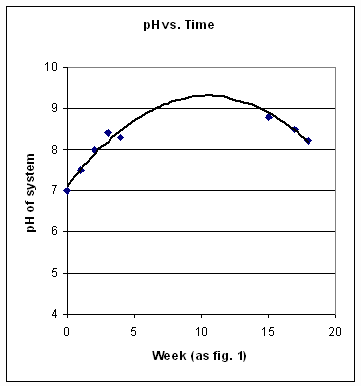
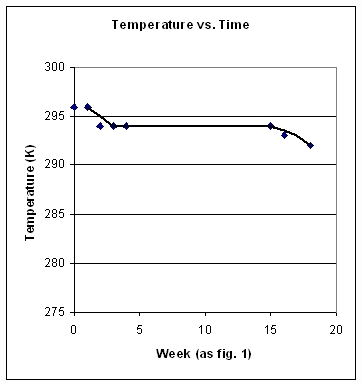
Graphs like these could be easily made by students in a grade ten class. Most of them should be familiar with Excel; and those who weren’t could be given a brief tutorial, or perhaps they could be assisted by group members familiar with the software. In any event, they could be asked to develop hypotheses based on their research. Questions which we considered included: Did competition for some unseen food source play a role? Perhaps there is a predator-prey cycle between these two organisms? Did environmental factors, such as temperature, light transmission, and/or pH play a role? (For instance, we eliminated light transmission and temperature as factors, but pH may have been a factor). Figures 2 and 3 illustrate the sort of plotting that students could do to determine what, if any, relationship there might be between environmental factors and population changes. With further experimentation, they could test their hypotheses.
|
|
|
| Fig. 2: pH vs. time: this graph indicates a possible link between pH and the population sizes of Paramecium and Rotifer. | Fig. 3: Temperature vs. time: show little, if any correlation to the changes in the populations in question. |
To students who have been studying factors affecting the growth of populations, this provides a real-world scenario for them to look at. Finally, by the manipulation of variables, students could investigate issues related to the sustainability of ecosystems; and the relationships of ecosystem sustainability to modern technology. Disturbing the ecosystem, by adding material, for example, could allow them to analyse the effects of various products of technology on aquatic ecosystems, as in the following examples: acid rain events could be simulated; the concentrations of various ions (nitrates and nitrites, for example) could be increased; heat pollution could be studied; students could likely come up with further suggestions of their own – an extensive list of topics could be developed by the students.
The chemical processes strand of grade X science expects that, among other things, students will "determine why knowledge of chemical reactions is important in developing consumer products and industrial processes and in addressing environmental concerns;" "describe how the pH scale is used to identify the acidity of solutions;" and "select and use appropriate vocabulary, SI units, and numeric, symbolic, graphic, and linguistic modes of representation to communicate scientific ideas, plans, results, and conclusions" (The Ontario Curriculum, Grades 9 and 10). Students could test water purification products, using water from their systems, to grow in their understanding of how chemical reactions affect the development of consumer products (most water filters function on the basis of chemical reactions and filters, of which students should also have an understanding). Environmental concerns could be addressed by adding human products to the ecosystems – whether industrial, agricultural, or other products. Weekly measurements of the pH of their systems may give students a better understanding of the uses of the pH scale; other physical measurements could give students a stronger knowledge of the vocabulary; and of the various modes of representation discussed in the curriculum, and listed above. From the data which they generated, they could formulate ideas about what was occurring in their respective systems, and relate this to the Biology strand (essentially, forming conclusions). The added benefit, of course, is that students are acquiring valuable skills by working with this data; graphing it; examining it to attempt to find patterns; and using it to develop theories.
Manipulation of variables could be used to study the effects of weather on pond life, in the same way as in the other strands. Refrigeration of their micro-ecosystem would allow them to discuss the effects of cool weather on the organisms in question; incubating the solution could allow a study of the effects of a heat wave (possibly including evaporation of a large portion of the pond); changing the air pressure over the surface of the water might have an effect on these organisms; and various other simulated situations could assist their understanding of the weather’s effects on other (i.e. non-human) populations. There are undoubtedly several other factors that could be examined from this perspective. By relating their weather unit to their system, relevance will be given to material which might otherwise seem unimportant; and students will learn more, as a result of actually being able to observe the effects of the weather on the organisms in their beakers.
Finally, the broadest expectation of the Ontario Curriculum for grade ten science is that "students will conduct investigations and understand scientific theories related to: ecology and the maintenance of ecosystems; chemical reactions, with particular attention to acid-base reactions; [and] factors that influence weather systems." Through the observations they make; the data they record; and the hypotheses and conclusions they form, students conduct a year-long investigation which gives them thorough insights into the concepts and theories involved in their class work.
Students will gain a knowledge of scientific processes and of the nature of scientific inquiry that a typical, behaviourist-modeled science classroom could never provide; and they will do so, for the most part, by pursuing their own interests in relation to the class material. Through this process, "the very private musing of a child…may eventually be transformed through reflection, dialogue, and finally collaboration into a question, and, ultimately, a theory about the world." (Galls, p. 16) Students’ imaginations will undoubtedly develop ideas for investigations which the teacher had never considered. As the teacher begins "seeking out and using student questions and ideas to guide lessons and whole instructional units…[and] using student thinking, experiences, and interests to drive lessons" (Yager, p. 3), it will become evident that "the process of scientific discovery is firmly rooted in intuition and imagination" (Gallas p. 14); and, as Gilbert, Osborne, and Fensham suggest, the students’ science can be developed into a "coherent scientific perspective" (p. 630), and that they will be more able to "comprehend the problem and each of the alternatives from a scientific and social perspective" (Volkmann p. 105). Ultimately, students will learn science, and will enjoy the process of learning it; and that result will benefit the teacher, the class as a whole, the individual students, and the process of science education.