
Tim Allison: A Virtual Portfolio
Teaching ESL in Korea:
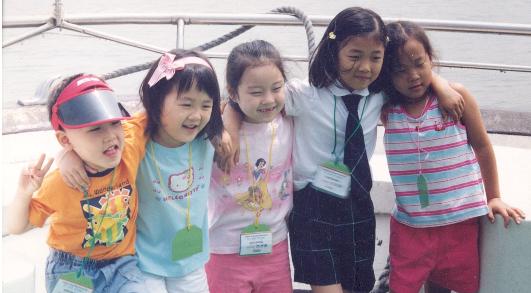
One of the most rewarding experiences of my life was my experience, recently, of teaching English as a second language in Seoul, Korea. My students ranged in age from 4-14 years (the images on this page are from a field trip on the Han River with my class of 6-year-olds). This experience assisted my development as a teacher in several ways: it taught me a great deal about the nature of teaching; it gave me experience working with students and relating with them and with their parents; and it taught me to communicate with those who don't understand the languages that I speak.
I had volunteered in a children's program for several years (one evening every week from September through April), and had enjoyed it thoroughly. It hadn't involved a great deal of work, and it had taught me that working with young people was something that I enjoyed. I quickly came to realize, as I started teaching three days after my arrival in Seoul, that teaching was going to involve significantly more work than what I had observed as a student. However, I managed to adjust quickly and smoothly to the demands of my job as an English teacher. Many evenings were spent working late, preparing lessons, battling with the photocopier, and trying to develop activities for kindergarten students who had never learned a word of English. I quickly learned that sharing ideas with colleagues was an efficient way to coordinate my classes. The 'you-scratch-my-back-I'll-scratch-yours' system which developed in the staffroom meant that ideas were shared among teachers, so that activities that worked well in one class could be recycled in other classes. Relationships between teachers, and between the teachers and the administration, were generally very good, as a result of these positive interactions between all of the staff members.
The development of my interpersonal skills was also an important result of my experiences in Seoul. While my experiences working in retail in North America had developed these skills to a great extent already, some adjustments had to be made, as those with whom I interacted frequently had limited English abilities. Certain aspects of Korean culture also called for slight modifications to the way that I interacted with my students and with their parents. Developing effective class management strategies was perhaps the greatest challenge, particularly with some of the younger children; and, while most of the parents were friendly and supportive, there were instances in which it was necessary to deal with difficult parents. This process often took place through the staff supervisor, a Korean, whose help in such matters was always appreciated, although it often made matters more complicated than might otherwise have been necessary.
Learning to communicate with those whose English language skills were limited was another challenge. It was an extremely valuable experience, however. As Bakhtin (p. 293-294) pointed out, "not all words for just anyone submit equally to...appropriation, to this seizure and transformation into private property: many words stubbornly resist, others remain alien, sound foreign in the mouth of the one who appropriated them and who now speaks them." Science is a subject which involves a lot of new vocabulary. Many of the words are completely unfamiliar to students; and to some of them it might as well be another language, as English was to my Korean students. Communicating with students who do not understand the language of science will be necessary, particularly in lower-level science classes, and this can be a difficult process when students do not understand many of the words that are being used in class. Helping them to understand this new 'language' is an important step in creating a more "coherent scientific perspective" (Gilbert, Osborne, and Fensham p. 630), just as teaching students a new language must be done through giving them a coherent understanding of that language. As Volkmann suggests (p. 105), this is best done by giving the students an experience of the material; by making it relevant to the students' experience. My students in Seoul needed to use English to communicate with me. They experienced it by using it; by experiencing western cultural activities in the classroom (cultural understanding is important to the understanding of a language); and through art and science activities in the classroom. There is no reason for a science classroom to be any different. Students can learn through using the language of science and through scientific cultural experiences (also known as experiments). By using design-and-perform labs (like those promoted by the authors of so many of our articles), in particular, students can coe to learn not only the language, but the nature of science.

In addition to the factors above, in many parts of Canada, the proportion of students whose first language is other than English is increasing. Communicating with these students can be difficult for the inexperienced; as I found at the beginning of my experience. With my experience teaching students whose first language is not English, I feel well-prepared for working with such students in the future.
My experience in Korea was excellent, and gave an incredible boost to my development both as an individual and as a teacher. Since returning to Canada, I have found that many of the skills which I learned and applied there are equally as useful here, in terms of interpersonal skills, of classroom management tools, and, of course, of teaching skills. It has taught me that it is important to be willing to take reasonable risks; it has given me invaluable cultural experience; and it has reinforced my desire to pursue a career in teaching.
