
Tim Allison: A Virtual Portfolio
Practicum Experience I
My placement at Sir Winston Churchill Collegiate and Vocational Institute in Thunder Bay was a wonderful and unique experience. Teaching grade twelve biology (see evaluation), as well as 11U Chemistry and 9 applied Science, the atmosphere in the science department was extremely encouraging to the student teachers. Much had been said at the faculty about the benefits of constructivism, and its benefits for students' learning. It had sounded nice, but I had had a really hard time seeing how it could be done in the classroom. Having the opportunity to observe it first hand, and then to try it on my own, was a fantastic experience, and made me realize that (i) it was possible, and (ii) it really did benefit the students. Seeing students extrapolating the lab work that they were doing, to beyond the material we had covered in class, was just great. Each class provided a unique challenge and a unique learning experience. In the same way, each one was rewarding in its own way; even if this reward was mainly in the experience which it provided.
The first class of each day was a grade 12U biology class, which went fairly well in general. This may have been due mainly to the fact that the students were mostly interested in the material to begin with. I did, however, use a pseudo-design-and-perform lab in which students studied factors affecting the growth of a population of yeast -- as Millar and Driver (p. 56) suggest, though, "effective science teachers...promote active learning," therefore this activity may have been part of an effective strategy for teaching in the science classroom. Allowing students to investigate a variable of their choosing; and trying to infer its applications to industry and to the class material (population dynamics) gave them an opportunity to learn from their lab work. This gave them the opportunity to "comprehend the problem...from a scientific and social perspective," (Volkmann, p. 105) as they considered the important societal uses of yeast and how the factors they controlled were important to the function of these organisms. Students also chose their own topic for a brief oral presentation in which they discussed a factor which had affected the human population (either positively or negatively). This seemed to work quite well, allowing them to investigate an issue of interest to them; and gave my aching feet a short rest. This activity was important in teaching the class about the "culturally specific nature of scientific and technological practice" (Hodson. p. 699), as they considered some of the reasons for issues of a medical nature in the third world, many of which no longer play a major role in North American and western European societies; while investigating an issue that was of interest or of importance to them, an element which was important to most of the authors whose work we read this term. I also learned from this class that sarcasm wouldn’t get me anywhere. I’m naturally a fairly sarcastic person, and an innocent and inoffensive sarcastic remark (something to the effect of “It’s really impressive that everyone’s talking about biology.”) was met with hostility from a number of the students.
After lunch, I had a class with a group that I expected to be one of my most difficult (especially as I was teaching them reproductive biology): grade nine applied science. As it happened, this was the class with which I developed the best relationship. Ten of the students were identified with learning difficulties, five were actually in grade XI, and several were not particularly interested in school to any real extent. While this class was certainly not trouble-free (there were behavioural issues with several students, and this was the only one of my classes in which a student told me to “f*** off”), it was an exciting class to teach, and interesting to me, because, as a high school student, I had never taken a general-level class. The major task for this class was to use information which they had acquired both in class and on the internet, to write a letter to an imaginary pregnant woman. This involved the students sharing their information and ideas, a practice encouraged by Yager (p. 2); as well as giving them a real-world context in which to use their scientific knowledge, which helps students move towards the 'unified scientific perspective' discussed by Gilbert, Osborne, and Fensham (p. 631). These strategies appeared to work. One of the most rewarding moments of my practicum experience occurred in this class, when one of the boys asked me as walked by him: “Mr. Allison, can we take science in Grade X? Science is really fun!” This class, and the next one, taught me that it is important to learn, as quickly as possible, how short is the attention span of the average student in the class. For these two classes, it was generally 10-15 minutes, on a good day. This time frame dictated the amount of time we could spend on any one activity. While some activities (such as lab work) can keep students interested for longer periods of time, it is usually important to switch modes frequently when the class has a short attention span; or perhaps even if they don’t.
My final class each day was the most challenging. It was an 11U Chemistry class in which the majority of the students were members of at least one of the school’s sports teams. This meant that a considerable investment of time and energy was required to get them on task; and even more was required to keep them on task. Partly as a result of the way they had been taught before my arrival in the classroom, they were not concerned with due dates, and it was not unusual for only six or eight students (out of 33) to submit their work on the recommended date; nor was it extraordinary for a student to try to submit an assignment long after the assignment had been graded and returned to the majority of his (or her) classmates. This class did, however, teach me a great deal about classroom management; about dealing with unexpected problems as they arise in the class; and about the little frustrations that are bound to crop up in the classroom. There was very little (short of fiery explosions, which they did enjoy) that could interest the 20 students who were there for the social aspects rather than for the Chemistry.
Overall, the practicum experience was extremely beneficial. Classes went fairly smoothly (with a few exceptions); and by the fourth and fifth weeks, I was feeling mildly confident as I walked into my classes. I learned quickly that it was important not to become overconfident, however – problems seem to arise most when they are least expected! I feel that the experience has taught me a great deal, through interactions with school staff and with other student teachers, and, especially, through the classroom teaching experience, that will be useful to me in my future experience as a teacher of science. The comments made on my evaluation form, below, indicate progress in my development as a teacher of science, and I was particularly happy with the comments relating to my use of the constructivist techniques, which were so strongly promoted in class, as well as by Gallas, Yager, and Volkmann, among others. My practicum experience also made me aware (at times, painfully so) of areas in which I still need to invest some effort. Time management in the classroom is probably the thing I’m having the most trouble with: while I’m beginning to get better at knowing how much material will fill a class period, I found myself several times either short or long by up to about 50%. I look forward, now, to the opportunity to refine my teaching skills in the spring placement, and to benefit further from the classes I’ll teach then.
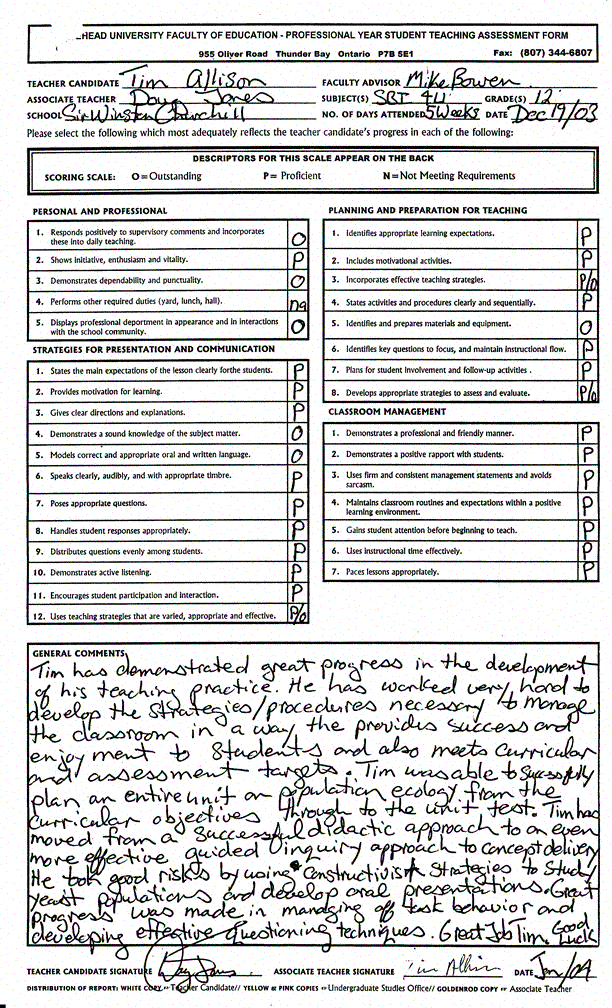
My practicum evaluation is below, along with a typed transliteration of my associate's comments, in case they are difficult to read on this scanned copy.
Associate's comments (as above, typed):
"Tim has demonstrated great progress in the development of his teaching practice. He has worked very hard to develop the strategies/procedures necessary to manage the classroom in a way the [sic] provides success and enjoyment to students and also meets curricular and assessment targets. Tim was able to successfully plan an entire unit on population ecology from the curricular objectives through to the unit test. Tim has moved from a successful didactic approach to an even more effective guided inquiry approach to concept delivery. He took risks by using constructivist strategies to study yeast populations and develop oral presentations. Great progress was made in managing off-task behavior [sic] and developing effective questioning techniques. Great job Tim. Good luck."
