
|
This section of my site is to those who need help with basic electronics. Lots of information can be found on this page covering almost all the basics of electronics. First off we will start with Capacitive Reactance. Capacitive Reactance is represented by Xc and is measured in ohms. In a Capacitive AC circuit, the applied voltage is constantly changing, thus causing the capacitor to charge and discharge. After the capacitor is intially charged, the voltage stored on its plates opposes any change in the applied voltage. This is the opposition that the capacitor offers to the applied AC voltage and is called Capacitive Reactance (Xc). Heres an example of Xc: What is the capacitive reactance of a 1-microfarad capacitor at 60 hertz? Given: Xc= ? Pi= 3.14 f= 60Hz C= 1-microfarad = .000001 F. The formula for this is Xc = 1 divided by 2PifC. Pi = 3.14, f = Frequency in hertz, C = capacitance in farads. Capacitive Reactance is a function of the frequency of the applied AC voltage and the capacitance. This is just the basics of Capacitive Reactance. Inductive Reactance is the opposition offered to current flow by an inductor in an AC circuit. Inductive Reactance is messured in ohms also and is abbreviated XL. The amount of inductive reactance offered by an inductor depends on its inductance and the frequency of the applied voltage. The larger the inductance, the lager the magnetic field generated and the greater opposition to current flow. Also the higher the frequency the greater the opposition to current flow. Here is the formula for inductive reactance: XL = 2piFL. Pi = 3.14, F = frequency in hertz, L = inductance in henries.
|

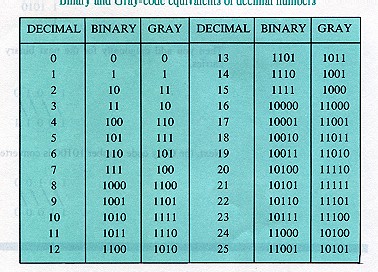 This table shows 1 - 25 in Binary and in Gray Code. For those of who want to learn either Gray or Binary Code this is the easiest way. Learning Binary first makes learning Gray Code easier. Hope this helps some for those who want to learn.
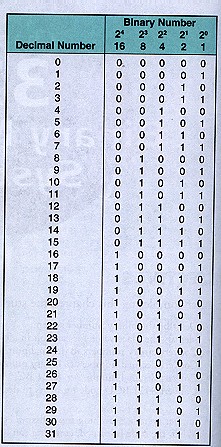 This is the Binary Code from 0 - 31 shown in decimal form and in binary form.
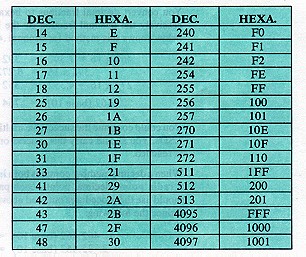 This is part of the Hexadecimal notation for selected decimal numbers. In hex numbers 0 - 9 are the same as in binary. But when you get to 10 you start with A. So hex is 0 - 9 and A - F. This table shows a bit more of hex starting with the #14. Hope this helps those of you who don't know alot bout hexadecimal to understand it a bit more.