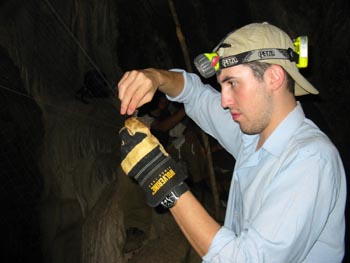
Dunc shows the concentration required to remove the bats from the mist net, this is where "Kretting Daeng" (red bull) helps |
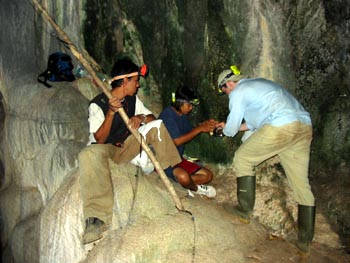
Once the bat has been removed from the net it has its head, face, and chest attacked with sellotape to remove any pollen, before being put into a bag for processing |
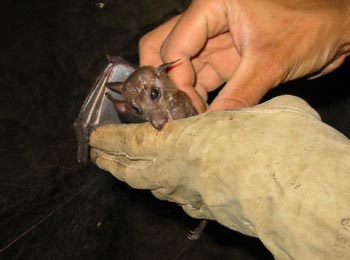
As you can see the bats don't really appreciate being handled very much, hence the glove! |
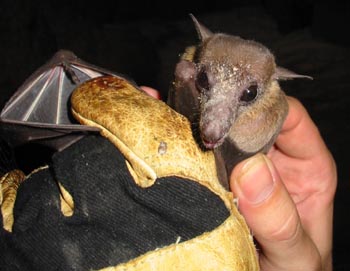
This photo clearly shows the pollen which is covering the face and head of the bat, this is one of the things we were interested in for our research (we looked at quite a few slides of pollen on sellotape!) |
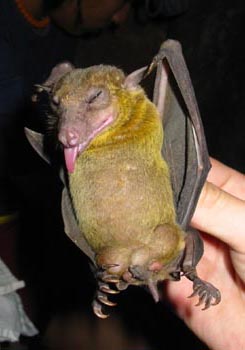
A male Cave Dwelling nectarivorous bat (Eonycteris spelaea which was the bat our research was focued on. The males of the species have remarkable large testis, as you can see from the photograph |
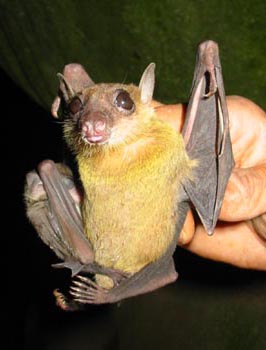
This is a female of our species, with her young. The female carries the young around with her when she goes out feeding |
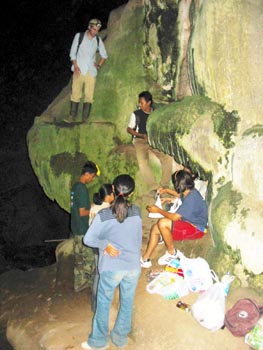
Here is the gang at the lower part of our main cave. This is the area where the bats were brought when captured to be processed. The area where we catch the bats is further up, the path up to it, starts at the ledge Dunc is standing on (not for the faint hearted, as it is a long drop) |
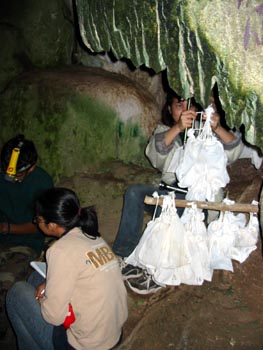
This shows the bats in the bags, where they are stored until ready to be processed (aged, sexed and faeces collected) |
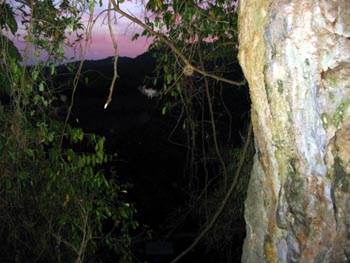
The photograph shows the view from the top entrance at night (this is the entrance the we catch the bats at) |
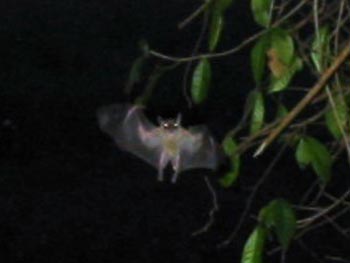
Don't know if you spotted it in the previous photograph, but there is actually a bat caught in mid flight. This is a zoomed in view of the previous photograph |
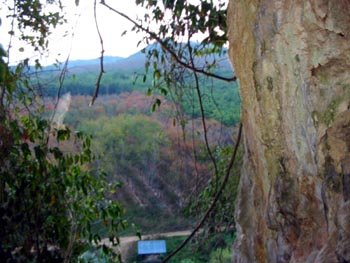
This is the view from the higher entrance in the morning, notice the trees turing red (the rubber trees turn red in spring/summer!) |
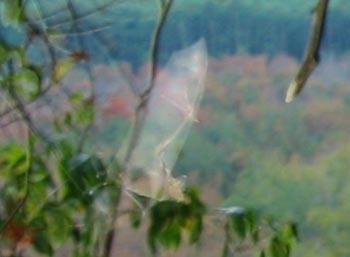
Here is another one you might have missed. In the previous picture there is a bat flying after an insect, which was captured in the photograph by the flash, and appears as a ghostly image. This photo is a zoom in on the bat from the previous photo |