
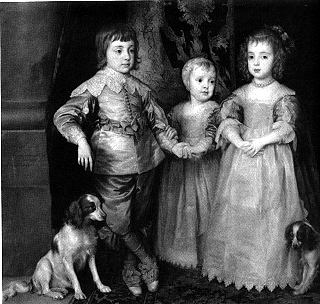
Here, for example, is a painting by Van Dyke of the three eldest children of Charles I, thought to have been painted about 1630. Shown here are the daughter, Mary, the future King Charles II (the oldest of the two boys), and the future James II. Both of the spaniels shown here are thought to be of the breed that later became known as the King Charles Spaniel. If you want to see a color version of this painting, click on the link near the bottom of the page that will take you to "Doggie Links." Then, click on the link that will take you to a site devoted to Cavalier King Charles Spaniel stamps.
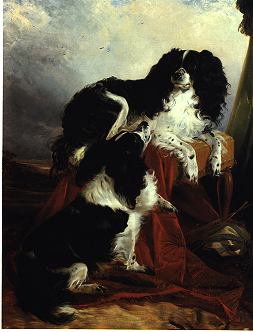
This painting, attributed to
Richard Ansdell, shows how the breed was developed.
Here are two King Charles Spaniels
set against a landscape.
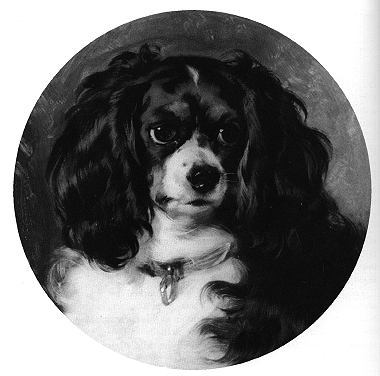
The famous Dash, in perhaps
the most widely copied portrait of dog painting, was
the favorite of Queen Victoria,
who commissioned Sir Edwin Landseer
to paint him.
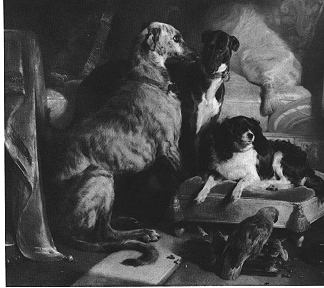
Another painting of Dash, again
by Sir Edwin Landseer, shows Dash in
the very lap of luxury accompanied
by other of Queen Victoria's pets.
The pictures above, then, show
what Roswell Eldridge expected to find when
he arrived in England.
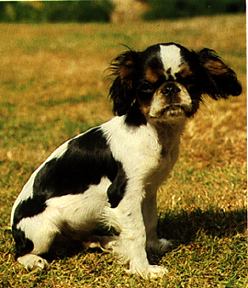
Instead, he found something like
this. The King Charles Spaniel had been
altered to have a pug faced appearance.
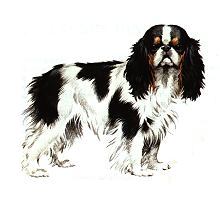
Here's another of the pug faced
dogs that Mr. Eldridge found when he got to England.
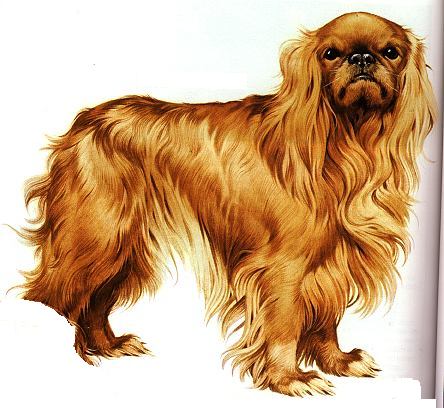
Here's a Ruby Version of the
King Charles Spaniel, again with a pug face.
Preferring the appearance he
had seen in the paintings, Mr. Eldridge offered
the prize at Crufts.
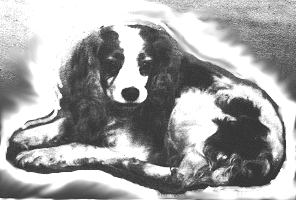
In 1928, the dog named Ann's
Son, owned by Mrs. Amice Pitt became the
standard for the breed. He was
never beaten in his show career. He contributed
greatly to the development of
the "Resurrected" Cavalier King Charles Spaniel.
Ann's Son almost missed this,
for in his younger days he was sold to an actress. She found him so destructive,
however, that she returned him and exchanged him for a Pomeranian. And
so, Ann's Son became the foundation stone upon which the new breed was
built. From him, came Champion Daywell Roger, the first champion in the
breed and the sire of eleven champions. Most Cavaliers go back to this
line.

Here is Champion Daywell Roger.
But how did Ann's Son come to
be? King Charles Spaniel breeders would not
readily help, considering the
Cavalier type as a retrograde step. To some extent,
long nosed rejects from the
King Charles breeders were used.
Breeders trying to resurrect the Cavalier type appear to have used other breeds of dog as well. The breeds mentioned include Welsh Springers, Cocker Spaniels, Papillons, and Dachshunds.
Of Ann's Son it has been said that his sire was not a King Charles Spaniel, but a Papillon.
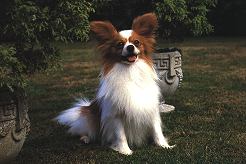
If one examines the picture of Ann's Son and then of this Papillon, one is likely to see a resemblance. The Blenheim coloring, the feathering, and the facial features are all very much like today's Cavalier.
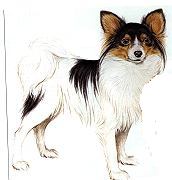
Again, one can see resemblances between the Papillon and the Cavalier. It might bother one, however, that the ears tend to stick upright on the Papillon.
There is, however, a sub breed of Papillon that the Americans tend to lump together with the other Papillons. The term Papillon means "butterfly." This sub breed, which the French distinguish with the term Phalene, meaning "moth," has ears which droop downward.
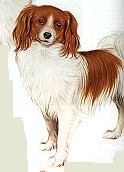
Here is the Phalene or "moth" variation of the "Papillon" or "butterfly." If one regards this picture and the picture of Ann's Son, a strong similarity may be seen. It is my opinion that Ann's Son may have had a Phalene rather than a Papillon as his sire, if one cares to make that fine a distinction.
Through a process of trial and
error breeding, then, the appearance of the King Charles Spaniel as it
was in the days of King Charles II, was resurrected in today's Cavalier
King Charles Spaniel.
THE LINKS BELOW ARE TO MY OWN SITE. FROM ANY LOCATION ON MY SITE, YOU MAY
NAVIGATE TO ANY OTHER LOCATION:
CLICK HERE TO GO TO THE MISS EMMA WEB PAGE
CLICK HERE TO READ A SHORT HISTORY
OF THE CAVALIER KING CHARLES SPANIEL.
CLICK HERE TO RETURN TO THE
HOME PAGE OF THIS SITE.
CLICK HERE TO LEARN OF SITES THAT
TEACHERS MAY FIND USEFUL.
CLICK HERE TO VIEW
MISS EMMA'S GENEALOGY.
CLICK HERE TO SEE MORE
OF MISS EMMA IN PICTURES.
CLICK HERE TO SEE
"ARNIE," EMMA'S DAD (ANIMATED).
CLICK HERE TO SEE
"SPIRIT," EMMA'S MOM (ANIMATED).
CLICK HERE TO VIEW
MISS EMMA'S LAKESIDE ADVENTURE, "MISS EMMA GOES TO THE LAKE."
