
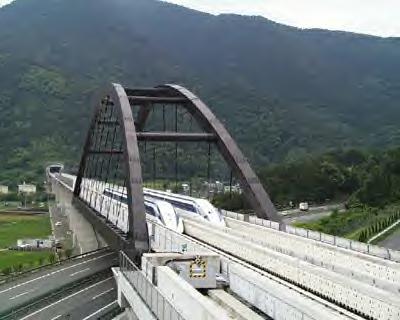
The Railway Technical Research Center (RTRI) is a Japanese railway research center. It develops basic rail technology and research applications, studies safety measures, and promotes the Maglev system.
RTRI uses more of the EDS system. To levitate its maglev trains, figure 8 coils are installed on the side walls of the guideway. Electric current is induced within these coils when the train's superconducting magnets go at a high speed about several centimenters below the coils' centers, making them temporary electromagnets. They in turn create forces that push the superconducting magnets upward and pull upwards at the same time, levitating the maglev vehicle.
For lateral guidance, levitation coils facing each other are connected under the guideway, making a loop. When the maglev vehicle- with its superconducting magnets- goes up, an electric current is induced in the loop, making a repulsive force acting on the levitation coils of the side near the car, and an attractive force acting on the levitation coils on the side farther from the car. Therefore, the car is always in the guideway's center.
A floating train does no good if it can't go anywhere. For propulsion, a repulsive force and an attractive force induced between magnets are used to propel the vehicle, which acts as a superconducting magnet. The propulsion coils on the side walls of the guideway are energized by a three phase AC current from a substation, making a shifting magnetic field on the guideway. The vehicle is propelled when the superconducting magnets on board are attracted and pushed by the shifting field.
Links
Back to the Maglev main page
How Maglev Works
Maglev Benefits
Magplane
Transrapid
California Maglev Project
HSST
Maglev Links
