|
|
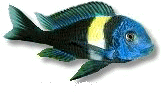
Basically, the Lake
Malawi cichlids can be divided into two large groups: the Mbunas and
Non-Mbunas. Mbunas is the indigenous name for the cichlids living in the
rocky littoral. Under this name is to be understood an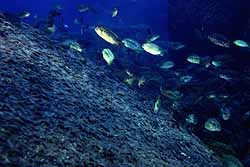 almost self-contained (i.e. it is well differentiable from the other
cichlids groups) group of small to medium-sized cichlids, which with
only a few exceptions live in intimate association with the rocks. The
basis of the Mbunasí diet is the rock aufwuchs which is grazed using a
number of techniques ñ scraping, plucking or by combing through the
algal carpet. It should be taken into account that the rock aufwuchs, or
in general any aufwuchs which settles on hard substrates, although
being mainly composed of algae and
bacteria, it also includes a number of small organisms (e.g. insect
larvae, crustaceans, small worms and snails). It is obvious that the
aufwuchs grows especially well where there is a lot of solar energy
available ñ i.e. in shallow water down to a depth of ca. 5 m. This is
most probably the main reason why the majority of the Mbunas occur in
shallow water. In extremely shallow waters (> ca. 1 m), only the
strongest or most assertive species are found as they force their rivals
into the deeper and therefore nutritionally poorer regions. Even though
many species have developed special techniques for feeding on the
aufwuchs, other sources of food are not rejected, especially if these
are more easily available. If there is an abundance of plankton, the
Mbunas can be seen in large groups feeding in open water. For many
species, plankton forms the main part of the diet.
almost self-contained (i.e. it is well differentiable from the other
cichlids groups) group of small to medium-sized cichlids, which with
only a few exceptions live in intimate association with the rocks. The
basis of the Mbunasí diet is the rock aufwuchs which is grazed using a
number of techniques ñ scraping, plucking or by combing through the
algal carpet. It should be taken into account that the rock aufwuchs, or
in general any aufwuchs which settles on hard substrates, although
being mainly composed of algae and
bacteria, it also includes a number of small organisms (e.g. insect
larvae, crustaceans, small worms and snails). It is obvious that the
aufwuchs grows especially well where there is a lot of solar energy
available ñ i.e. in shallow water down to a depth of ca. 5 m. This is
most probably the main reason why the majority of the Mbunas occur in
shallow water. In extremely shallow waters (> ca. 1 m), only the
strongest or most assertive species are found as they force their rivals
into the deeper and therefore nutritionally poorer regions. Even though
many species have developed special techniques for feeding on the
aufwuchs, other sources of food are not rejected, especially if these
are more easily available. If there is an abundance of plankton, the
Mbunas can be seen in large groups feeding in open water. For many
species, plankton forms the main part of the diet.
At this moment in time,
the Mbunas have been classified in 10 genera: Cyathochromis,
Cynotilapia, Genyochromis, Gephyrochromis, Iodotropheus, Labeotropheus,
Labidochromis, Melanochromis, Petrotilapia and Pseudotropheus.
A total of nearly 300 species are known. It is not possible to exactly
say how many species there are as with some populations it has not as
yet been definitely decided whether they are geographical forms of a
known species or whether they actually true species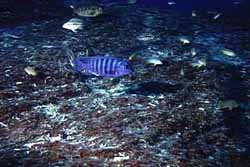 themselves. The smallest Mbunas grow only to a length of 6-7 cm (total
length). The largest Mbunas are representatives of the genus Petrotilapia,
whose males can even attain a length of 18 cm. The majority of the
Mbunas have a length of 9-11 cm.
themselves. The smallest Mbunas grow only to a length of 6-7 cm (total
length). The largest Mbunas are representatives of the genus Petrotilapia,
whose males can even attain a length of 18 cm. The majority of the
Mbunas have a length of 9-11 cm.
The close association of
the Mbunas to the rocky substrate results in that the majority of the
species are very sedentary. Furthermore, it is of significance that even
small, only 20 m wide stretches of sand will not be crossed by many
Mbunas. Due to this factor there are many isolated populations in
existence which with time have undergone different developments and
have, for example, formed different geovariants. Such processes will
lead finally to the formation of new species.
<<
Back | Home
| Next >>
Site designed by Gatekeeper. Best viewed under Internet Explorer 5.0 or above. All
text files provided here are copyrighted by their respective author.
©
Copyright 2001 - Present. Philippines. Keep Your Fish Team
|