
 |
CICHLIDS By: Gatekeeper |
|
|
Lake Malawi, previously known as Lake Nyasa, lies in the southern section of the East African Rift valley. The north-south axis is almost 600 km long and the lake has a maximum breadth of ca. 80 km. Its surface area has been given as nearly 31 000 km2 . The maximum depth is more than 700 m. This means that after Lake Victoria and Lake Tanganyika, Lake Malawi is the third largest lake in Africa. This inland sea is
bounded by three countries. Most of the coastline belongs to Malawi,
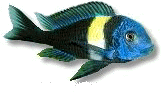
which Lake Malawi is really an unique body of water. When one takes a bathe in the waves on one of the often extensive beaches, it is surprising to find that the water is not salty. In addition to the long flat sandy beaches there are stony and rocky coastal regions, in which especially the cichlids known as îMbunas” are to be found. Wide river mouths and marshy shores covered with reeds complete the diverse landscape of Lake Malawi. A most prominent feature is the gigantic chains of mountains that frame the lake both on its north-west coast (north of Nkhata Bay) and its north-east coast (the Livingstone Mountains). These geographical formations illustrate impressively the structure of the rift valley through which Lake Malawi was formed approximately 1-2 million years ago. There is no doubt that Lake Malawiís most special feature is its cichlids. More than 600 species are now known, though many of these still have to be described scientifically and are classified under working names or trade names (see below). Apart from a few exceptions, all these cichlids are endemic to Lake Malawi, which means that they are only found in this body of water and no where else in the world. Site designed by Gatekeeper. Best viewed under Internet Explorer 5.0 or above. All
text files provided here are copyrighted by their respective author. |

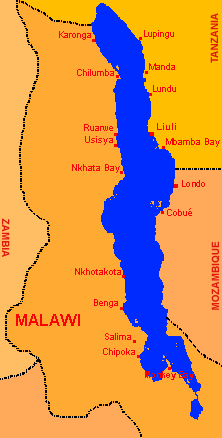 extends along almost the whole of the west coast
and includes the southern coast up to the middle of the eastern shore;
roughly 800 km in all. Mozambique borders on ca. 200 km of the central
eastern coast. The north-eastern coast and a negligible part of the
north-western coast belong to Tanzania forming a further 300 km of
coastline. In Tanzania and in Mozambique this lake is still called Lake
Nyasa, which in the language of the Yao means "great water".
extends along almost the whole of the west coast
and includes the southern coast up to the middle of the eastern shore;
roughly 800 km in all. Mozambique borders on ca. 200 km of the central
eastern coast. The north-eastern coast and a negligible part of the
north-western coast belong to Tanzania forming a further 300 km of
coastline. In Tanzania and in Mozambique this lake is still called Lake
Nyasa, which in the language of the Yao means "great water".