|
Electromagnetic Radiation |
Forms
of electromagnetic radiation
Visible Radiation
Visible light is the most familiar
form of electromagnetic radiation and makes up that portion of the spectrum
to which the eye is sensitive. This span is very narrow; the frequencies of
violet light are only about twice those of red. The corresponding
wavelengths extend from 7 10-5 centimetre (red) to 4 10-5 centimetre
(violet). The energy of a photon from the centre of the visible spectrum
(yellow) is h = 2.2 eV. This is one million times larger than the energy of
a photon of a television wave and one billion times larger than that of
radio waves in general (see Figure 1)
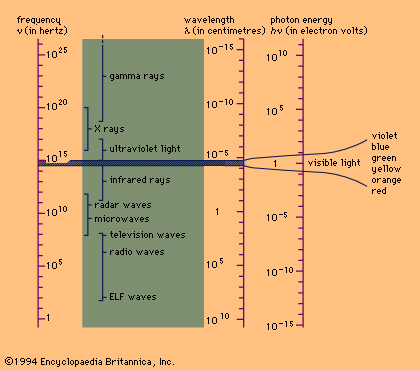
Electromagnetic spectrum. The small visible range
(shaded) is shown enlarged at the..)Life on Earth could not exist without
visible light, which represents the peak of the Sun's spectrum and close to
one-half of all of its radiant energy. Visible light is essential for
photosynthesis, which enables plants to produce the carbohydrates and
proteins that are the food sources for animals. Coal and oil are sources of
energy accumulated from sunlight in plants and microorganisms millions of
years ago, and hydroelectric power is extracted from one step of the
hydrologic cycle kept in motion by sunlight at the present time.
Considering the importance of visible sunlight for all aspects of
terrestrial life, one cannot help being awed by the absorption spectrum of
water in Figure 3
Figure 3: The absorption coefficient for liquid water as a function of
frequency.. The remarkable transparency of water centred in the narrow
regime of visible light, indicated by vertical dashed lines in Figure 3 , is
the result of the characteristic distribution of internal energy states of
water. Absorption is strong toward the infrared on account of molecular
vibrations and intermolecular oscillations. In the ultraviolet region,
absorption of radiation is caused by electronic excitations. Light of
frequencies having absorption coefficients larger than = 10 cm-1 cannot even
reach the retina of the human eye because its constituent liquid consists
mainly of water that absorbs such frequencies of light.
Since the 1970s an increasing number of devices have been developed for
converting sunlight into electricity. Unlike various conventional energy
sources, solar energy does not become depleted by use and does not pollute
the environment. Two branches of development may be noted--namely,
photothermal and photovoltaic technologies. In photothermal devices,
sunlight is used to heat a substance, as, for example, water, to produce
steam with which to drive a generator. Photovoltaic devices, on the other
hand, convert the energy in sunlight directly to electricity by use of the
photovoltaic effect in a semiconductor junction. Solar panels consisting of
photovoltaic devices made of gallium arsenide have conversion efficiencies
of more than 20 percent and are used to provide electric power in many
satellites and space probes. Large-area solar panels can be made with
amorphous semiconductors that have conversion efficiencies of about 10
percent. Solar cells have replaced dry cell batteries in some portable
electronic instruments, and solar energy power stations of one- to
six-megawatts capacity have been built.
The intensity and spectral composition of visible light can be measured and
recorded by essentially any process or property that is affected by light.
Detectors make use of a photographic process based on silver halide, the
photoemission of electrons from metal surfaces, the generation of electric
current in a photovoltaic cell, and the increase in electrical conduction in
semiconductors.
Glass fibres constitute an effective means of guiding and transmitting
light. A beam of light is confined by total internal reflection to travel
inside such an optical fibre, whose thickness may be anywhere between one
hundredth of a millimetre and a few millimetres. Many thin optical fibres
can be combined into bundles to achieve image reproduction. The flexibility
of these fibres or fibre bundles permits their use in medicine for optical
exploration of internal organs. Optical fibres connecting the continents
provide the capability to transmit substantially larger amounts of
information than other systems of international telecommunications. Another
advantage of optical fibre communication systems is that transmissions
cannot easily be intercepted and are not disturbed by lower atmospheric and
stratospheric disturbances.
Optical fibres integrated with miniature semiconductor lasers and
light-emitting diodes, as well as with light detector arrays and
photoelectronic imaging and recording materials, form the building blocks of
a new optoelectronics industry. Some familiar commercial products are
optoelectronic copying machines, laser printers, compact disc players, FAX
machines, optical recording media, and optical disc mass-storage systems of
exceedingly high bit density.
|
 |
 |
|


