
|
|








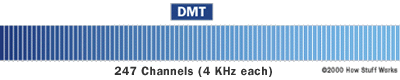
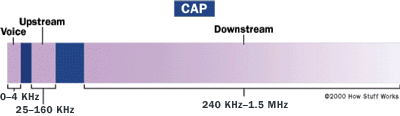
Discrete Multitone (DMT) DSL has two main standards: Discrete Multitone (DMT) and Carrier-less Amplitude/Phase (CAP). John Cioffi developed DMT. This standard is the most modern standard used in most DSL modems today. It utilizes the telephone signal in a very efficient manner. DMT separates a single telephone channel in to 247 channels, each with 4KHz. As Data propagates through the channel the DMT looks ahead to ensure data propagate on stable channels. It is common for data to change channels several times in DMT. DSL is a mode of Internet connectivity that uses the same telephone wires that carry voice and is setup to allow voice conversation while surfing the internet. Though DMT is a very efficient standard for signal propagation, it is prone to cross channel interference. To fix this DSL access providers install a Low-Pass filter at the wall jack of every phone not connected to the DSL modem. The low-pass filter blocks any frequency above 4KHz from entering phone conversations. Carrier Amplitude/Phase (CAP) CAP is an older standard used in earlier DSL installations. This standard worked by taking the single telephone signal and dividing it into three bands. The first band was for voice and had a range of 0KHz to 4KHz, upstream data is carried in the band of 25KHz 160KHz, and downstream data is carried in the band of 240KHz and up. This standard provided protection against cross-band interference by placing huge gaps in between the frequencies of the different bands. However, the CAP standard did not provide enough flexibility to ensure a clear, stable channel for signal propagation. In other words, since the signal was separated to there bands there were only three bands for data propagation. If the upstream, or downstream channels were degraded propagation would be impossible. The only advantage CAP has over DMT is its ease of installation but its lack of flexibility has given rise to the dominance in use of DMT. |

click me to move ahead to dial-up history. |
