
|
|









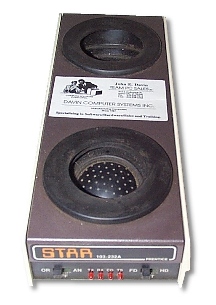
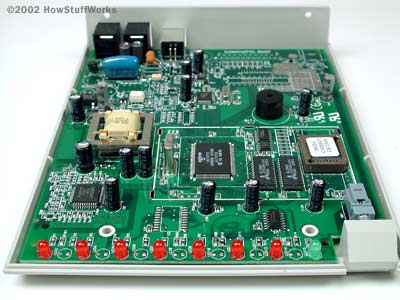

Dial-up Modems: The history of the dial-up modem first started in the 1950s with the need of the US military to be able to send data between air defense bases that are placed throughout the United States and abroad. The basic need was that the US military wanted a way for all military bases to be able to linked to one another and that in case of an attack on the USA whether by conventional bombs or nuclear weapons that these bases could still be able to send data to one another even if all other means of communication were destroyed. The idea was for these bases to find a means of transmitting data over existing telephone wires or what is know as the PSTN or public switched telephone network. This military need led to the first commercial dial-up modem named the Bell 103 being built in 1962 by AT&T. At the modems conception it had a data rate speed of 300 baud. At first this speed rating of 300 baud was more the adequate or so the public thought at the time, since basically what the 300 baud rating means is that 30 characters can be transmitted every second which was about what a normal person could type at that time. Eventually it was realized that 300 baud was becoming too slow with the inception of BBSs which were the start of and the building block for what is known to us as the Internet today. BBSs were privately owned bulletin boards hence the acrenem BBS and where a way for those with dial-up modems and the know how to use them could find groups of interests to them and post messages which allowed a community of people throughout the US and the world to be able to communiucate with one another on a regular basis. AS the BBSs grew in popularity, users where finding was to upload programs and other large files to these community boards and that 300 baud was no longer being able to handle to download these large files without taking enormous amounts of time to accomplish the task. Eventually the Bell 212 was designed and it increased speed up to 1200 baud. As demand for higher rates of transfer by those using the dial-up modem networks it became appranent that part of the problem was the phone line system itself. At first the telephone line system was able to handle the slower rates of speed without too much interference or loss of data intriguity, but as the higher rates of transfer grew and the more interference and data loss was being obtained this problem lead to an invention known as the automatic data equalizer. The automatic data equalizer dealt with the problem of data attentuation, attenuation meaning a data's signal frequency in which it was being transmitted over the phone lines. Attenuation was causing a problem of too many data signals being sent at the same or near the same frequency as others which lead to mass collisions of the data trying to be transmitted. Propagation which is the weakening of a data signal over the length that it had to travel over the phone lines to connect with the modem on the other side of the transmittion. The automatic data equalizer helped to solve these problems by better monitoring and allocating certain frequencies to each data transmission to alleviate the possibility of data collison and interference among all data signals being sent over the telephone lines. The invention of the automatic data equalizer meant that the data equalizers no longer had to be monitored by individuals and collabrate constantly based on traffic that was coming through that part of the phone network and this in turn lead to higher transmission rates for dial-up modems and in turn the next generation of a dial-up modems was born that was named the 14.4k modem based on the speed that it could achieve. Since then dial-up modems have been growing in transferring speeds that went from then 28.8k introduced in 1994 and sortly there after was the introduction of the 33.6k modem which has now lead to the industry standard among dial-up modems which is called the 56k. As it stands today the 56k modem has pushed the current limitations of the telephone network for speed in transmitting among analog to digital lines which has in part lead to the popularity of cable modems and dsl lines of today. |
*Evolution of the first dial-up modem which required the user to physically place a phone receiver into the modem itself, just like the one used in the movie War Games, to a modern modem that usually is found inside the case of your computer and only requires a standard RJ-45 phone line jack to be connected to its phone port. Cable Modems: Well, unlike DSL, cable Internet access doesn't have as extensive a history. However, I can tell you that development has come along at a very fast rate considering that cable TV has only been in out homes and businesses a little over thirty years. At the same time cable Internet access has made huge strives to perfect cable Internet access. In 1996cable Internet access was still in work. It wasn't until 1997 that Internet access through cable would be sold commercially. Cable has become the largest competitor to DSL in home and small business Internet access. |
Click me to move ahead and learn about how dial-up modem standards. |
