
Quick Links:
Statement from the Crown Council of Ethiopia and the Imperial Family
The Imperial Churches
The Imperial Constitutions of the Empire of Ethiopia
The Imperial Crest of the House of Solomon
Coronation Traditions in Imperial Ethiopia
Origins of the The Solomonic Dynasty, the Imperial House of Ethiopia
Family Trees of Various Branches of the Imperial Solomonic Dynasty of Ethiopia
Emperor Haile Selassie I, Part 1
Emperor Haile Selassie I, Part 2
Emperor Haile Selassie I, Part 3
Emperor Libne Dingel (Wanag Seged)
In Memory of Her Imperial Highness, Princess Tenagnework of Ethiopia
Emperor Sertse Dengel (Melek Seged)
Emperor Tekle Giorgis II
Emperor Tewodros II
Titles in the Empire of Ethiopia
Traditions, Rituals, Practices and Etiquette in the Ethiopian Empire
Emperor Yohannis IV
Empress Zewditu, Queen of Kings
Amha Selassie I,Emperor-in-Exile (Crown Prince Asfaw Wossen)
Imperial Burial Traditions
Flags and Symbols of Ethiopia
Imperial Funeral Events October 30th - November 5th, 2000
Emperor Gelawdewos (Atsnaf Seged)
Lij Eyasu Michael, Emperor-Designate (Eyasu V)
Maps of Ethiopia Across Time
Emperor Menelik II : Part I
Menelik II Part II: The Post Adowa Era
Emperor Minas (Admas Seged)
Imperial Monuments of Ethiopia
Pictures and Stories on the Imperial Funeral Events
Imperial Palaces and Residences of Ethiopia
Emperor Susneyous the Catholic (Siltan Seged)
The Imperial Family Today
Emperor Yacob
Emperor Yekonu Amlak
History of the Ethiopian Orthodox Tewahido Church Homepage
Coronation Traditions in Imperial Ethiopia
|
Ethiopia is filled with buildings, or remains of buildings from which the Emperors ruled their subjects. Below are a few examples.
THE QUEEN OF SHEBA'S PALACE, AXUM

The Ruins of the Queen of Sheba's Palace
These ruins are of a very large palace, located in Axum. At least a millenium old, this palace was of vast purportions and indicates the importance of the Axumite Empire at the time. Popularly refered to as the "Queen of Sheba's Palace" there is no evidence that this was indeed the home of Makeda. That it was the home of powerful monarchs is not doubted.
DANQAZ
 
These are the ruins of an elaborate Palace built by the Emperor Susneyos at Danqaz near Lake Tana around 1604. The Palace is said to have been built according to Ethiopian design, but with heavy Arab and Indian influences, by two builders named Abdal Kerim and Sadaqa Nesrani. Following his abdication, the Palace at Danqaz was abandoned by his son Fasiledes. The Emperor Fasiledes moved his capital to Gondar and built his own new palace there. The Palace at Danqaz has deteriorated heavily ever since, and an effort is despirately needed to save the site from complete distruction. Sadly, it continues to crumble.
THE PALACE COMPOUND OF GONDAR
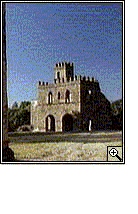
 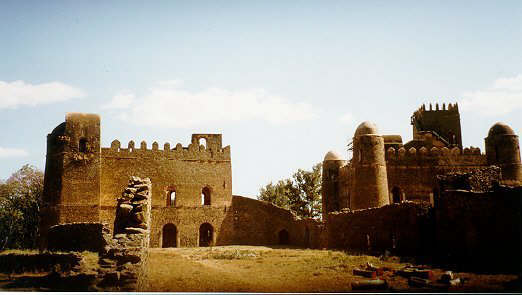
From 1665 to 1864, the city of Gondar served as the Capital of the Ethiopian Empire. Founded many years earlier by the Emperor Sertse Dengil, Gondar became the capital upon the succession of Emperor Fasiledes in the aftermath of the abdication of his father Emperor Susneyous in 1665. Due to the wars between the Catholic former Emperor and the Orthodox loyalists, the new Emperor ordered the Portuguese and the Roman Catholic clergy to leave his Empire immediately. The new Palace he set out to build in Gondar however, was strongly influenced by Portuguese architecture. It is said that many Indian craftsmen were also employed in the construction, and South Asian influences are thus also apparent.
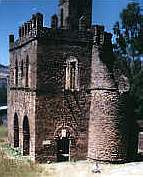
Regardless of these strong influences, the palaces of Gondar are uniquely Ethiopian, and elements of the earlier Axumite and Lasta periods are also evident in the architecture. The Castle of Fasiledes was the first building built in the Palace precinct in Gondar, and each of his successors built more castles in the same basic style, within the compound, of various sizes.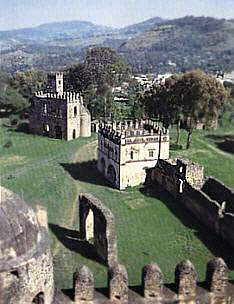 Banqueting halls, Reception chambers, libraries, chapels, store houses, stables, towering arches, crenelated walls and towers gave the Gondar Palace compound a very grand aspect. Foriegn visitors have left accounts of the lavish decour of these castles. Venetian mirrors, intricate woodwork, vivid traditonal paintings and art work, lavish ivory inlay, and liberal use of gold, silver, and rich fabrics are attested to by several writers. Banqueting halls, Reception chambers, libraries, chapels, store houses, stables, towering arches, crenelated walls and towers gave the Gondar Palace compound a very grand aspect. Foriegn visitors have left accounts of the lavish decour of these castles. Venetian mirrors, intricate woodwork, vivid traditonal paintings and art work, lavish ivory inlay, and liberal use of gold, silver, and rich fabrics are attested to by several writers. 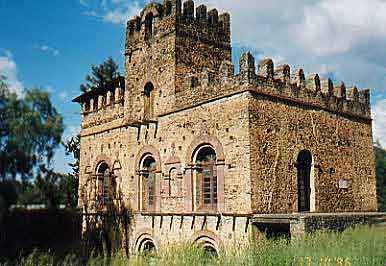 The Palaces were looted several times during the course of many wars, especially during the Zemene Mesafint period. Tewodros II carried off much of what remained to Magdalla, which was in turn looted by the British expeditionary force. The Mahdists of the Sudan ransacked the Palace compound reducing it to ruins in 1888, and the complex suffered bombing during the Ethio-Italian conflict of 1936-1941. The Fascist Italian occupiers did clean out the piles of rubish that had accumilated in the Palace compound over the years and tried to do some preservation work. Emperor Haile Silassie, and the successive regimes that followed the revolution of 1974 also did much to preserve these historic buildings. The Palaces were looted several times during the course of many wars, especially during the Zemene Mesafint period. Tewodros II carried off much of what remained to Magdalla, which was in turn looted by the British expeditionary force. The Mahdists of the Sudan ransacked the Palace compound reducing it to ruins in 1888, and the complex suffered bombing during the Ethio-Italian conflict of 1936-1941. The Fascist Italian occupiers did clean out the piles of rubish that had accumilated in the Palace compound over the years and tried to do some preservation work. Emperor Haile Silassie, and the successive regimes that followed the revolution of 1974 also did much to preserve these historic buildings.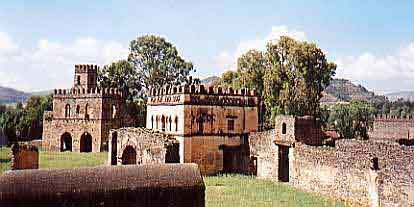
QUSQUAM PALACE

Upon the death of her husband the Emperor Bakaffa, Empress Mentewab scrambled to ensure the succession of her underage son Eyasu II, and had herself crowned as co-ruler to help him govern. The Empress played a leading role during the reign of Eyasu II, and following his murder, in the reign of his son Eyoas I as well. Not long after being crowned co-ruler, Empress Mentewab built the Church of Qusquam Mariam (Our Lady of Qusquam), in the mountains out side of Gondar on the road to Armachoho. The church is named for a place in Egypt where the Holy Family lived in exile after leaving Bethlehem because of Herod's massacre of the innocent babies. Next to this church, the Empress built a large and elaborate Palace that she intended to be her refuge from the court intregue and manuvering of the Palace compound in Gondar. The Empress held court here, and was visited often by the highest officials and important clerics wishing to conduct official business. However, the site was regarded as a place of rest for the Empress, and a retreat for prayer. Her father-confessor had appartments at this palace, located over the large gate separating the Palace from the Church which can still be seen today. Due to the prohibition of menstruating women from entering churches in Ethiopia, the Empress had a large circular "Se'el Bet" or Icon Chapel constructed containing Icons of all her favorite saints where she would pray on days she couldn't go to church. Her Banquet Hall at Qusquam was famed for the huge banquets she would hold. The Empress had a large complex of servants quarters constructed that contained vast kitchens and bakeries, and places for weavers, embroyders, and other servants. The palace also contained a room with a sunken bath that can still be viewed today. Following the murder of her grandson Eyoas I, her influence decreased considerably, but she remained a deeply respected figure. Although she had been involved in raging disagreements with her grandson during his life, the murder of Emperor Eyoas I on the orders of her son-in-law, Ras Michael Sehul, horrified her, and was to cause her life-long sorrow.  In her grief, she had her grandson buried at the Qusquam Church next to his father and then took up permanent residence in the Palace there, refusing to return to the capital. The Empress would live to see two more Emperors on the throne, and officials continued to pay respectful visits to her at Qusquam although she retired from political activity. She too was buried at Qusquam upon her death. The Palace was looted and distroyed by the Mahdists during their sacking of Gondar in 1888. They burned the Church to the ground. Only the Banquet Hall of the Palace remains largely intact, although the floor was burned away and the large cellar exposed. The Italian occupiers during the 1936- 1941 Ethio-Italian war hoped to win some favor by beginning to re-build the church and by protecting and renovating the ruins of the Palace. Emperor Haile Selassie completed the Church, and the bones of Empress Mentewab, her son Emperor Eyasu II, and grandson Emperor Eyoas I, were placed together in a glass topped coffin in the crypt of the church, and can be viewed today by visitors. 
MEKELE CASTLE
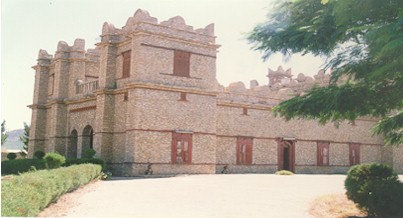
This Palace was built by Emperor Yohannis IV in the 1870's as his official residence. Yohannis IV originally resided in Debre Tabor, where the ruins of his earlier palace still stand. He subsequently returned to his home region, and established Mekelle as his capital. The Mekelle building was strongly influenced by the castle compound in Gondar. It served as the seat of the princes of Tigrai following the death of Emperor Yohannis. The palace continues to be a dominant feature of the town of Mekele, which remains the capital of Tigrai province. Set in lovely hilltop gardens, it is currently undergoing extensive renovations.
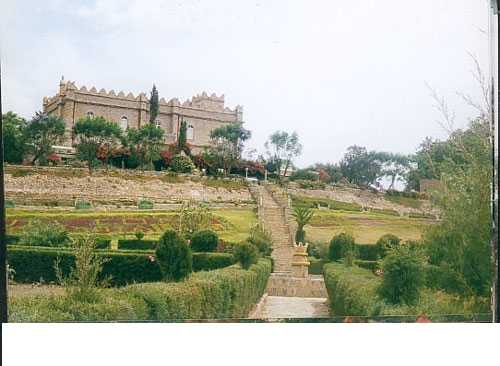
ENTOTO PALACE
(Picture coming soon)
This Palace was built by Menelik II when he was still king of Shewa, and had just moved the capital of his kingdom from Ankober to Entoto. The Palace was criticized by some as not being as imposing as the one that the king abandoned in Ankober, and was actually described as "ramshackle" by others. It was not as extensive as many of the other Royal and Imperial residences that existed in the Empire at the time. Once Menelik became Emperor, an effort was made to expand the palace, but Menelik soon moved to his new capital at Addis Ababa and he only stayed at Entoto when he was visiting St. Mary's Church on the mountain top, or as a stop over when he was traveling north. Empress Taitu was compelled to return to this Palace when she was widowed, and died at this Palace in 1928. Menelik and Taitu are the only soveriegns to have lived in this palace. It is currently going through extensive renovations after years of falling into disrepair.
THE IMPERIAL PALACE (also known as THE GREAT GUIBI, or the MENELIK PALACE)
(Picture coming soon)
The Imperial Palace was begun as a house on a hill built for Empress Taitu who would visit the hot mineral springs at Finfine, a short distance away. The area was named Addis Ababa by the Empress, and a town grew rapidly around the house of the Empress. In 1886, the capital of the Empire was moved to this site from Mt. Entoto, and Taitu's husband, Emperor Menelik II rebuilt the house as his primary Palace. Over the years the Palace was added to and expanded, to include a multitude of buildings of various sizes and functions in a large wooded compound. The Imperial Palace served as the official Palace even after Emperor Haile Silassie I moved his primary residence out to the Guenete Leul Palace in 1932, and it remained the official seat of the Monarchy until the revolution of 1974. The Marxist military dictatorship (known as the Derg) that overthrew the Imperial Government in September 1974 continued to use the Palace as it's official seat of government. The Derg renamed the Palace as the "Grand Palace" but it also used the term Menelik Palace regularly. The extensive wine cellars of the Palace were used to imprison prominent figures of the Imperial government, including male members of the Solomonic Dynasty. It remained the seat of power of the Peoples Republic of Ethiopia when it was proclaimed in 1986 by the Derg, and the current government of the Federal Republic of Ethiopia also uses it as it's official seat of power. Emperor Haile Selassie was kept under detention in one of the buildings in the palace compound following his deposal in 1974. He was killed here, and buried secretly on the grounds, a latrine built over the site of his grave. His remains were disintered following the fall of the Derg and he has been reburied. There are three important churches on the grounds of the Palace. The most prominent is the magnificent Ta'eka Negest (Resting Place of Kings) Ba'eta Le Mariam Monastery, with a large Imperial crown atop it's dome, which serves as the mausoleum of Emperor Menelik II, his wife Empress Taitu, and Empress Zewditu, his daughter and eventual successor. The other churches are the Se'el Bet Kidane Meheret Church (Our Lady Covenant of Mercy) and the Debre Mengist St. Gabriel Church. Former President, Lt. Col. Mengistu Haile Mariam converted the house of the Dean of the Ba'eta Le Mariam Monastery, into a large residence for himself, and this building continues to serve as the residence of the Prime Minister of the current government, and is an outer part of the Palace complex. This Palace remains the seat of government in Ethiopia, and is not open for tours.
THE GUENETE LEUL PALACE
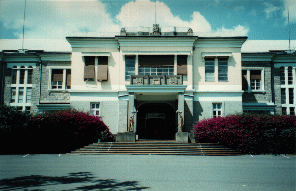
The Guenete Leul Palace (Paradise of the Princes) was built by Emperor Haile Selassie on the site of an earlier house he had inherited from his late father, Ras Makonnen. The building was begun in 1930 as a guest house, and it's first occupants were the Crown Prince Gustav Adolf of Sweden with his wife during thier state visit to Ethiopia in 1931. Subsequently, Emperor Haile Selassie and his family moved out of the Imperial Palace (also known as the Great Guibi or the Menelik Palace) into the Guenete Leul (also known as the Little Guibi) making it his primary residence. The Guenete Leul Palace had very extensive grounds, and the Menbere Leul Kidus Markos Church (Altar of the Princes St. Mark's church) was built in the compound to serve the Imperial family and the large staff. Following the Italian occupation of 1936, this Palace served as the official seat and residence of the Italian Vice-Roy of Italian East Africa, first Marshal Badoglio, followed by Marshal Graziani, and finaly H.R.H. Prince Amadeo Di Savoia, Duke of Aosta. It was here that an attempt was made on the life of Marshal Graziani by two Eritrean rebles during celebrations to mark the birth of a son to Prince Umberto, heir to the Italian throne. This resulted in the brutal massacres ordered in reprisal, in Addis Ababa and later at the Debre Libanos Monastery. Emperor Haile Selassie moved back into the Guenete Leul Palace upon his return from exile in 1941. Later, during the attempted Imperial Guard coup-d'etat of December 1960, the leading nobles and government officials of the Empire were placed under arrest by the rebellious guards and imprisoned at the Palace in the Green Salon. When this attempt to seize power collapsed, the Imperial Guards and the Army engaged in a fierce battle through the grounds of this palace, and as the Imperial Guards withdrew, they massacred the officials held hostage in the Green Salon. Upon his return, the Emperor in light of the Green Salon massacre, decided to move into the new Jubilee Palace. The Guenete Leul Palace was subsequently donated by the Emperor to the Haile Selassie University (re-named Addis Ababa University in 1974) and it continues to serve as it's main campus. The Palace itself was renamed Ras Makonnen Hall in memory of the Emperor's father who had owned the property originally.
 The Palace has elaborate gates, and lovely formal gardens. The Palace itself is used for University ceremonies and conferences, and houses a large exhibit of artifacts from around Ethiopia as well as the Library of the Institute for Ethiopian Studies. Funds are being raised to move the library to a new building, so that the Palace can be solely a museum. On the upper floor, interesting gifts given to Emperor Haile Selassie on his many foriegn visits are displayed. His old bedroom is furnished just as it was when he lived there, and is open for tours. There are many other newer buildings on the grounds including classrooms, libraries, labs, and dormitories that were not part of the original Palace complex.
THE JUBILEE PALACE
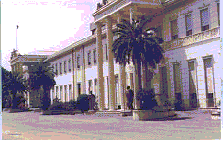
Completed in 1955, this modern Palace was built to mark Emperor Haile Selassie's Silver Jubilee. This large cream colored Palace has three grand pillared porticos on it's front that rise the height of the building. The Emperor moved into the Palace and made it his primary residence after the Massacre of the Green Salon at the Guenete Leul Palace in 1960 during a coup attempt. The palace was significantly expanded in 1966-1967. Located across Menelik II avenue from Africa Hall (site of the founding of the Organization of African Unity and Headquarters of the United Nations Economic Commission for Africa), and just accross the narrow Finfine river from Maskal Square and St. Stephen's Church, the Palace has stately grounds, impressive fountains and an interesting collection of animals in it's zoo. The gates of the Palace are topped by large carved lions. The Emperor lived here between 1961 and 1974. The Jubilee Palace was the site of the dethronement of Emperor Haile Selassie in September 1974, when 10 low ranking military officers appeared before the Emperor in the Palace library and read him the statement of the Derg officially removing him from the throne. The Derg renamed the Palace the "National Palace" and the current government of Ethiopia continues to refer to it by this name.

The Derg used this Palace for state ceremonies involving visiting heads of state, state banquets and receptions. The derg added a swimming pool to the grounds. With the fall of the Derg, and the proclamation of the Federal Republic, the Jubilee Palace became the official residence of the President of the Federal Republic of Ethiopia (who only has a ceremonial role), who uses the palace for official functions.
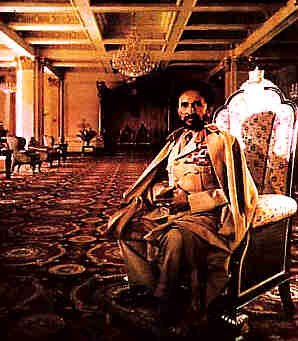
Emperor Haile Selassie in the Throne Room of the Jubilee Palace
The Palace is not open for public tours, but it does contain a small museum stocked with artifacts from the reign of the late Emperor Haile Selassie. These include his Imperial Crown, his Coronation Robes, his various military uniforms, his vast number of foreign and domestic medals, orders and decorations, including his robes and decorations as Knight of the Garter (Great Britain) which were never returned upon his death to Windsor as was customary.
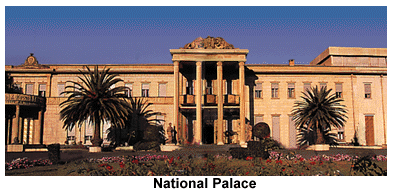
The Jubilee Palace before the 1966 expansion
(Notice the smaller portico on the left side.) The palace remained fully staffed during the revolution as if the monarch was still in residence, and continues to be now that it is used as the official Presidential residence. Recently, the Ethiopian Government announced it's intention to build a new Official Presidential Residence. The Jubilee Palace will then be opened as a museum. It will continue to house the President of the Republic until that time.

MASSAWA PALACE
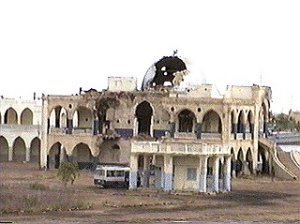
The Palace in Massawa qualifies as an Imperial Palace due to the fact that Emperor Haile Selassie resided there when he visitied once a year for the graduation ceremony of the Cadets from the Imperial Ethiopian Naval Acadamy. However, the Palace was built much earlier by the Turkish rulers of Massawa during their long occupation of the port, and was inherited by the Egyptians and later the Italians. Built with airy arches and domes to cool the palace with ample airflow, due to the oppressive heat of the port, the palace was once a glittering gem on the shoreline of the island it was located on. During the brutal battle for Massawa between the Ethiopian Communist government and the Eritrean Independence movement in the late 1980's, the palace was struck by bombs, and has been in the ruined state shown here. It is now in the posession of the government of Eritrea, and it remains derelict. There was once talk by the Eritrean government of restoring it to become a museum, but nothing appears to have been done.
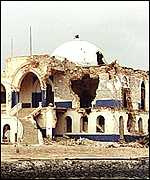
The Ruins of Massawa Palace
ASMARA PALACE
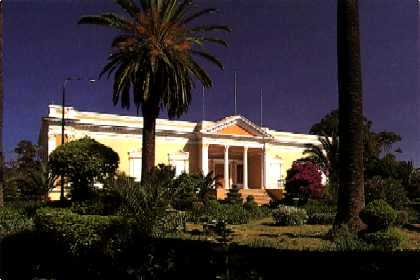
The Asmara Palace was yet another Imperial residence built for someone other than the Emperor of Ethiopia, but subsequently used by Emperor Haile Selassie and thus qualifies as an Imperial Palace. It was built in 1897 by Italian Governor Martini of Eritrea as the official Royal Palace of the King of Italy in the colony. It was the seat of the Italian Governors of the Colony of Eritrea. King Vittorio Emanuelle III became the only Italian king to actually stay there during his visit to Eritrea in the 1920's. Following the Federation with Ethiopia, it became the Asmara residence of the Emperor, and the seat of the Crown Representatives, first Betwoded Andargatchew Messai and Princess Tenagnework, then Lt. Gen. Abey Abebe. Later it became the residence of the first Governor-General when Eritrea became a province. The first Governor-general of Eritrea to live in the palace was H.H. Prince Asrate Kassa, with his wife Princess Zuriashwork Gebre Igziabiher. The Derg used it as an official palace. It is used today for official state functions and events of the Eritrean Government, and it also briefly served as a museum, but is no longer accessable to the public. Built in the Neo-Classic style popular in Europe towards the end of the 19th Century, the Palace is set amid lush gardens and has served as the seat of Italian, British, Ethiopian and Eritrean administrations.

The Palace and Gardens at Asmara
Fairfield Palace, Debre Zeit
Located South East of Addis Ababa, Debre Zeit is a leisurly resort town that is also home to the headquarters of the Ethiopian Air Force. Just outside of town, on a hill overlooking Lake Bushoftu is Emperor Haile Selassie's favorite getaway, Fairfield Palace. The Emperor would spend many weekends here, away from the bustle of the capital. The Palace was named Fairfield, after the house of the same name that had been the Emperor of Ethiopia's residence in exile in Bath England, between 1936 and 1931.
Koka Palace
(pictures coming soon)
This ultra modern Palace was built overlooking the hydro-electric damn built on the Awash river that formed the large picturesqe Koka lake. The Emperor handed over this lovely site to the Ghion Hotels who turned it into a resort which was popular with Addis Ababa's professional classes as a out of town get away. The Derg restored it to Palace status and used it as an official guest house briefly, before once more turning it back into a hotel resort.
PALACES OF OTHER PROMINENT FIGURES
RAS BET
(Pictures coming soon)
Located in Gondar, this house was built by Ras Anastasios, the illegitimate son of an Emperor, and an ancestor to many prominent Imperial and Noble figures in Ethiopia since that time. Ras Bet became the home of the Enderase of Ethiopia during the Zemene Mesafint period when political power was stripped from the Emperor and bestowed on the Enderase, and the country was ruled by warlords and regional princelings. This castle is seperate from the Imperial Castle compound in Gondar, and is the only one that was still in full use into the 1970's. It is a museum today.
Abba Jiffar's Palace
(Pictures coming soon)
This Palace was the residence of Abba Jiffar II, the last reigning Sultan of Jimma. Jimma was an Oromo muslim sultanate that after was reincorporated into the Ethiopian Empire by Menelik II. Following his decision to submit to the authority of the Emperor, the Sultan was allowed by Menelik to retain his titles and rule over the Jimma Sultanate, ruling it as he had before, but providing an annual tribute and tax to the central government. Menelik resisted all advice to abolish the sultanate by those who saw the arrangement as a feudalistic obstruction to centralization and modernization. Lij Eyasu maintained the Sultanate and even fathered a child by a daughter of the Sultan. Emperor Haile Selassie brought Jimma under central government rule as part of the province of Kaffa in the 1930's and abolished the sultanate. The Italians briefly restored the sultanate in Jimma under Abba Jobir, but it was re-ablolished by the Emperor upon his return in 1941. The elegant palace is located in the southern town of Jimma, capital of the former province of Kaffa. It is also a museum and is open for tours.
THE PALACE OF THE CROWN PRINCE
(Picture coming soon)
The Palace of the Crown Prince of Ethiopia is located north of Sidist Kilo, across the street from the grounds of the Guenete Leul Palace (Addis Ababa University) and next to the Church of the Savior of the World (Meskahazunan Medhane Alem). Built as a residence for Lij Eyasu while he was Crown Prince, the prince seldom stayed there as he traveled around the Empire. It is a spacioius palace set in lovely gardens, with beautiful fountains stocked with gold fish. Crown Prince Asfaw Wossen took up residence after his first marriage to Princess Wolette Israel Seyoum. He returned to this Palace after the liberation of 1941 a divorced man, and continued to live there after his remarriage to Princess Medferiashwork Abebe. Following the fall of the monarchy in 1974, the Derg turned the palace into the Political College for the training of communist cadres. A large bust of Karl Marx was placed at the entrance, and many classroom and dormitory facilites were built on the grounds. In 1991, when the EPRDF marched into Addis Ababa and assumed control of the government, the former members of the Derg and the highest officials of the Communist government were arrested and imprisoned temporarily at this former palace/political school. They were later moved elsewhere.
THE DUKE OF HARRAR'S PALACE
This Palace was built for Emperor Haile Selassie's second son, Prince Makonnen, Duke of Harrar, and his family in Addis Ababa. It is located North of Sidist Kilo and north of the Crown Prince's Palace. This grand mansion remains one of the more imposing houses in the city. Following the death of the Duke in 1958, Princess Sara Gizaw, Duchess of Harrar, and her sons continued to live in this palace right up to September 1974 when the monarchy fell. When the women and children of the Imperial family were initially rounded up during the seizure of power by the Derg, they were first imprissoned at this Palace before being transfered a couple of months later to the Kerchele Akaki (Alem Bekagn) prison. The Derg later made the palace the Headquarters of the Ethiopian Socialist Women's Association (an associated group for the ruling "Workers Party of Ethiopia"). The innaugural cermonies of this association at this palace served as the first public function carried out in an official capacity by Woizero Wubanchi Bishaw, wife of the President Mengistu Haile Mariam. There were rumors that the Palace was being renovated in 1993 to serve as the official residence for the President of the Federal Republic following the EPRDF's assent to power, but the President moved into the Jubilee Palace instead.
To be continued...
|


