volume 1
 by Shaun McCracken
SUPER METROID

Published and Developed by Nintendo for the Super Nintendo Entertainment system in 1994.
Welcome to the inagural volume of "Anniversary Edition", where we take games that
have reached a certain "milestone" in it's history, and give it an appropriate
retrospective it deserves. And what better game to kick off this new feature is
Super Metroid! Undoubtably one of the finest and influential games in video game
history, in 2004, Super Metroid celebrates it's 10th year anniversary. We'll take
a look at the game itself, why it was so great, the influence it had and where it
stands in video game history.
BACKSTORY
As you probably realize, Super Metroid is not the first game in the franchise.
In fact, it's the thrid game in the series. The Metroid series began life on the NES
back in 1987 as an innovative sci-fi adventure game that had a design that wasn't
seen in platfrom games before. The world was fairly open-ended, and there was a
lot of oppertunity for exploration. Players would wander through the caverns of
Brinstar, Norfair and Tourian and encounter memorable enemies such as the alligator-like
Kraid, the pteroydactyl-like creature Ridley, the life-sucking creatures known
as Metroids, and the Mother Brian. If you completed this adventure quick enough,
players were in for a suprise. Unlike what the instruction manual claimed, at the
end of Metroid, gamers were shocked (and perhaps pleased) to find that Samus was
actually a woman. This (I believe) marked as the first time in gaming that a female
character had the leading role of an action game. If I'm wrong on this, let me know.
Still, this was a fairly big milestone in how we saw gender roles in video games.
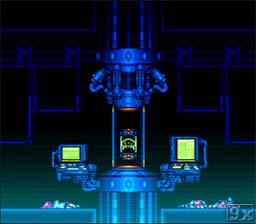 But, Metroid was not perfect. The game lacked battery back-up in favor for a cumbersome
password system (and Nintendo even had the nerve to label "Password Series" on
the cover). The lack of a map and even crucial landmarks made finding what to
do next in the game difficult.
But, Metroid was not perfect. The game lacked battery back-up in favor for a cumbersome
password system (and Nintendo even had the nerve to label "Password Series" on
the cover). The lack of a map and even crucial landmarks made finding what to
do next in the game difficult.
In 1992, the Metroid series jumped to the Game Boy in the form of Metroid II: The Return Of
Samus. A new planet, new Metroids, and new abillites for a (relatively) new system.
Metroid II gave more of what people liked in the NES Metroid and then some. In this
adventure, there are different types of Metroids to fight instead of just one
form. On top of that, Samus had to deal with new enemies and puzzles if she
wants to escape SR388 alive. Of course, she doesn't go around empty handed. Along
her adventure, she'll collect the usual missle, bomb and morph-ball power-ups, as
well as new beam attachmets. The adventure is made easier with a battery back-up
catridge, so you can continue the adventure right from where you left off. Unfortunatley,
there's still no map, and there is still a bit of backtracking. On the bright side,
this was an adventure you could play at home or on the road.
THE GAME
We're now caught up to 1994. May 1994, to be exact. This is when Super Metroid
debuted on the Super Nintendo Entertainment System. It took nearly three years for
Nintendo to come around and give a Metroid game for it's current system. But when
Super Metroid was finally released, gamers were given the ultimate love gift from
Nintendo. Super Metroid had everything you could want in a sequel: better graphics and sound,
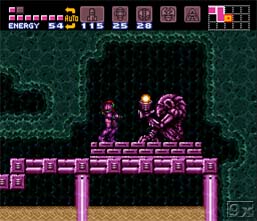 bigger areas, bigger bosses, better weapons and a whole lot of improvements from
past games in the series. Super Metroid was so polished and refined, that it not only became
the best game in the series (even though Metroid Prime is bitting at it's ankles),
but probably one of the best gaming experiences a gamer will ever have.
bigger areas, bigger bosses, better weapons and a whole lot of improvements from
past games in the series. Super Metroid was so polished and refined, that it not only became
the best game in the series (even though Metroid Prime is bitting at it's ankles),
but probably one of the best gaming experiences a gamer will ever have.
Super Metroid was kind of a return to the NES Metroid. Samus, after recieving
a distress call from a space station, finds that this space station is a literal
ghost ship as all the people on board are missing or dead (or passed out, who
knows). She enters a room and finds the Metroid she dropped off to this space station
earlier. Suddenly, Ridley appears, takes the Metroid from the ship, and makes way to
the Planet Zebes. Samus follows. The planet she arrives at is a familliar place,
as this was the site of her first advenutre. But now, she'll have to go farther than
she's ever had to go before, from the jungles of Brinstar to the waters of Maridia
and the firey depths of Norfair. After she's done battle with the planet inhabitants
new and old, she finds that she's come full circle to her first affair in Tourian,
and catches up with her old fling, the Mother Brain. One way or another, Samus
made sure that she would never cross paths with this planet ever again.
The adventure this time around is pretty similar in design to past Metroid games.
You're thrown into a large world in which you need to re-acquire your abillities and
weapons, but not everything is avaibale and open to you off the bat. You'll need to explore
each area, find new paths and defeat certain enemies to move further along. Well,
one could say that I'm not 100% right on that. Actually, you can go into certain areas, but you won't
get too far if you don't have the right suit. Some areas you can't go back to until
you find a specifc item that will let you through. And everthing you need to find
or want to explore isn't fully visible. There's a lot more hidden areas in Super
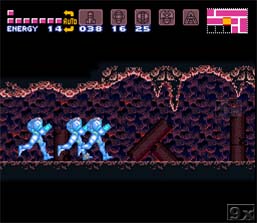 Metroid than in previous entries. There's just a lot more to Super Metroid than
most people realize. It wasn't just a platform game, and it wasn't just an
action/adventure. Super Metroid gave you quite a bit of freedom to choose wether or
not you wanted to get specifc items, since it wasn't neccessary to collect them
(such as the Spazer beam or the Spring Ball and numerous missile or bomb pickups),
and the freedom to explore the space you were given. Like I said before, not every
path and secret is visible, and I would say a good 30-50% of the game was made up
of hidden items, so there was a lot of exploration to be had. Plus, the design
of Super Metroid was almost made for repeat plays after completion. It was fun to
see how fast you could complete this game.
Metroid than in previous entries. There's just a lot more to Super Metroid than
most people realize. It wasn't just a platform game, and it wasn't just an
action/adventure. Super Metroid gave you quite a bit of freedom to choose wether or
not you wanted to get specifc items, since it wasn't neccessary to collect them
(such as the Spazer beam or the Spring Ball and numerous missile or bomb pickups),
and the freedom to explore the space you were given. Like I said before, not every
path and secret is visible, and I would say a good 30-50% of the game was made up
of hidden items, so there was a lot of exploration to be had. Plus, the design
of Super Metroid was almost made for repeat plays after completion. It was fun to
see how fast you could complete this game.
When you play a new installment of a game (sequel and beyond), you expect
some changes to the exisiting design, as well as new improvements. Super Metroid
did this as well. I did say that Super Metroid played like previous games in the
series, and for the most part, that's a fair assessment. But Super Metroid also
went beyond the basic skills presented in previous games. In the original Metroid,
you can do a technique with the bombs when you're rolled in a ball to reach higher
places, provided that you time it right. In Super Metroid, you can still do the
same, but there's also a new technique that you can use instead of the bomb jump,
which is a wall jump. In principle, this move is similar to the bomb jump, as
timing is crucial. But the wall jump allows for a little more direction, and
once perfected, it's pretty easy to do.
In Super Metroid, you don't clear paths with just bombs anymore. With the
speed booster, you can run at breakneck speed and smash certain types of
rock, as well as launch yourself in the air or gain enough speed to pull off a really
long jump. And sometimes, a normal bomb just won't do, so we now have the new
power bomb, which can clear almost anything out of the way (provided it can be
destroyed). That's just a sampling of how techniques and items have improved over
previous games. As for a general improvement in design, Super Metroid introduces
some great new features. The most important feature that's new is the map. You probably
 have no idea how much of a difference having a map makes. You can actually see
where you are, where you need to go, and even figure out potential secrets. The map
made Super Metroid one of the easiest Metroid games to get into, as you would
less likely become lost and wander aimlessly through places in the game. Another
new addition is the energy and missile recharge stations that are scattered along the
planet. Finding one of these stations can be a lifesaver, and comes in really handy
when you acquire many energy tanks and missile pick-ups. The last new addition
is the reserve tanks. Maybe you'll need them, maybe you won't. But at some point
you may be glad you have these tanks, as it can be a lifesaver when you think you're
about to retire. There's four of them in the game, which can equal up too 400
extra points of stored health, and it can be deployed automatically when your main
health reaches 0. These new features may not win the game for you, but it does
certainly help.
have no idea how much of a difference having a map makes. You can actually see
where you are, where you need to go, and even figure out potential secrets. The map
made Super Metroid one of the easiest Metroid games to get into, as you would
less likely become lost and wander aimlessly through places in the game. Another
new addition is the energy and missile recharge stations that are scattered along the
planet. Finding one of these stations can be a lifesaver, and comes in really handy
when you acquire many energy tanks and missile pick-ups. The last new addition
is the reserve tanks. Maybe you'll need them, maybe you won't. But at some point
you may be glad you have these tanks, as it can be a lifesaver when you think you're
about to retire. There's four of them in the game, which can equal up too 400
extra points of stored health, and it can be deployed automatically when your main
health reaches 0. These new features may not win the game for you, but it does
certainly help.
The graphics and sound have played a pretty big part to Super Metroid's
nostalgia value as well. Even 10 years after it's debut, it would be folly
to call Super Metroid "primitive" or "ugly". Technologically, it is outdated,
the game is in 2-D, and the future Metroid Prime most certainly ups the ante
in the visuals department, but comparing those two games would be unfair. Super
Metroid still does have a very classic yet edgy look to it. It's not typical
bight and sunny Nintendo fare of what we see in Super Mario Bros. or the Kirby
games. In fact, not one Metroid game has been that. Super Metroid had a dark,
gritty and somewhat menacing look to it. The game is to be taken a bit seriously
(although not plotwise), and it has the visuals to back that up. This may
be as great as 2-D sprite-based graphics get. The atmosphere is just plain great.
The sound compliments the graphics as well. The background music has a wide
range, from the somewhat militant tone to when you are on the planet's surface,
to the eerie sounds of the Wrecked ship, to the menacing sounds of lower Norfair
(which is also heard in the Magmoor Cavern area of Metroid Prime). This just added
to the quality gameplay the game already had. As far as balance goes in a game,
from graphics and sound to the gameplay, Super Metroid seemed to have this feat down.
THE INFLUENCE
Like a lot of games of this nature, where it has memorable gameplay elements
and design, there's bound to be an influence on some games and developers. Super
Metroid was no stranger to that. First of all, I would like to mention the influence
on the future Metroid games after Super Metroid. While it took 8 friggin years to
finally get not one, but two new Metroid games, the developers of each project knew
what they had to live up to. For the Game Boy Advance introduction to the Metroid
series, which was titled Metroid Fusion, the developers used Super Metroid as
a blueprint of sorts on how this game should play. Many of the things done in
Super Metroid carried over into Metroid Fusion, such as specific items, the
 maps, the recharge points and the hidden items. For Metroid Prime, there was
not only a lot to live up to, as the wait for a new console version of Metroid
took 8 years and skipped a console generation, but the game was also a make-or-break
situation for a new developer and Nintendo itself. What Retro Studios did was that
they realized how much of a pedestal Super Metroid was put on, and you really
have to use that game as the framework of how you would take on the franchise in
3-D. A lot of what went on in Super Metroid carried over almost smoothly into
3-D. The world was large, nearly seamless and was rife with possibillities for exploration.
Old techniques and items, such as the bomb jump and grappeling beam carried
over into this 3-D environment as well. Sure, Retro Studios could have gone at this
game as a mindless first-person shooter and pretend that Super Metroid didn't exist,
but that would result in some pretty disappointing gameplay. One thing that Super
Metroid did was acknowledge what went on in the past, and Metroid Prime does the same.
maps, the recharge points and the hidden items. For Metroid Prime, there was
not only a lot to live up to, as the wait for a new console version of Metroid
took 8 years and skipped a console generation, but the game was also a make-or-break
situation for a new developer and Nintendo itself. What Retro Studios did was that
they realized how much of a pedestal Super Metroid was put on, and you really
have to use that game as the framework of how you would take on the franchise in
3-D. A lot of what went on in Super Metroid carried over almost smoothly into
3-D. The world was large, nearly seamless and was rife with possibillities for exploration.
Old techniques and items, such as the bomb jump and grappeling beam carried
over into this 3-D environment as well. Sure, Retro Studios could have gone at this
game as a mindless first-person shooter and pretend that Super Metroid didn't exist,
but that would result in some pretty disappointing gameplay. One thing that Super
Metroid did was acknowledge what went on in the past, and Metroid Prime does the same.
Super Metroid's design not only influenced it's future games, but also influenced
exisiting game franchises. The best example is the Castlevania series by Konami,
which has stuck around as long as the Metroid series. In 1997 Konami released Castlevania : Symphony Of The Night
for the PlayStation, and 2001, they released Castlevania : Circle Of The Moon for the Game Boy Advance,
both influenced by Super Metroid's design. Both games featured open and explorative
environments and both games had the same type of item and weapon acquisition. The
two Castlevania games have shown that Super Metroid's design can work well in
other types of games, and even rejuvinate some dying licenses.
WHERE WILL YOU BE?
Dare I beg to ask where Super Metroid stands in history? 10 years after it's release,
many gamers (including myself) still hold Super Metroid as an extraordinary piece
of work, and rightfully so. The developers did everything right in this game to
not only make it a memorable piece of gaming, but a game that can stand the test of
time. 10 years in the gaming world is a long time, and the place where Super Metroid
stood was very close to the 3-D age in gaming. So to still manage to stand up against
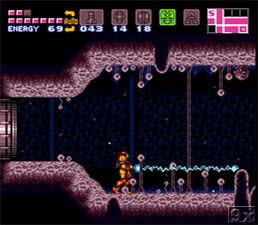 bigger and immersive games of the future, and even going against itself in the undeniably
great Metroid Prime in 2002, is quite a big feat for a game such as this.
bigger and immersive games of the future, and even going against itself in the undeniably
great Metroid Prime in 2002, is quite a big feat for a game such as this.
Super Metroid is just one of many of Nintendo's contributions to video game
history. They have proven time and again that they are still one of few companies
that can produce excellent titles that people will not only enjoy for the time being,
but for the future as well. In today's world where graphics and in-depth immersive
experiences reign, where your next game is as only as good as it looks, it's nice
to look back at games such as Super Metroid, to remind us of what gameplay in video
games was all about, and what right ingredients was needed to have a truly great
gaming experience.
Congratulations to Nintendo and Intelligent Systems on the 10th anniversary
of Super Metroid!