Two sisters stood in front of the iron door painted red, waiting for an answer. They were let in. We glimpsed trees and shell-finished steps leading into another door beyond. The iron door immediately closed after initial hugs and greetings between the visitors and the mysterious owners of the house beyond the iron door. Later, a plaque near the door was installed, "Sisters of the Madonna della Strada."
We schemed how to get inside the convent, but let it drop, since it was walled from all sides by a tall, hollow-block fence topped with barbed wires. We respected the convent's privacy, because if we tried to take an even longer peep, we'd get laughed at by everyone and we'd burn in hell for all eternity.
When one of us mentions that we are willing to find out if God is calling us to a religious life, we immediately scream one of two things:
"Oh wow!"
"Oh... really?"
We tend to scurry as far as we can from any mention of religious callings because it sounds like a death trap: No more loudness, crasness, or freedom; your every move must be monitored so that you don't give out the wrong signals.
"I can only see them doing stuff in church. Religious callings are like Masses and our YFC conferences -- a mass gathering of people," Elvin Tacdeo said.
Some images of religious -- the priesthood and sisterhood -- are of senior citizens teaching or preaching. Others have a symbolic image of "A man walking a narrow road into the horizon. I picture nuns or priests helping people. Religious callings mean sacrifice," said Jozel Villamayor.
Ever thought of becoming one of them?
"Without a lay community like you, I would never have become a priest," declared Fr. Mario at the 1999 SFC Conference in Chicago. "When I first entered the ballroom, I said, 'Wow! what Spirit!"
Recent allegations against priests have put the religious in awkward positions with often devastating consequences. Yet it seems that more young men and women are pursuing the religious life. In a recent study by Georgetown University's Center for Applied Research in the Apostolate, the number of graduate-level seminarians rose from 3,172 in 1995 to 3,483 in 2001. The number of Catholics rose as well -- from 46 million in 1965 to 60 million in 2001.
WHY JOIN THE RANKS?
Rene Recato is interested becoming a priest. "My reasons for thinking of the priesthood are mostly faith and spiritual, but also practical. Becoming a priest would also be a good way to recieve an awesome education -- a lot of orders will pay for your graduate studies. That's why it's so strict sometimes," he said.
Sr. Barbara Fiand says there should be only one reason for entering the religious life. At a recent conference at Loyola University Chicago she said, "Perhaps one of the most important points that needs to be made right at the start, therefore, and with absolute clarity, is that religious life does not exist for itself and that self-perpetuation as such is not, and ought never to be, our primary concern. Religious life and, for that matter, the Church of which it is an expression, exists for the sake of God's reign, for the purpose of extending the mission of Jesus. It exists for no other reason."
Before that could be the deciding aspect, much prayer needs to be said to at least get to know Jesus better. Committing to the religious is a lofty sacrifice -- something not to be taken lightly. Schooling alone would take at least 10 years. Time away from family is a given. While committment isn't necessarily forever, it is hoped that a person would stay in the religious all their days. With such high stakes, it's only understandable that one needs to know the Person to who he or she is giving their lives so overtly to.
As Fiand and others, the best way to show God their devotion is to become a sister, brother or priest.
DREAM JOB
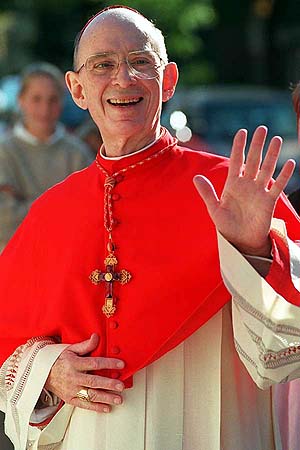
Yet for others, the religious life is where one's best desires are fulfilled. The late Joseph Cardinal Bernadin, archbishop of Chicago, wrote in his last memoir, "The Gift of Peace":
The summer after my freshman year, I became friends with a couple of young priests from my hometown parish. They took a great interest in me and eventually asked if I had ever thought about entering the priesthood. When I told them that I wanted to become a doctor, they approached the question a different way. They showed me that my interest in becoming a doctor indicated that I wanted to help people, to reach out to others. They proceeded to explain to me that I could also help people by being a priest.
I pondered what these young priests were telling me because I respected them. Almost instantly I decided to enter the seminary. My mother was concerned, of course, that my decision was perhaps too hasty. She also cautioned me that giving up my scholarship could be risky, and that if the seminary did not suit me I would not have anything to fall back on.
I decided to go anyway. God was calling me, and I had to listen. ... Time and again I found myself smiling to recognize that what those young priests had said about the priesthood was true: Through my work I was able to help people.
People look to priests to be authentic witnesses to God's active role in the world, to his love. They don't want us to be politicians or business managers; they are not interested in the petty conflicts that may show up in parish or diocesan life. Instead, people simply want us to be with them in the joys and sorrows of their lives. I understand that organization is important. The Church as a human institution needs a certain amount of administration. But structures can take on a life of their own and obscure the real work with people that priests should be doing. ... No matter how significant our other work might be, the people want something different from their clergy. Even if they are not committed to any specific religion, men and women everywhere have a deep desire to come into contact with the transcendent. Members of the clergy can facilitate this through the simple goodness they show in being with their people. The things people are naturally attracted to and remember most are small acts of concern and thoughtfulness. Years later, that is what they tell you about their priests and other clergy.
Joseph Cardinal Bernadin, "The Gift of Peace: Personal Reflections by Joseph Cardinal Bernardin." Archdiocese of Chicago. Loyola Press, Chicago, IL 1997.
Text from Vocations
Photos courtesy of Michael Keating of the Cincinnati Enquirer