THE EDUCATION OF ROSE DAWSON: PART I
Chapter Nine
Demonstration
After Rose returned to the
shelter, she saw the volunteers from Stuyvesant in the lobby taking a break
from the repair work. "Miss Dawson, it’s good to see you again," said
Mr. Word. "We’re almost finished with your room. Right now we’re about to
head for lunch. We’ll resume work after we eat."
"Thank you again, Mr. Word.
And thank you, Mr. Schwartz and Mr. Burkowski. I look forward to sleeping in
the room."
"You’re very welcome, milady,"
said Solomon in a mock gentleman’s accent as he curtsied in jest. "But
call me Solomon instead." The men laughed, and even Rose managed a bemused
grin.
"And call me John. You’re
quite the lady, Miss Dawson," said John.
Believe me, I was.
Solomon, however, was not
finished with his jibes. "Have you caught anything with your hat, Miss
Dawson?"
"I beg your pardon?"
Solomon pointed at the plumes
that adorned Rose’s hat. "Those feathers on your hat look big enough to
catch flies or knock down a man." He winked at John, who smirked in
approval.
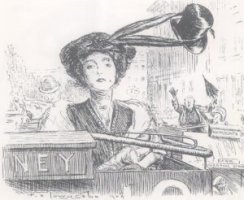
A situation similar to what Solomon had in mind
Rose remained calm, but gaped
down at Solomon, who was three inches shorter than she. "My hat only has
three feathers. I got it from this shelter. I do believe you have seen hats
with even more elaborate decorations."
"I have," said Solomon,
still in a lighthearted mood. "Some of ‘em look like fruit baskets or
flower beds. If I wanted to help myself to some, the wearer wouldn’t even
notice." John could barely contain his laughter as his friend spoke, while
Mr. Word shook his head.
I am dealing with a couple of
clowns. "Thank you,
gentlemen, for your keen interest in women’s headwear," she said, trying
hard not to look visibly aggravated. The finishing school training she received
was working even though she was using it in a situation she could not have
foreseen.
"This is the first time
anyone’s called me a gentleman," said Solomon, feigning a strut and
jutting his chin upwards. "Now, all I need is a top hat!"
It would certainly make you
look taller.
"Miss Dawson’s just being
polite, boys," said Mr. Word, trying to put an end to the nonsense.
"I think we can learn something from her flawless etiquette." He
smiled at Rose before lowering his voice. "I hope you don’t mind me saying
this, Miss Dawson, but Brigadier Bown briefed me about your experience. Please
stop me if you don’t want me to go on."
"You may continue, Mr.
Word."
"Thank you. I am impressed
by how well you have managed to cope with it. You seem to have resumed a normal
life just two days after you’ve returned to New York."
"You are not the first
person to tell me that, Mr. Word. But to be honest, it has not been as easy for
me as it looks. I still have many things to overcome before I can return to a
normal life, although I doubt that things could ever be the way they were
before the incident."
"That’s true. People’s lives
have been altered forever. Many problems were exposed by the sinking, like
faulty bulkheads and faulty regulations, and…"
And faulty egos.
"…those with the power to do
something to correct them would best do so soon, or we will never learn from
this tragedy," concluded Mr. Word.
Solomon and John, who had been
listening to the conversation intently, decided to join in. "I say the
arrangement of the bulkheads is to blame," said Solomon. "If they’d
been better arranged, the flooding could’ve been limited to only a small part
of the ship, and it would’ve stayed afloat. But they’d have to keep the
watertight doors shut, too."
"Fat chance," countered
John. "More lifeboats would be better. That’s what a naval engineer said
in today’s New York Times."
"The boys love big
ships," explained Mr. Word, "and they’ve been following the Titanic
even before it sailed. I remind them to be respectful of people’s feelings when
they discuss it in public."
"Boys will be boys,"
Rose murmured as she gave Solomon and John a respectful, but somber, look.
"I would’ve liked to travel
on either ship," said John. "The papers were running advertisements
for both at the start of this month. Now, it’s only for the Olympic."
So Miss Howard was right about
the advertisements.
"So, Miss Dawson,"
inquired Solomon with a slight air of self-assurance. "What do you think?
More bulkheads or lifeboats?"
"How about more hearts and
brains first?" retorted Rose.
"Huh?"
All right. Here is my chance
to recount the tragedy again…and to conquer my fears. "I had two chances to board a
lifeboat before the ship sank. The first time was on one of the larger boats
that could hold sixty-five people, but mine was only half-filled when they
lowered it. There were fourteen lifeboats of this type, and most of them were
not filled to capacity, some of them not by half. I know this because I saw
them." Rose felt the emotions building up inside her as she spoke, but
managed to keep them under control.
She continued: "The second
time I could have boarded one of the smaller boats that could hold thirty-five
people each. But I counted only twenty-five in this one before they lowered
it." The boys and Mr. Word were transfixed by her story, so she stopped to
let them digest some of it.
Solomon was incredulous.
"Why didn’t you board either lifeboat?" he asked half-accusingly.
Rose glared at him. "They
were only allowing women and children on. I had men in my family. How could I
leave them behind?" she asked calmly, but in a tone that hinted at
annoyance with his question. "They wanted me to get on, but I was
determined to sink or swim together." She became so focused on and
passionate about the conversation that she failed to notice others gathering
around just to hear a first person account of the sinking.
"And that’s what you
did," deduced Solomon, who felt a little guilty for his knee-jerk
reaction.
"Right. The third time I was
pulled out of the water by the only lifeboat that came back," said Rose as
she picked up the pace. "One lifeboat out of twenty. As I said
before, the fourteen larger lifeboats could each hold sixty-five people. That
would be nine hundred ten people. The two smaller lifeboats could each hold
thirty-five, so that would be seventy people. The four collapsibles could each
hold fifty people, so that makes two hundred. Altogether, they could have
carried one thousand, one hundred eighty people, and perhaps a few more."
Rose spoke so quickly that she had to stop to catch her breath.
"Y-yes, that’s just about
right," said Solomon, who was almost too speechless to reply.
"I counted only five other
people who were saved from the water. Not all of them survived. There were just
over two thousand, two hundred people on board Titanic. If almost
sixteen hundred of them are now missing, as yesterday’s newspaper stated–for I
have not read today’s–then that means just over six hundred people boarded the
lifeboats, which would be only half their total capacity. Yet, only one boat
came back, and by that time almost everybody in the water had frozen to
death." Including Jack.
Rose’s minuscule tally of the
number of people rescued from the water stunned those around her into silence
for a while. "That does explain the lack of heart," Mr. Word finally
said.
Rose nodded slightly in agreement
and let out a sigh of relief. It was then that she sensed the small audience
she had attracted, but she did not care.
"So how did you escape
freezing, Miss Dawson?" asked John.
"I was most fortunate to
have found a large piece of wood floating nearby. I climbed on it and lay there
until help arrived." Good, I did not mention Jack.
"How about your family?"
asked Solomon, who immediately regretted allowing the question to leave his
mouth.
"I am the only one
left," replied Rose unhesitatingly. She closed her eyes to hold back the
tears, but the dam held this time. Upon hearing those six words, some in the audience
gasped, and a few even shed tears. Then more silence followed as everyone
waited uneasily for someone to break it.
"Those in charge of the
other nineteen lifeboats were either too afraid or too selfish to return and
save even one more life each," conjectured Mr. Word.
"Probably less than
nineteen, Mr. Word," John reminded him. "The surviving wireless
operator said in the Times yesterday that he was on an overturned
lifeboat. Then there was a collapsible that had filled up with water. And one
boat already had seventy people on board. So these three couldn’t have gone
back even if they wanted to. But there were still sixteen other lifeboats that
could have gone back, so that’s why I think more lifeboats are the
answer," he said in a restrained manner out of respect for Rose, although
he still looked somewhat triumphantly at Solomon.
"More lifeboats don’t mean
anything if the ship carelessly sails into an ice field. That’s what Andrew
Carnegie said yesterday in a letter to Mayor Gaynor," said Solomon, trying
to salvage something after losing the debate, although he looked at Rose
uneasily as he spoke.
"Yes, but neither do more
bulkheads," John shot back.
"Then perhaps avoiding the
iceberg altogether is the best solution," said Mr. Word, attempting to make
peace. "Would you agree, Miss Dawson?"
"Possibly. I was there when
Captain Smith was warned of icebergs by the wireless operator. Instead, he
increased speed," said Rose.
"The papers said something
about that two days ago," said John. "I think that’s what you meant
by brains."
"Or the lack of it,"
suggested Mr. Word. "This shows that technology is only as good as its
user. There are limits to it, and we misuse it at our own peril."
Everyone nodded in agreement.
Rose was relieved. I did it. I
talked about my experience on the Titanic without crying.
*****
It was getting close to noon, and
Mr. Word sent Solomon and John off to lunch while he had a final word with
Rose. "That was a remarkable presentation you put on, Miss Dawson. I hope you
were not offended by the boys. They meant no harm. As you could see, they tend
to see the world from a scientific and technological point of view and overlook
the human element."
"I understand perfectly, Mr.
Word. But now we know there are limits to the first two."
"I’ve known that for some
time, even though I teach a subject that directly relates to technology. My
students see science as a ticket out of poverty because many of them come from
families with limited means, and that’s understandable. But I fear that too
much focus has been put on technology over that put on people. That’s what
happened with the Titanic."
"I could not have said it
better myself," concurred Rose. Jack was the opposite. He saw things
science cannot create, like people, love, and friendship.
"I’m also impressed by how
quickly you broke down the capacity of the lifeboats, Miss Dawson. Did you perform
the calculations yourself?"
"Yes, I did. Thomas Andrews,
the ship’s designer, even confirmed them."
"You met Thomas Andrews on
board? That must have been a memorable encounter. Didn’t he travel in First
Class?" Mr. Word then realized his gaffe and apologized. "Sorry, I
hope you’re not offended by my insinuation."
"No, I was not. Yes, Mr.
Andrews traveled in First Class, but he was very proud of his ship, and he
tried to inspect every part of it during the sailing to make sure they all
worked. So he had no problem socializing with those of us outside of First
Class." There. I did not tell the whole truth about my relationship
with Mr. Andrews, but neither did I lie.
"But he’s now listed as
missing. I wonder if he went down with the ship."
Upon hearing these words, Rose’s
eyes became downcast. Sadly, he did.
Mr. Word realized the sensitivity
of his remarks. "I think I know the answer to that already," he
lamented. "And I’m sorry again, Miss Dawson. That was an impressive
demonstration of your math proficiency. You would have made a fine student at
Stuyvesant if they admitted girls."
Rose looked back up. "Even
if they did so tomorrow, it would be too late for me."
"Unfortunately, you’re
right. But I think they will eventually. Somewhere in this city may live a
future Marie Curie or Elizabeth Blackwell, and we’ll miss her if we never give her
a chance."
"I have heard of Madam
Curie, but who is Madam Blackwell?"
"Why, she’s the first woman
to become a physician in this country, and for that, she was scorned by many,
including other women. She had to patiently and painfully win the public’s
trust, and eventually she did. She opened the hospital that’s next to
Stuyvesant to serve poor women and children, and she lived to a very old
age–dying only two years ago."
Mr. Word is quite a
progressive. "That
is very interesting…and encouraging to know. But at least this shelter and the
Army are run by women."
"Yes, Brigadier Bown has
done a lot for women in this city. That’s why I couldn’t refuse when she asked
us to help at the shelter. And Commander Booth has demonstrated strong
leadership qualities in the eight years she’s been here. Her response to the
earthquake in San Francisco six years ago was excellent, and it appears she’s
repeating her feat with the Titanic survivors."
"Did someone call me?"
asked a familiar voice. It was Commander Booth making a grand entrance into the
shelter.
"Good afternoon,
Commander," said Mr. Word.
"Hello again, Madam
Booth," said Rose. "Mr. Word and I have been getting
acquainted."
"Quite nicely, as I can see.
How are you today, Miss Dawson?"
"Better than yesterday, I
hope."
"Definitely better than
yesterday, I’m sure," said Mr. Word. "Miss Dawson’s recuperative
skills have been amazing. Do you know that she’s also quite a mathematician,
Commander?"
"No, but I would not be
surprised," said Commander Booth, eyeing Rose with approval. "Miss
Dawson is an unpretentious young woman. She has many gifts we have not seen
yet."
Rose blushed at the compliment. I
hope you are right, Madam Booth.
"Well, she’s already touched
the people around her with the gifts she’s chosen to display," said Mr.
Word. He checked his pocket watch. "I must be joining my students for
lunch now, ladies. It was a pleasure talking to you both. We’ll be back after
lunch." He gave Rose’s hand a firm shake, and did the same with Commander
Booth’s.
"The pleasure is mutual, Mr.
Word," said Rose. "I will see you in the afternoon."