THE EDUCATION OF ROSE DAWSON: PART I
Chapter Four
Orientation
"I have something else for
you," announced Cadet Hill, who had returned to the dining hall, with Miss
Howard in tow, to check up on Rose as she finished her breakfast. "Please
wait in the lobby for me."
Rose did as Cadet Hill requested,
and once Cadet Hill had Miss Howard seated and eating breakfast, she returned
to the lobby and produced a packet. "We’ve collected donations from many
people and organizations for the survivors. Right now we can distribute to each
survivor twenty-five dollars." She produced a ten dollar bill, two five
dollar bills, two one dollar bills, eight quarters, five dimes, and ten
nickels. "I hope you can hold it all," she joked, as she put the
coins into a change purse, clipped the bills, and handed both to Rose.
Of course I can, thought Rose, as she carefully
put the money into one of the pockets of Cal’s jacket. Twenty-five dollars was nothing compared to
the amounts she had seen members of her former circle of family and friends
carry and sometimes literally throw around. Cal sometimes tipped that much if
he bought something expensive and wanted to further flaunt his wealth. Even
Rose was carrying more–a lot more–than twenty-five dollars at that moment, not
counting the Heart of the Ocean. There. They will be safe inside this
jacket.
"Miss Dawson, if I may so
inquire, are you American? Your accent doesn’t sound like that of an
immigrant," observed Cadet Hill.
"You are right, Miss Hill. I
am from Pennsylvania. I had gone to Europe with my family, and we were on our
way back to this country when…" Rose could not finish her sentence.
"I’m sorry. I should
apologize for asking that question." Cadet Hill took Rose by the hand and
waist to steady her in case she broke down.
"I am all right, Miss Hill.
Thank you for your concern." Rose then changed the subject. "So, Miss
Hill, how did you become involved in the Salvation Army?"
"I’m from Canada. Commander
Booth became head of the Army there when I was very little. It didn’t have a
major presence in Canada before she arrived, but she expanded it by appealing
to more people, my family among them. From the moment I met her I knew I wanted
to be a part of the Army. She was so good she became commander of the Army here
eight years ago. Once I became old enough, I came south to join her. Now I’ve
been at the shelter for half a year."
"Madam Booth must have made
quite an impression on you for you to want to leave Canada to enroll in the
Army here."
"She did. She has an uncanny
ability to touch the rich and the poor alike, and that’s how she has been able
to enhance the Army’s status in this country. I only hope I can be even half as
good as her in this respect."
"Well, Miss Hill, you have
won my admiration already," said Rose, who saw that Miss Howard had
finished breakfast and was joining them in the lobby. "And probably Miss
Howard’s, too."
Cadet Hill turned around and
spotted Miss Howard coming towards them. "I hope you ate well, Miss
Howard."
"The food was great, Miss
Hill. Were you discussing me?"
"I was telling Miss Hill how
grateful you are for her help, Miss Howard." Rose winked.
"Oh, absolutely, Miss Hill!
You’ve been an angel."
Cadet Hill blushed at the praise.
"Thank you. That makes my job all the more worthwhile."
"Please keep up the good
work," said Miss Howard. "We depend on people like you."
"I will. Now, ladies,
Brigadier Bown would like to speak with both of you in her office. Please
follow me."
*****
Cadet Hill led Miss Howard and
Rose to Brigadier Bown’s office, which was a small, well-lit room with a desk
and three chairs. "Good morning, ladies," greeted Brigadier Bown.
"Please take a seat. I assume you’ve had breakfast already. I hope you
both slept comfortably last night. Again, I must apologize for the
inconvenience of placing you in the corridor."
"The bed was comfortable,
Madam Bown," said Miss Howard. "And the food was delicious. We’re
very grateful for the Army’s help." Rose nodded in agreement.
"I’m happy to hear
that," said Brigadier Bown. "The purpose of this meeting is to tell
you a little about this shelter. The Women’s Rescue Home has sheltered
destitute women for twenty years. Now we open our doors to some of the women
who survived the Titanic disaster. Since you are the shelter’s newest
guests, could you begin by telling me something about yourselves and your final
destinations?" She looked at Miss Howard. "Why don’t we start with
you?"
Miss Howard nervously cleared her
throat before commencing. "My name is May Elizabeth Howard. I’m twenty-six
years old. Bred and born in North Walsham, England. I came to work as a maid in Canada, but now I may join
my sister in Northern New York."
"A pleasure to meet you,
Miss Howard," greeted Brigadier Bown. She then turned to Rose.
Rose thought quickly about what
she had to say. "My name is Rose Dawson. I am seventeen years old. My
family and I lived in Philadelphia before we went to Europe to attend a
relative’s wedding. I am the only survivor of the sinking, and since I have no
other family in this country, New York is my home for now." The words came
out of her mouth more casually than was normally expected for someone who had
lost so much so recently. I lied. I had no choice.
"Oh," muttered
Brigadier Bown, looking a bit stunned, as was Miss Howard. "I’m so sorry
to hear that, Miss Dawson. My condolences go out to you and your family. I’m
sure they’re in Heaven right now looking over you."
"Thank you, Madam Bown, and
you do not have to apologize for anything," said Rose, trying hard to hold
her emotions in. "I will need time to mourn for my family, but I think I
am stronger now, and I will make each day of my life count–for myself and for
them."
"And I think you’ll succeed,
Miss Dawson. You are holding up extremely well, given the loss you’ve
sustained," said Brigadier Bown. "Now, Miss Howard, you said that you
may join your sister in Northern New York, or what we call Upstate New York. Do
you know exactly where she lives and have you contacted her?"
"I’m not sure which town or
city she lives in, but I can send my brother in Canada a telegram, and he may
contact her. Can you help me with that?"
"We certainly can, Miss Howard.
You can ask any of our staff for assistance when you’re ready to send a
message."
"Madam Bown, if I may ask,
how long will we be allowed to stay here, and how much will we have to
compensate the shelter?" queried Rose.
Brigadier Bown gave her a reassuring
smile. "I was just about to discuss that. God would never let us charge
those who’ve suffered so much. You and all the other survivors may stay without
charge until you’ve recovered enough to move on. Don’t worry about compensating
us. It’s our duty to help those in need. Besides, there’s been such an
outpouring of donations since the sinking that you’re almost being paid to stay
here."
"It is really good to know
that there are still people who care," said Rose.
"As long as there’s a God,
there will always be people who care," said Brigadier Bown without
sounding sanctimonious. "However, we ask that our guests refrain from
smoking and drinking, especially the latter. The Army has a strong policy
against alcohol."
Rose and Miss Howard nodded to
indicate their acceptance of this policy. I have not smoked or tippled since
the steerage party, thought a relieved Rose. Yet I
do not crave it like I thought I would.
Brigadier Bown seemed satisfied
with their understanding of the rule. "So, what do the two of you have
planned for the rest of the day? We have some religious activities for our
other guests, and you are welcome to join them."
"I think I want to explore
the city," said Rose. "It has been some time since I have taken a
long walk on dry land." The three of them grinned at that comment. "I
did it with a proper escort in the past, but I want to try it myself
today."
"That should be a good
experience for you, Miss Dawson," said Brigadier Bown.
"Miss Dawson, do you mind if
I join you?" asked Miss Howard. "I wouldn’t mind seeing a little bit
of the city before I leave."
Rose was actually warm to the
idea. On the Carpathia, she found that assisting another survivor in
greater need helped take her mind away from her own agony, even if only
temporarily. Perhaps it would work in New York, too. "I would be happy for
some company, Miss Howard."
"Thank you, Miss Dawson. I
truly appreciate that."
"You’re welcome."
"It remains cool today, with
the possibility of rain," said Brigadier Bown. "I can ask my staff to
get you something for your trip." She concluded the meeting and led Rose
and Miss Howard back out to the lobby, where they saw Cadet Hill. "Cadet
Hill, can you kindly find a couple of hats and umbrellas for Miss Dawson and Miss
Howard? They plan to go outside."
"Yes, Brigadier Bown."
Cadet Hill went off and returned two minutes later with two used wide-brimmed
straw hats and umbrellas. "Please try on the hats to see if they
fit."
Rose had not worn a hat since she
boarded Titanic at Southampton, but she willingly tried on hers. It was
a dark blue "Merry Widow" style hat similar to the type Mrs. Brown
had worn on board Titanic, with minimum trimming and some plumage still
attached. It fitted almost perfectly. Slightly old-fashioned, but that is
all right. "Thank you, Miss Hill."
"My pleasure, Miss
Dawson."
"Mine is a little
tight," commented Miss Howard. "But I’m not that fond of hats. Would
you have a bonnet, like the ones you wear?"
"Let’s see what I can dig
up," said Cadet Hill. She went off again and returned with a spare blue
bonnet. This one fitted Miss Howard better. "Thank you again for your
help, Miss Hill," said Miss Howard.
"I also have some money for
you, Miss Howard." Cadet Hill gave her the same amount she had given Rose.
"These funds were donated to us to provide relief for the Titanic
survivors."
"Is this a lot of
money?" Miss Howard asked Rose, as she held U.S. currency for the first
time.
More than most people earn in
a week. "It can be
if you spend it wisely," said Cadet Hill.
"Oh, I’m very thrifty,"
said Miss Howard. "I think I’ll save most of it. Thank you, Miss
Hill."
"Always at your
service," said Cadet Hill. "We may have more on the way." She
looked at the clock. "I’ll let you two go now. Just in case you get hungry
and want to return to the shelter to eat, our dinner service starts at one PM
and supper at six PM."
"That sounds
wonderful," said Miss Howard.
"Enjoy your tour of the
city."
"Yes, we will," said
Rose. "Thanks again." They bade Cadet Hill farewell, and stepped out
onto the street.
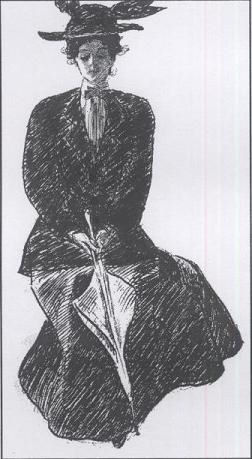
Rose wearing her donated clothes along with Cal’s jacket
*****
For the first time since that day
in Southampton, Rose and Miss Howard were on terra firma when the sun was out,
although the sky was overcast. They walked one block south on Second Avenue and
then turned west on 14th Street. It was just past 9:30 AM on Friday,
April 19, 1912.
Miss Howard was almost
immediately impressed by the sheer numbers of people and stone that surrounded
her on four sides. "We don’t have this many people in North Walsham,"
she said. "Nor as many tall buildings."
"Where is North Walsham,
Miss Howard?"
"Oh, tucked away in a nice,
little, quiet part of England," said Miss Howard merrily. "In
Norfolk, actually. Do you know Lord Nelson? He was our most famous
resident."
"Nelson? Is he the gentleman
who has a statue in Trafal—"
"Trafalgar Square in
London," interrupted Miss Howard, as she finished the sentence for Rose.
"Have you been to London before?"
"Yes, I have. My most recent
trip there was two weeks ago, right before I went to Southampton with my family
to…" Rose cut short her reply.
"Sorry, Miss Dawson,"
said Miss Howard, as she changed the subject back to Nelson. "I’ve only
been to London once–to see the statue. They say he was a great war hero, but I
never knew how war makes a man great…or gentle."
Or full of adventure, thought Rose, remembering what Angus had
told Jack.
"It must be something only
men understand," said Miss Howard. "I couldn’t look Lord Nelson in
the eye. The column holding up his statue is too tall."
"It must be the male preoccupation
with size," suggested Rose, evoking her reproach to J. Bruce Ismay.
"They build enormous monuments to make up for a personal deficiency."
When Miss Howard seemed a little confused upon hearing this, Rose held her left
thumb and index finger just an inch apart to signify the offending part of the
male anatomy. The two of them laughed at this witticism.
*****
They eventually found themselves
amid the bustle of the city. The morning rush hour was about to end. Most
people were already at work, while a few were still getting there on foot,
horse, trolley, and the increasingly common automobile. But the big story of
the day–none other than Titanic–made more than a few halt their daily
routines and scramble for copies of the city’s major newspapers, which were
quickly snapped up from the paper boys who sold them. Many copies had more than
one pair of probing eyes poring over them, with the illiterate relying on the
pictures in the papers and the patience of the educated to learn all they
could. For these folk, life could wait as they satisfied their appetites on all
the news that was fit to print on the disaster.
Both Rose and Miss Howard clearly
noticed the attention paid to Titanic, but reacted to it in different
ways. While Miss Howard showed a bit of curiosity about what the press was
saying, Rose tried to detach herself from this phenomenon by politely weaving
her way around the news seekers on each block, trying hard not to get caught up
in their reactions to the tragedy, while making sure that Miss Howard was close
by. It was too soon for her to face up to the matter in its entirety. Fearing
the chance that her picture was in the papers, she lowered the brim of her hat
to avoid recognition. She knew the sinking was not her fault, but she felt the weight
of it on her shoulders.
The rumble of a train along the
Third Avenue elevated tracks above jolted her, momentarily upsetting her gait.
The noise, which contrasted brutally with the ding-ding and clang-clang of the
trolleys, was a chilling reminder of Titanic’s final seconds above
water, when only her stern remained, and the immediate aftermath. Hundreds of
people, Jack and herself among them, desperately stayed on the ship for as long
as they could to avoid being dragged under the water by the ship’s mass, a
process comparable to being flushed down a toilet. But the suction was not as
powerful as feared, and was certainly not as haunting as the screams of some
fifteen hundred other souls flailing in the water.
Rose had to pause to regain her
composure. Stop it, Rose! You have just as much right to live as any
survivor. Then she continued to walk west with Miss Howard, who could see
that she was acting strangely.
"Miss Dawson, are you all
right?"
The two of them stopped in the
middle of the sidewalk. "Yes, Miss Howard. You do not have to worry about
me."
"Are you sure? Do you need
to return to the shelter?"
Rose knew that Miss Howard could
see through her weak lie, but did not want to disappoint her by turning back.
Moreover, she needed to immerse herself in her new life instead of dwelling too
much on the tragedy. But signs of it were too visible as they walked down the
street.
They neared Union Square, where
traffic was heavy. As they crossed Union Square East to reach Union Square
Park, minding traffic in both directions, Rose inadvertently walked into
something that felt mushy. She looked down and discovered, to her horror, that
she had stepped on a big piece of horse manure! She was shocked.
Miss Howard, who managed to avoid
the manure, steadied her. "Let’s see if you can wash that off in the park.
If you can’t, then tread on the grass." She slowly walked with Rose, whose
face had become as red as her hair, into the park. Fortunately for Rose, most
people were focused more on news about Titanic than on her embarrassing
encounter with one of nature’s callings. Most people, that is, except one.
A loud guffaw coming from their
left made them turn their heads in that direction. On one of the benches, a
tall, elderly man with white hair and a scraggly face that could use a shave
sat there doubled up in laughter, which was obviously directed at Rose. He was
ruggedly dressed with an athletic build. Next to him was an elderly woman who,
although amused at Rose’s misfortune, was also hitting the man lightly to get
him to stop, but he found the event too funny to silence himself.
"Cheeky bastard!" shot
back Miss Howard. The man did not seem to hear her, although he sensed her
displeasure when he saw her shake her umbrella at him. His companion, however,
was taken aback by her boldness.
"The nerve of some
people!" Miss Howard grumbled as she walked off with Rose, who was still
speechless. They located a fountain, but had nothing with which to scoop some
water up to rinse the manure off Rose’s shoe. It would be too inconsiderate of
her to dip her shoe into the fountain, so Miss Howard was prepared to wet a
handkerchief and sacrifice it to wipe the manure off when a hand stopped her.
It was the elderly man’s female
companion. Standing fully erect, she was a little taller than Rose, with long,
slender fingers and a slim build, but one that had probably been honed on not a
little physical activity. She had a long horizontal scar on her neck and held a
metal canteen, which she offered to Miss Howard. "Fill it with water and
pour it on the shoe. Anything you can’t wash off you can wipe off on the
grass."
Miss Howard already knew what to
do. She filled the canteen with water, walked Rose over to a bench, had her
take off the dirty shoe, and rinsed the shoe over the grass. Most of the manure
came off. She put the shoe back on Rose’s foot and told Rose to trample the
grass for a while to rub off the rest.
For Rose, such was a disadvantage
of not being properly chaperoned. As Rose DeWitt Bukater, she mainly walked
those streets frequented by the rich, and they tended to be cleaner. On the
rare occasion in which she walked through a less affluent neighborhood, her
escort would help her navigate the streets so that she would never cross paths
with any type of refuse. Now she had to learn the hard way how to cross a busy
street without getting into trouble.
"One more thing. Make sure
the bottom of her dress hasn’t touched the manure," instructed the elderly
woman. "You don’t want to take that home with you."
Miss Howard thoroughly examined
the bottom of Rose’s dress, found that it had been spared, and returned the
canteen to the elderly woman. "Thank you, madam. That was one heavy
jug."
"Thank you," echoed
Rose, finally coming out of the shock from the incident. Her resolve was
already shaken by news of Titanic, the noise generated by the train, and
now this incident. She sat back down on the bench and took off her hat to
compose herself.
"My pleasure," said the
elderly woman. "It’s heavy because I use it for protection, as well as for
drinking," she explained with a smile to a confused Miss Howard. "And
second, please don’t call me madam. I’m not that old. Just call me Jenny. And
you are…"
"May Howard."
"Rose Dawson."
"Nice to meet you. Please
forgive my husband for his behavior," added Jenny, shaking their hands.
"Sometimes he enjoys acting cruel and heartless, but he hardly ever means
it."
"So that’s your husband.
Well, I’m sorry I had some harsh words for him," said Miss Howard with
some reluctance.
"Don’t worry about that.
He’s been treated far, far worse." Her eyes were fixed on Rose’s hair,
although Rose did not notice. "New to New York, I presume?" asked
Jenny.
"I am," replied Miss
Howard. "But Miss Dawson has been here before. She was nice enough to go
with me today." They both looked at Rose, who seemed to have trouble
regaining her poise.
"Are you all right,
Rose?" asked Jenny, reaching out to hold her hand.
Rose, still disturbed, collected
herself before responding. "I think I will be," she said meekly.
"Where are you girls
headed?"
"Just sightseeing around the
city," said Miss Howard.
"Well, it seems we’re the
only people who aren’t paying attention to the big news story of the day,"
said Jenny. "The streets have been jammed with people hungry for the
latest news on the sinking since Monday."
Miss Howard looked at Rose, and
was tempted to tell Jenny just how personal the big news story was to them, but
hesitated for fear that she would further dampen Rose’s mood.
Rose got up. "I think we
must be moving along," she said. "Thank you once again, Jenny."
"Yes, thank you for your
help, Jenny," said Miss Howard as she followed Rose.
"Glad to be of help, girls.
Walk safely, and I hope we meet again." Jenny watched Rose and Miss Howard
continue west. Then she walked back to her husband, who was still smiling about
the incident.
"Such a fine prim, the
redhead," he commented.
"You noticed her hair color
from that far away?"
"My eyes ain’t as bad as you
think, darling." He looked at her affectionately. "It reminds me of
someone’s from a long time ago."
Jenny rolled her eyes at her
husband’s remark. "I think we’ll see her again," she told him.
"Oh, I’m sure you
will," he surmised, as he rubbed the medallion around his neck.
*****

Union Square circa 1912
Rose and Miss Howard resumed
their walk down 14th Street. When Rose was younger, she had come to
14th Street and vicinity, among other places, to shop with her family.
That was when some of New York’s most well-known merchants, among them Tiffany & Co., were still located in the area. But even
then, the city center had been moving north for some time, and many merchants
followed it, as did wealthy patrons like the Bukaters. By 1912, Union Square
had been replaced by sweatshops, bargain retailers, pubs, and cheap
entertainment establishments like vaudeville, burlesque, penny arcades, and
nickelodeons.
It does look different in the
daytime, thought Rose,
who had been driven down 14th Street the previous evening after
being picked up at the pier by the SA. Her thoughts were interrupted by a
request from Miss Howard.
"Miss Dawson, if you’re
feeling better, I was wondering if we could take a ride on one of those trains
traveling above us," she proposed, as they approached the elevated tracks
of the Sixth Avenue El. "I’ve never been on one in England, not even the
one in London. It’ll be nice to get on one before I leave the city."
Rose contemplated Miss Howard’s
request for a moment. As a young girl, she would always yearn to ride in one of
the cars of the elevated fleet whenever she came to New York. She had taken
trains that traveled between cities (like Philadelphia and New York), but the
sight of trains snaking their way through the concrete canyons of a large city
captivated her. When New York’s first major underground commuter railway opened
less than ten years earlier, her interest in rail only intensified. Now it was
a train that burrowed its way below the surface with scarcely a notice from
those above it. Rose had a special affinity for anything, be it a train or a
roller coaster, which ran on a set of metal banisters that sometimes twisted
and turned and never seemed to end. But every single time she was deterred from
pursuing this interest on her own by her mother.
Not this time.
This time she was free from her
mother’s domineering influence. But, as luck would have it, her experience on
the sinking Titanic had unsettled her, and this was exacerbated by the
passing of the train earlier on the Third Avenue El. Her best opportunity yet
to ride the train without being supervised was about to pass, unless…
…unless she conquered her fears.
"All right, Miss Howard. I
have never taken them myself, so it would be a new experience for both of us.
Do you want to stay above ground or go underground? We passed the entrance to the
subway station already, and the elevated station is to the west."
"Let’s stay above ground.
Where are the well-off areas of New York? I’d like to see them."
This was something with which
Rose was familiar. "That would be farther uptown," she said, mindful
of returning to one of her old haunts. But she agreed to have Miss Howard
accompany her on this trip, so she saw it as her duty to be a good guide. They
ascended the steps to the Sixth Avenue El’s 14th Street station,
where Rose checked the system map to see where they had to get off. Then
they each paid five cents for their tickets and waited on the platform for the
train. When it came, Rose braced herself for its rumble and then the screech of
its brakes by covering her ears, as did Miss Howard—the train was that loud.
It’s interior was mercifully quieter, and its seats were reasonably
comfortable. As on the street, many passengers were riveted to news of Titanic’s
sinking, but Rose and Miss Howard passed the time by looking out the windows.

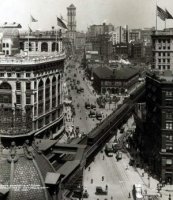
Sixth Avenue El passing through Herald Square
The ride north was scenic, with
Rose noticing the demographics of the city changing as they headed north. The
Ladies’ Mile, Herald Square, and Times Square–each locality was fresher in her
memory than the last. Looking out the window, Rose noticed that Macy’s off
Herald Square seemed to be closed, as the block on which it was situated was
quieter than normal. She deduced that something terrible had happened to Mr.
and Mrs. Isador Straus, who owned the department store. On the Carpathia,
she had heard rumors that some First Class women refused to board the lifeboats
in order to stay with their husbands, and that was probably what Mrs. Straus
did. That was what I did–until Jack taught me to live. But I admire your
stance, Mrs. Straus. You jump, I jump. You stay, I stay. May you rest in peace
with your husband.
The five-stop journey to 42nd
Street was quick and efficient. Rose and Miss Howard exited the train and
station to find themselves near the city center, with Bryant Park and the new
public library among the first landmarks they encountered. This part of the
city was undeniably grander than 14th Street. They headed east.