THE EDUCATION OF ROSE DAWSON: PART I
Chapter Five
Recollection
Rose and Miss Howard turned north
once 42nd Street crossed Fifth Avenue. This part of town was the
city’s most exclusive retail district, and it showed in the people who were on the
street. But even these denizens shared something in common with their less
affluent counterparts farther south–they, too, were discussing Titanic.
Normally, they would be checking the papers for news that pertained most to
them–like the stock reports and society pages. A shipwreck would not usually
draw their attention, since its victims tended to be members of the bottom
rungs of the social ladder. But today was different. As far as anyone knew, no
other shipwreck in recent memory, if ever, had killed so many rich people as
that of Titanic.
"They’re reading about the Titanic,
too," whispered Miss Howard. "That’s touched everyone."
It certainly has. Rose studied the faces of her former
social peers as she passed them, worried that some of them would recognize her.
She soon realized that they showed as much grief and concern as anyone.
"The sea can’t tell apart
the prince from the pauper," Miss Howard indicated.
The Prince and the Pauper? One
of Mark Twain’s books? How right you are, thought Rose, who could not resist adding her own observation.
"Death comes equally to everyone, unless you want a bigger funeral and
tombstone." It was a perverse belief, but Rose could not help herself.
Miss Howard was complimentary.
"Well said, Miss Dawson."
After walking north for two
blocks, Rose stopped to reminisce about this part of town. She had come here
every time she came to New York with her parents when she was younger, and more
recently when Cal tried to court her. But a chaperone or chauffeured limousine
had always been provided. On her first full day in New York as Rose Dawson, she
was rediscovering a part of the city that she knew almost by heart. This was 44th
Street and Fifth Avenue, on one corner of which was located one of her favorite
eating establishments. It had been there for as long as she could remember. She
prepared to cross Fifth Avenue to get a closer look at it. Now that cars were
just as numerous as horses in New York, if not more so, pedestrians required
the assistance of the police to help them cross busy streets, and Fifth Avenue
was one of them. The good thing about this part of the city is that there
are always policemen to help you cross the street. And more street
cleaners, too. If they cannot protect the masters of the universe from the
hazards of the streets, they cannot protect anyone.
All traffic came to a full stop
as a policeman stood in the middle of the street directing pedestrians, Rose
and Miss Howard among them, to cross. When they arrived on the other side, Rose
led Miss Howard to the front of the entrance of this establishment and they
both gazed inside. Delmonico’s looked as splendid as ever. If there was one thing Rose missed
about being rich, dining at Delmonico’s was it. Connoisseurs of fine dining had
dubbed it "America’s First Restaurant," and it deserved the accolade,
as far as Rose was concerned. Sherry’s diagonally across the street and the
Waldorf farther down Fifth Avenue were formidable competitors, but they still
were not Delmonico’s. Service here was impeccable, and as for menus, the one
for Delmonico’s was encyclopedic. Anybody who was anybody in those days had to
have dined at Delmonico’s at least once.
Now, Rose could only stand
outside looking in with Miss Howard, whose eyes lit up once she saw the
interior. "Cor blarst me!" she exclaimed in her Norfolk dialect. "Have
you eaten here before, Miss Dawson?"
Rose offered a playful and
ambiguous reply. "Do you suppose I could afford to eat here, Miss
Howard?" she said with a grin. "But it is nice to stop and look
inside every time I walk up Fifth Avenue. This must be the finest restaurant in
the city." For Rose, however, Delmonico’s was more than the food. It was
where she was emboldened to light up for the first time due to its generous
smoking policy, although she still had to do it in secret because of the social
mores against female smokers. Mark Twain, one of her favorite authors, lived in Manhattan
during his twilight years and celebrated his seventieth birthday here. These two pieces of trivia reminded Rose
that Sunday, April twenty-first, would be the second anniversary of Twain’s
death. His funeral was at a church to the south.
All the cuisine, décor, and
service came at a price, and while Rose was certainly carrying enough money for
a meal, she refused. All the money she owned was contained in her pockets, with
no hope of replenishment for the time being, so she had to spend wisely. She
also did not want to ask Miss Howard to join her inside a place where Miss
Howard may not feel at home. Still, it was fun to muse over one of the few
happy moments of her former life. Jack would have loved this place, and not
just for the food. Say we spend an evening here one of these days, even if we
only ever just talk about it. Dreaming was one thing Rose could still
afford to do liberally.
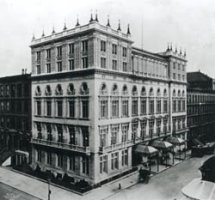
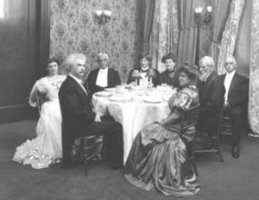
(L) Delmonico’s (Fifth Ave. & E. 44th St.); (R)
Mark Twain’s 70th birthday party, 1905
After a few more minutes of
staring, Rose and Miss Howard resumed their trek up the east side of Fifth
Avenue. Between 46th and 47th Streets was a cluster of
uninspiring shops housed inside what was otherwise an architecturally rich
building, half of which seemed to be prepared for demolition. They stopped in
front of the structure.
"Something interesting here,
Miss Dawson?" asked Miss Howard.
"There was a hotel at this
site called the Windsor. It burned down when I was a little girl. The building
you see here is the Windsor Arcade."
"Did you stay here?"
"No, but I knew some people
who did."
"I hope they made it
out."
"They did, thank you."
Rose had heard stories about the
Windsor Hotel from the society events she attended with her parents and from a
couple of distant relatives on her mother’s side who were guests at the hotel
the day it burned down. It was an exclusive residence that hosted the likes of
Vanderbilt and Carnegie. Cal and members of his family sometimes stayed there
during their trips to New York, as he recounted to her during their courtship.
All this came to an end on St. Patrick’s Day, 1899, when a fire destroyed the
hotel and killed over forty people, some of them prominent citizens. Some
trapped guests tried to escape by jumping out of their windows, to no avail. A
few bodies were never identified. The elements never discriminate by the
size of your estate.
On a happier note, one notable
survivor was Isadora Duncan, one of Rose’s favorite entertainers, who also led
her students to safety. A couple of paintings by Monet, one of Jack’s favorite
artists, were also saved by their owner, a guest at the hotel. I wonder if
Jack knew that.
All of a sudden, the walk up
Fifth Avenue, which was supposed to be enjoyable, put a chill on Rose. Every
stop she and Miss Howard made seemed to bear a connection to Jack, as if Jack’s
spirit had steered her to Delmonico’s and the Windsor Hotel’s old location–two
places he likely never visited when he was alive.
Oh, Jack. I miss you so much.
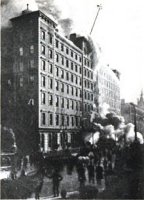
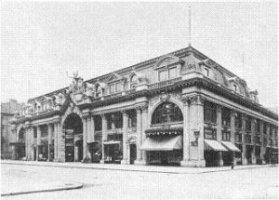
(L) Windsor Hotel fire, 1899; (R) Windsor Arcade circa 1901
*****
Miss Howard sensed Rose’s
hesitation again. "Is there something wrong, Miss Dawson? Maybe we should
find a place to sit down."
"That would be a good
idea."
They turned around and made their
way back to Bryant Park, where they found a bench. "That should be
better," said Miss Howard. "Well, now I’ve ridden the train and seen
the rich part of New York. Very interesting, but I wouldn’t trade one day in
Norfolk for a life here. That’s not my cup of tea."
"I can understand,"
said Rose.
"The big city isn’t for
everyone, and there’s nothing wrong with that. London has scoundrels, and I’m
sure New York does, too. I go with what I know. Lord Nelson said, ‘I’m a
Norfolk man, and glory in being so.’ Well, I’m a Norfolk woman, and always will
be, wherever I go."
"You’re quite the poet, Miss
Howard."
Miss Howard’s attention was
distracted by a copy of the New York Times that a fellow park goer had
left behind. Unable to contain her curiosity, she retrieved it and started to
flip through its pages. As she had traveled alone aboard Titanic and
knew that all the friends she made on the ship were safe, she was less worried
about the sensitive information that could be inside. Not being a very keen
reader, she merely skimmed through the pages.
On page seventeen, an
advertisement from International Mercantile Marine Lines (the parent company of
White Star) announcing the May fourth sailing of Olympic, Titanic’s
sister ship, caught her eye. "Humph!" she sneered, showing Rose the
ad. "They call it the largest steamer in the world, but is it the safest?
I bet the other ship’s name was here just last week," she sneered.
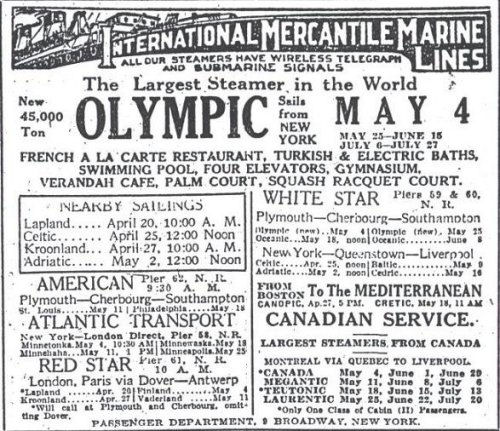
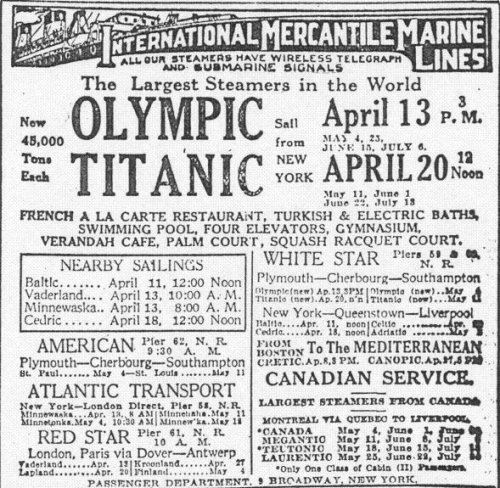
(L) NYT ad for Olympic, April 19, 1912; (R) NYT
ad for Olympic and Titanic, April 8, 1912
Rose looked at the ad for a
second before turning her head away. Miss Howard realized her slip. "Oh,
my goodness, Miss Dawson! I’m so sorry about that!" She put the newspaper
down.
"It is all right, Miss
Howard," said Rose, trying to sound reassuring. Her better judgment told
her to avoid the newspaper, but if she could not bear to see what happened to
Jack and her other friends, she had to know what happened to Trudy, whom she
had known longer than any of the friends she made on Titanic. She hoped
for the best as she opened the Times to look for a list of survivors,
and found it on page thirteen. She found her new moniker under the D-section
before backtracking to the B-section. Obviously, her old name would not be
there, but that of her mother (as Mrs. R.T. Bukater, with "R.T."
being Royce Tarleton, the name of Rose’s father) was present. Trudy, however,
was not listed–neither under her own name nor as a servant of Rose or her
mother.
The absence of Trudy’s name under
the list of survivors disheartened Rose. She fearfully shifted to the B-section
under the list of missing on page twelve, which was not in alphabetical order: Beattie,
Brandies, Mrs. William Bucknell’s maid, Baumann…Bukater, Miss Rose D. and maid.
Rose’s heart stopped. Her fears
had come true. Trudy was missing and probably dead. Not only that, but the
other maid, Sophie (listed as "Maid of Mrs. R.T. Bukater"), was also
missing. Rose was visibly disturbed by this discovery.
"Miss Dawson, don’t read it
if it upsets you so much," advised Miss Howard, who put a hand on her arm.
Rose continued to stare blankly
at the newspaper, a mixture of grief and anger building up inside her. Mother,
it’s all your fault! Why did you tell Trudy and Sophie to go back to our room
to turn up the heat and make your tea? If not for your stupid request, they
would have been able to board the lifeboat! The tears began to roll down
her cheeks. She crumpled the newspaper and buried her face in her hands.
Miss Howard slowly took the
newspaper from Rose and tried to comfort her. "Remember, Miss Dawson, stay
strong. I know that’s hard." She took out a handkerchief, gave it to Rose,
and then hugged her after Rose wiped some of the tears from her face. The two
remained embraced for over a minute.
"Remember what I said last
night. It’s a better day tomorrow, and it is, Miss Dawson. You’ve done well.
Most people would be too pained to go out after losing someone dear to them,
but you’re strong enough to show a greenhorn like me this city. You should be
proud."
The tears slowed down. Rose had
never looked at her actions in this way.
"The news is everywhere,"
continued Miss Howard. "You can’t escape it. Soon the public will forget
about the Titanic and go on with their lives. The person who left this
paper here has moved on already. I’ll be moving on, too, and so should you.
Those who died would want those who lived to move on, and that’s what we must
do. We can’t stop the world from spinning."
Rose stopped crying. Jack
wanted the same thing for me. "You are right. I must move on. But
sometimes it is so hard."
"It won’t always be easy,
Miss Dawson. But we still have to try."
Rose smiled again. "Yes, we
do."
Miss Howard rose from her seat.
"Come, let’s go back to the shelter for dinner. Miss Hill said that starts
at one, and besides, that’s free. We can go back early and rest first. Should
we return to the station to take the train back?"
"Yes, but let us make one
more stop. Do you read Mark Twain? Your mention of the sea being unable to
tell the prince apart from the pauper made me wonder if you have read his works."
"No, I don’t read much, but he’s
so popular in England that even we in Norfolk have heard of his books."
"Oh. Mr. Twain–actually Mr.
Clemens–was one of my favorite writers. Sunday is the second anniversary of his
death. Funeral services were held at a church located a few blocks south. Do
you mind if we walk past it on our way to the El?"
Miss Howard was happy to see Rose
recover so quickly. "Not at all, Miss Dawson. Lead and I shall
follow."
Rose and Miss Howard returned to
Fifth Avenue before turning south. It did not take them long to locate a building
with unmistakably ecclesiastical architecture–a tall spire–on the northwest
corner of Fifth and West 37th Street. This was the Brick
Presbyterian Church, where Twain’s funeral was held on April 23, 1910. Its
doors were opened, but very few people were inside.

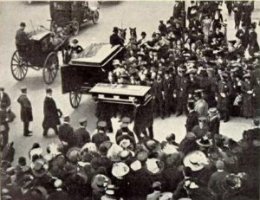
(L) Brick Presbyterian Church (Fifth Avenue & West 37th
Street); (R) Mark Twain’s Funeral
"It looks pretty empty right
now, but on the day of the funeral, so many people wanted to get inside that
the church could not hold them all," explained Rose. "So, hundreds
more people remained out on the street, and they ended up blocking
traffic."
Miss Howard seemed amazed by
Rose’s short account. "Were you here on that day?" she asked.
"Yes, I was. I was visiting
the city and wanted to pay my respects to Mr. Clemens, so I begged my father to
stop here." A year later, he was gone, too.
"You cared enough about
someone you’ve never met to send him off to Heaven?" asked Miss Howard.
"That’s amazing. Mr. Clemens must mean so much to you."
"He did. He was always able
to see people when he wrote." Just like Jack. "And he could be
extremely witty."
"Thank you for sharing your
interest in Mr. Clemens with me, Miss Dawson. You’ve been a wonderful
guide."
"You are welcome, Miss
Howard. I am glad this tour will end on a happier note, and we owe it all to
Mark Twain’s funeral!" They both laughed at this irony.
"So, how will we get back to
the shelter?" asked Miss Howard.
"Let us take the Third
Avenue El. That one scared me this morning. I have to try to overcome my fear
of it."
"That’s the spirit, Miss
Dawson."
They continued south on Fifth
Avenue until they reached 34th Street. Then they turned east and
walked a few long blocks to the Third Avenue El’s 34th Street
station. They paid their fare and waited for a southbound train. When it
rumbled into the station this time, Rose steeled herself and bravely faced it
down. It was not easy, but she was moving on.
*****
Some twenty minutes later, Rose
and Miss Howard were back at the Women’s Shelter. They saw some of the other
guests performing their daily chores, including preparing dinner.
Brigadier Bown saw them as they
entered. "Good afternoon, Miss Dawson and Miss Howard! How was your
trip?"
"It was most fascinating,
Madam Bown, thank you," said Rose.
"New York is so
crowded," said Miss Howard. "There are probably more people here than
in all of London."
"Probably. I can tell that
both of you are recovering very quickly." Brigadier Bown looked at their
mixed facial expressions. "And I apologize if you’d rather not discuss it
right now."
"That is all right, Madam
Bown," said Rose. "But it would be helpful for me to contribute to my
own relief. I notice that some of the guests are working. Is there anything I
could help with?"
"Thank you, Miss Dawson, but
we can’t have our survivor guests working for their room and board. It most
certainly wouldn’t look right!"
"We’re ready to help if you
need us," insisted Miss Howard.
"Madam Bown, I do believe
all the guests have survived something, have they not?" asked Rose.
"Personally, I think if I can return to a normal routine, it will help me
recover faster." But she knew that a "normal" routine for her
had never involved work.
"I appreciate your offer to
help, ladies, but we have more than enough hands right now. Besides, what would
the public think if we put the survivors to work for their own relief as soon
as they arrive in New York? Our donations would suffer and perhaps even
stop."
Rose and Miss Howard were
silenced. They had never considered the politics behind the aid to the
survivors.
"I know both of you are
sincere, and I appreciate it," continued Brigadier Bown. "I also know
that you want to help yourselves to restore your sense of dignity, and if you
stay at the shelter long enough, we’ll ask you to contribute something. But for
now, we’d just like you to be our esteemed guests."
*****
Rose and Miss Howard went
upstairs to rest and wash up for lunch. Rose was able to give her shoes a real
cleaning. My first attempt at doing laundry, but I never thought I
would start with my shoes! Thankfully, she and Miss Howard had already
given them an interim cleaning back at Union Square Park, so her work was made
easier. Then they reported to the dining hall for dinner.
After they finished eating, they
were met by a large man in an SA uniform in the lobby. "Greetings, ladies.
Which one of you is Miss May Howard?"
"That would be me,"
said Miss Howard.
"Nice to meet you, Miss
Howard," said the man as he shook her hand. "I’m Major Thomas Cowan,
and who may your friend be?" He looked at Rose.
"Rose Dawson. I share a bunk
bed with Miss Howard." She also shook Major Cowan’s hand.
"A pleasure to meet you all.
I hope you’ve been well provided for by the Army." He turned to Miss
Howard. "Miss Howard, I believe you know Mrs. Goldsmith and her son Frankie?"
"I do. Are they all right?"
"They’re doing fine. Right
now, they’re staying at our training station on West 14th Street. My
wife and I wanted to take Frankie out today to ride the El, but he was scared
of the noise, so we took him to a department store instead so he could ride its
escalator. He had fun."
Rose and Miss Howard looked at
each other. Now Rose knew that she was not the only one to have feared the roar
of the train.
"Mrs. Goldsmith asked about
you, Miss Howard. She’s leaving for Detroit tomorrow, and wants to see you
before she leaves. Will you be ready to go in half an hour’s time?"
"Yes, I will. And thank you
for telling me."
"Excellent. I will see you
then."
As Major Cowan left to prepare
for the trip, Miss Howard turned excitedly to Rose. "I’m so glad they’re
safe. I’m sorry to leave you by yourself, Miss Dawson, but I promise that we’ll
talk again later."
"That is all right, Miss
Howard. I can see you made excellent acquaintance with Mrs. Goldsmith during
the voyage. Was she the one who made clothes out of the blankets they gave us
on the Carpathia?"
"That’s Emily. She should
get a medal, but I think she’ll be forgotten after all this is over. No one
will even write a book about her. They’ll never remember us down in steerage.
We’re just invisible."
"There will always be people
who will remember, Miss Howard. The world is changing, and the voices of the
many can never be entirely suppressed."
"Well said again, Miss
Dawson."
"You do not have to worry
about me, Miss Howard. Just enjoy your time with Mrs. Goldsmith. I will see you
later."