Lab #4 Non-Linear
Temperature Distribution
with Newton Convergence
Problem Statement: Using the jacobian and residual developed for problem P-07a, solve
for the temperature distribution using a 32 element grid and a thermal
conductivity of k(t) = 73.2 - 0.04T - 0.000003T2. Verify and report quadratic convergence for
the iterative solver. Then remove one term from the jacobian, resolve, and
comment on solution convergence/divergence.
Solution: With help from page 6 of the Non-Linear
Heat Conduction Handout, MatLab Code
was generated to solve for the temperature distribution within the slab and
also for the convergence of the iterative solution. The solution was iterated until the maximum change in the
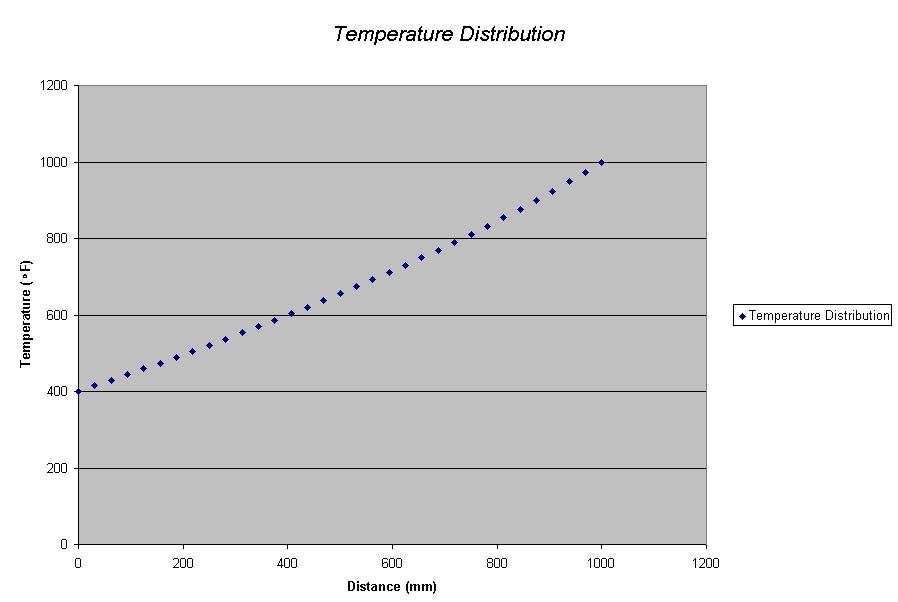
temperature was with in 1e-6. A plot of
the 32 element Temperature Distribution can be seen here.
A
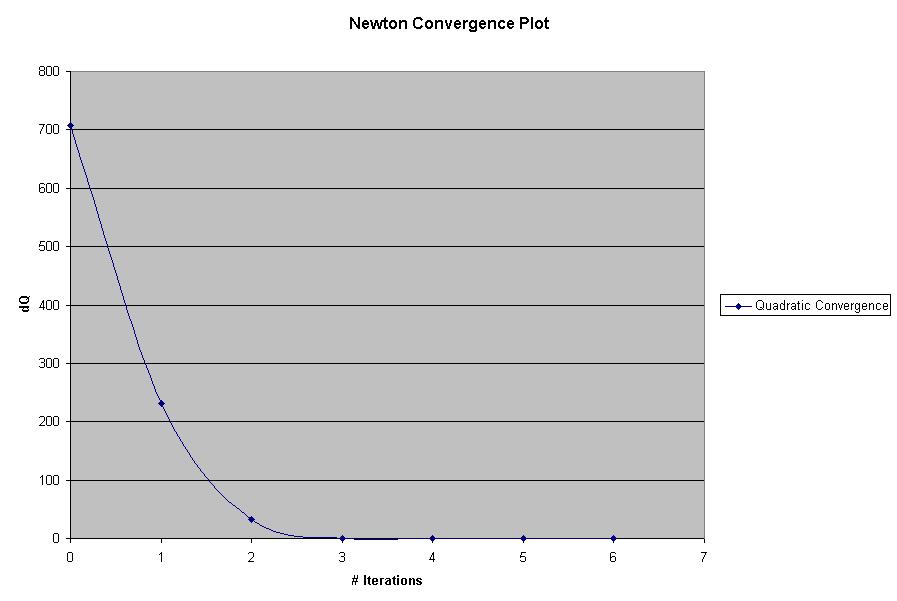
graph of dQ
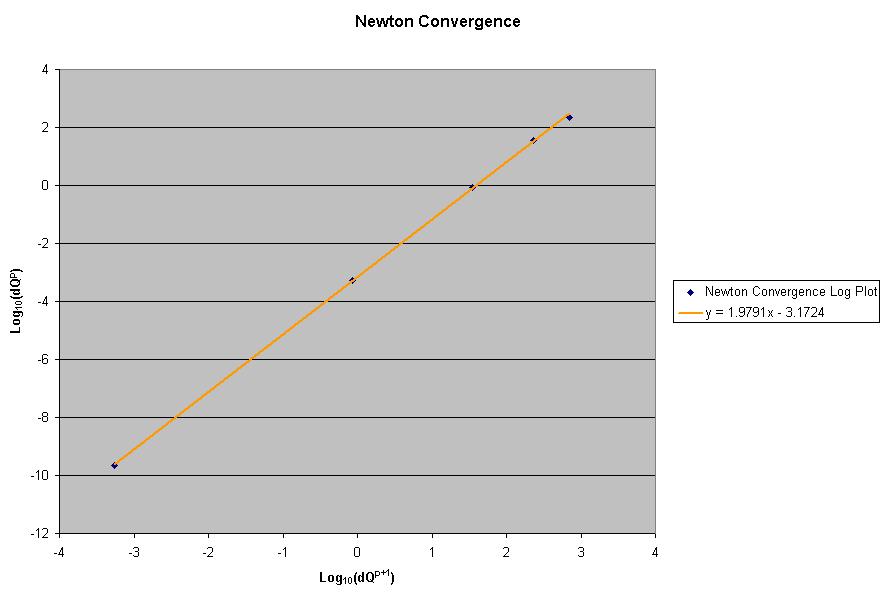
Vs. # of Iterations was plotted to show the quadratic convergence of Newton’s Iteration method. A second plot of log10(dQp+1)
Vs. log10(dQp) was done to further verify quadratic
convergence by having a slope of 2. From the plot you can see that the slope is very close to 2, which
shows the quadratic convergence of the Newton Iteration Method.
For
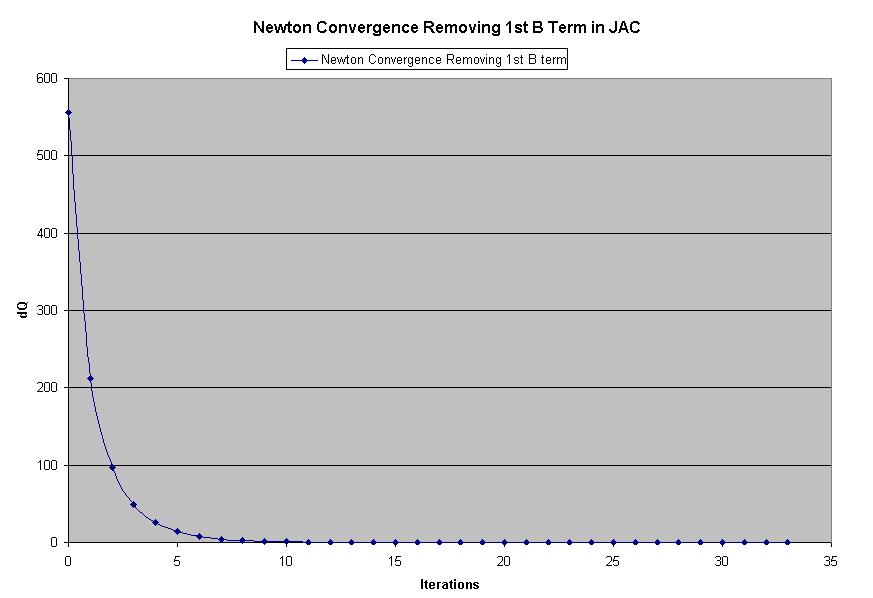
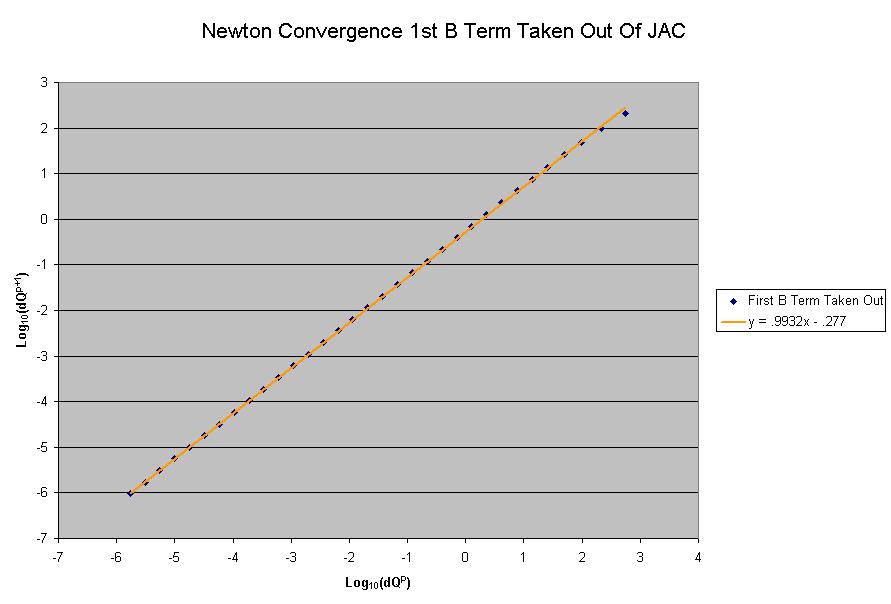
the second part of the lab I removed the first b term in the Jacobian
asjac1d(b,[],Q
,-1,A3110L,[]) and ran the code again.
I found that it took 33 iterations compared to 6 iterations with all the
jacobian terms in the code. Convergence
Graph with the first b term taken out of the Jacobian. log10(dQp+1)
Vs. log10(dQp) with the first term taken out of the
Jacobian.
Conclusion: The graphs
show that the Newton Iteration method converges quadratically. When you take terms out of the jacobian the
solution takes longer to converge, as was demonastrated when the first b term
was taken out of the matlab code.