Taishan
At six we arrive in Tai'an, birthplace of Mao's wife, Jiang Qing, ex-actress and leader of the Gang Of Four who, after Mao's death, took the excesses of the cultural revolution to a new degree of viciousness. For the Chinese, Mao is a cherub compared to his wife and most of his ruthless deeds have conveniently been ascribed to her influence.
We will climb the sacred mountain of Taishan. It has steps all the way up. Only the next day do I learn there are six thousand, two hundred and ninety three of them.
Tai'an is at the centre of much Chinese history, and several strands of religion and philosophy come together here. Taishan Mountain, the most important of China's five sacred mountains, is an hour's drive away, and Confucius, whose philosophy, with its emphasis on discipline and respect for authority is still influential, was born 80 miles down the road at Qufu, over two thousand five hundred years ago.
All this may account for why they are playing 'The Ride of the Valkyries' over the dining room loudspeakers at half past six this morning. Wherever there is likely even to be a smattering of foreign tourists, western music, rather than Chinese, will accompany them. I would rather it didn't. It's not easy to eat a hard boiled egg to 'Ride of the Valkyries'.
Although we arrive at the base of the Exalted Mountain by eight o'clock, there is already a steady trickle of pilgrims on their way up. It is said that if you can climb to the top of the mountain you will live to be a hundred. An unlikely assortment of would-be centenarians push past me. Schoolchildren in parties, lithe and bony old ladies, women in high heels, newly-weds, and couples practically frog-marching elderly relatives onwards and upwards. The object of their efforts is the Southern Gate of Heaven, a massive two-tiered red arch. It stands way above on a sharp rocky ridge and can be glimpsed occasionally through drifting clouds.
Halfway up, at the Middle Gate of Heaven, are lines of souvenir shops, most of which sell hats and walking sticks for about a pound. There is also a cable-car station here for those who aren't so worried about living to a hundred.
After five thousand steps, we are surrounded by unmelted snow. The only people not stopping for frequent rests are the wiry, bandy-legged porters who ascend steadily with enormous loads of bricks, cement, roofing tiles, or food supplies slung from yokes across their shoulders. They make two trips a day and are paid thirty yuan (two pounds) a time, enough for three beers.
The view from the Nantiamen Gate, the South Gate of Heaven, is obtained after more than two hours climbing and comes with the satisfaction of seeing an ant-like stream of figures still toiling up the pale white ribbon of stairs below. The centre of Paradise is a hundred and fifty steps away up the Scaling Ladder to the Gate of Heaven through Immortalization Archway and into the Temple of the Princess of the Azure Cloud. No azure clouds today, but a murky, clinging white mist which binds the cold air tight around me. The monks wear army greatcoats and rub their hands, and the pilgrims, having made the long journey, kneel at the blood-red doors of the temple, throw a money offering into what looks like a horizontal British pillar-box, bow three times before the Princess, raise their incense sticks, and move out pretty smartish.
As we retrace our steps away from this, one of the most revered sites in China, a sound drifts in the air above the chatter of the tourists. It's the sound of 'Moon River', played by Richard Clayderman.
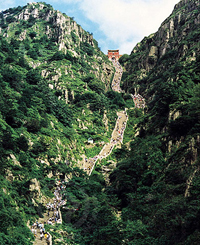
Taishan Mountain lies in central Shandong Province, spanning the ranges of Tai'an and Jinan cities. It covers an area of 550 square meters. It was regarded as preeminent among China's Five Sacred Mountains. 72 Chinese emperors of various dynasties made pilgrimages to Taishan Mountain for sacrificial and other ceremonial purposes, including Emperor Shihuang of the Qin Dynasty (221-206BC), Emperor Wudi of the Han Dynasty (206BC-8AD), Emperor Xuanzong of the Tang Dynasty (618-907) and Emperor Qianlong of the Qing Dynasty (1644-1911).
 Taishan Mountain is endowed with many scenic spots. A large number of them were given names in ancient times. They include 112 peaks, 98 precipices, 18 caves, 58 oddly shaped rocks, 102 streams and valleys, 56 pools and waterfalls, and 64 springs. Vegetation covers 79.9% of the area. The flora is known to comprise 989 species in 144 families.
Taishan Mountain also boasts cultural heritage with an incessant history of several thousand years. Currently on the mountain, there are 22 ancient architectural complexes, 97 ruins, 819 stone tablets and 1,800 stone inscriptions, which provide a natural museum for the study of ancient history and calligraphy. Main sites of interest are the Tiankuang Temple, Nantian Gate, Azure Cloud Temple, Peak for Viewing the Sun, and Sutra Rock Valley, etc.
Taishan Mountain is a mountain of outstanding value from the point of view of aesthetics, science, history and culture. Taishan Mountain was elected to the "World Heritage List" in 1987. Chinese people tend to describe a situation as being as stable as Taishan Mountain or a matter as being as weighty as Taishan Mountain, giving clear evidence of such an impression.
Cultural Heritage
Taishan Mountain is one of the birthplaces of the ancient Chinese civilization along the Yellow River. Evidence of human activities includes two flourishing cultures -- the Dawenkou Culture to the north and the Longshan Culture to the south of the mountain. During the Warring States Period, a 500-kilometer-long wall was built from Taishan Mountain to the Yellow Sea. Scenic spots related to the famous ancient sage Confucius are the Confucian Temple, places where Confucius climbed Taishan Mountain and viewed the scenery, etc.
Taishan Mountain has an extremely rich cultural heritage. It has always been regarded as pre-eminent among China's five sacred mountains. It was also a symbol of power. Emperors of different dynasties have made pilgrimages to it for sacrificial purposes shortly after they came to the throne or when the land enjoyed peaceful and prosperous times. Poets and literary scholars of each dynasty also visited Taishan Mountain. Numerous rock inscriptions and stone tablets bear testimony to such visits. Renowned scholars, including Confucius, Sima Qian, Cao Zhi, Li Bai, Du Fu, composed poetry and prose and left their calligraphy on the mountain. The currently preserved 97 sites and 22 ancient building complexes provide materials for research into China's ancient architecture.
Natural Heritage
Taishan Mountain rises abruptly to 1,300 meters above the vast plain of north China. The sharp contrast between Taishan Mountain and its surrounding plain and hills makes it especially majestic.
Taishan Mountain rises from about 150 meters above sea level (north of Tai'an City), to the Middle Gate to Heaven at 847 meters, to the Southern Gate to Heaven at 1,460 meters, and finally to the Jade Emperor Peak at 1,545 meters. Standing in the central part of Shandong, the mountain stretches 100 kilometers. Its base covers an area of 426 square kilometers. The wide base and huge body of the mountain gives an impression of solidity and dignity.
Taishan Mountain is a symbol of loftiness and grandeur, characterized by numerous old but still green pines and cypresses, towering precipices comprising metamorphic rock and granite, and ever-changing seas of clouds.
Preeminent of the Five Sacred Mountains
Taishan Mountain is also called Daishan, Daizong or Taiyue. Taishan Mountain lies west of the Yellow Sea and east of the Yellow River, spanning Tai'an City in the south and Jinan City in the north. The scenic area covers 125 square kilometers. Its main peak (Jade Emperor Peak) is 1,545 meters high. It is 8.9 kilometers from the Temple of the God of Taishan Mountain at the foot of the mountain to the Jade Emperor Peak, with over 6,660 steps, 60 major scenic sites, and nearly 1,000 cliffside sculptures and over 200 stone tablets. Taishan Mountain is regarded as preeminent among the Five Sacred Mountains.