
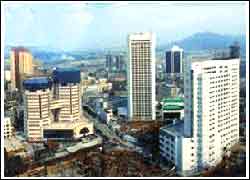
 Nanjing, southern capital, is one of the six ancient capitals of China (from beginning of the 3rd century to the end of the 6th century), situated at the south bank of the lower reaches of the Yangtze River.
Today, Nanjing is the capital of Jiangsu Province and covers an area of 860 square kilometers with a population of more than 5 million.
Nanjing, southern capital, is one of the six ancient capitals of China (from beginning of the 3rd century to the end of the 6th century), situated at the south bank of the lower reaches of the Yangtze River.
Today, Nanjing is the capital of Jiangsu Province and covers an area of 860 square kilometers with a population of more than 5 million.  more info
 Sun
Yat-sen
is recognised by the Chinese as the father of modern China.
The tomb itself lies at the top of an enormous stone stairway,
323m long and 70m wide.
more info Sun
Yat-sen
is recognised by the Chinese as the father of modern China.
The tomb itself lies at the top of an enormous stone stairway,
323m long and 70m wide.
more info
|
|


 Confucian Temple (Fuzimiao) Linggu
Temple Mausoleum
of Dr. Sun Yat-Sen
Confucian Temple (Fuzimiao) Linggu
Temple Mausoleum
of Dr. Sun Yat-Sen  Ming
Xiaoling Mausoleum Mochou
Lake Mount
Qixia Nanjing
Museum
Qin Huai River Xuyuan
Garden Xuanwu
Lake Yangtze
River Bridge Zhanyuan
Garden Zhonghua
Gate Zijinshan
Observatory
Ming
Xiaoling Mausoleum Mochou
Lake Mount
Qixia Nanjing
Museum
Qin Huai River Xuyuan
Garden Xuanwu
Lake Yangtze
River Bridge Zhanyuan
Garden Zhonghua
Gate Zijinshan
Observatory