The National Gallery of Art, Washington, D.C.
The National Gallery of Art, Washington, D.C.

Painted in 1917 with oil on canvas, Allies Day, May 1917 is one of about thirty paintings Childe Hassam made of New York City’s flag covered streets during World War I. This painting was done from a balcony on the corner of Fifth Avenue and Fifty-second Street. Fifth Avenue was temporarily named the Avenue of the Allies. British and French was commissioners paraded down this street on May ninth and eleventh to celebrate the United States entering the war. The slogan “Show your colors” brought forth a flood of Stars and Stripes, Tricolors, and Union Jacks in support. Hassam captured this occasion of patriotic support in his painting, preserving it so that those who may never know a time of war will know hat patriotism means.
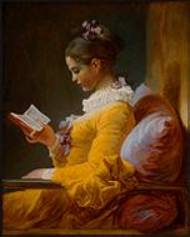
A Young Girl Reading is one of Jean-Honore Fragonard’s many portraits of young girls in quiet moments. He painted these very quickly, in one hour according to his friends. With the quick brushstrokes and brilliant colors, the saffron, lilac, and magenta, Fragonard’s paintings cause the viewer to focus on the technique rather than the subject. This 18th century oil on canvas helped to blur the line between sketch and finished product.
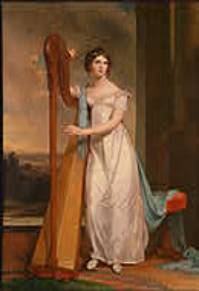
Lady with a Harp: Eliza Ridgely by American artist Thomas Sully was done in 1818 with oil on canvas. Sully’s paintings reflect his early familiarity and upbringing in the dramatic arts. The subject in this piece is Eliza Ridgley, the daughter of a Baltimore merchant, who is transformed into a personification of gentility and refinement. It is doubtful that the fifteen-year-old Eliza had such slender fingers, lengthy arms, or willowy thighs and torso. Sully learned from experience that improvements for the portrait were seldom frowned upon.
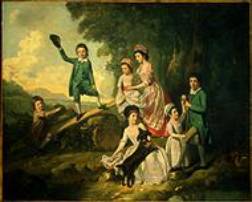
An oil on canvas painting, The Lavie Children is an 18th century work by British artist Johann Zoffany. Though he had worked in Germany and Rome, his stay in London brought him royal recognition and a nomination to the Royal Academy of Art when it opened in 1769. After a rejection his court commission by King George III, Zoffany left London and worked in Italy and India. The portrait of the Lavie children includes all seven siblings in that English family. Zoffany carefully arranged a design of interweaving curves among the children. The animated postures and gestures bring the conversation piece to life. Germain balances atop the seesaw, which is anchored by Thomas. Maria holds baby Emilia, Sarah pets the spaniel, and Frances reaches for John’s catch of fish.
Next Museum
Email:
trprice@bluefield.edu

