The Art Institute of Chicago
The Art Institute of Chicago
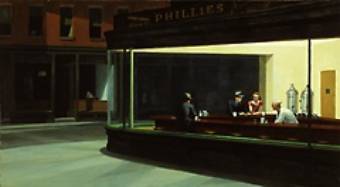
Nighthawks, an oil on canvas painting by Edward Hopper, is clearly 20th century, particularly reminiscent of the 30’s and 40’s. Hopper was inspired by a diner on New York’s Greenwich Avenue, where two streets meet. The timeless quality of the painting transcends the location, and seems to embrace all who are lonely and thoughtful. There is a lack of visible entrance to the diner, cutting the viewer off from the people inside. The four night owls appear to be disconnected from one another was well, sitting silently in their own thoughts. The lights glow eerily into the night, providing a type of beacon to the darkness.
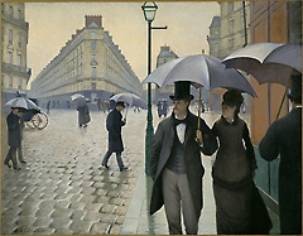
Paris Street, Rainy Day is an 19th century oil on canvas look at the complex intersection near the Gare Saint-Lazare. Artist Gustave Caillebotte based his painting on a careful orderliness of mathematic perspective. Though it is highly organized, it is still casual, expressing a moment in time that seems eased and relaxed. This enormous painting, nearly seven by ten feet, is considered Caillebotte’s masterpiece.

The Artist’s Mother is a charcoal drawing made in 1938 by Armenian immigrant Arshile Gorky. It was inspired by a photograph of Gorky as a young boy with his mother. He drew with careful and classic simplicity, turning his mother’s dark features into the face of the perfect Eastern Orthodox woman. Though the family was of noble lineage, they lived in poverty under Turkish persecution and massacre. Gorky’s mother died of starvation in 1919, and he and his sister came to the United Stated in the year that followed.
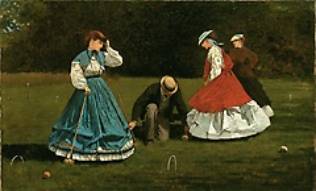
Croquet Scene is an 1866 oil on canvas that is common to many of Winslow Homer’s works. He was particular to people being in outdoor scenes and in the sunlight. Croquet was a sport newly introduced to America from England, and was a favorite subject of Homer’s from 1865-1869. The spirit of a breezy, casual afternoon is highlighted by a sense of immediacy, evident from Homer’s use of color, broad brushstrokes, and light effect. His brightly dressed figures also help add to the gaiety of the mood.
Next Museum
Email:
trprice@bluefield.edu

