Museum of Modern Art, New York
Museum of Modern Art, New York
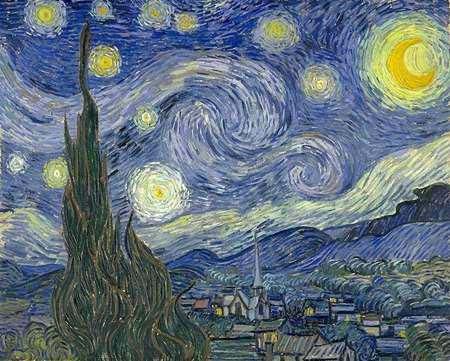
Starry Night, the work of Dutch Postimpressionist Vincent van Gogh, is an oil on canvas painting done in 1889. The painting was presumably made after van Gogh viewed the morning star over a quiet country village. It is possible that this morning star, or Venus, appears as the large white star left of the center. The flame-like cypress tree connects the earth and sky. Van Gogh thought that the shining dots in the sky should be just as accessible as the black dots on a map. He abandoned the realism of nature in favor restless motion, intense feeling, and odd colors, setting a precedent for the Expressionism that followed.
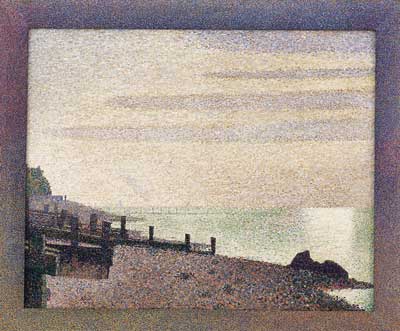
Evening, Honfleur was painted with oil on canvas in the summer of 1886, following artist Georges-Pierre Seurat’s stay at the resort town of Honfleur on the north coast of France. Seurat was attracted to this place of rugged coastline and turbulent waters. His scene is still and tranquil, with a density yet openness of light. He used a method known as pointillism, employing the use of small dots of pure color to create a form. The viewer sees these dots collectively or separately, turning the picture into a work of enchanted glitter. Seurat painted a frame around the scene as a way of separating the painting from reality, thus making a small, contained world of a soft, cool study of natural beauty.
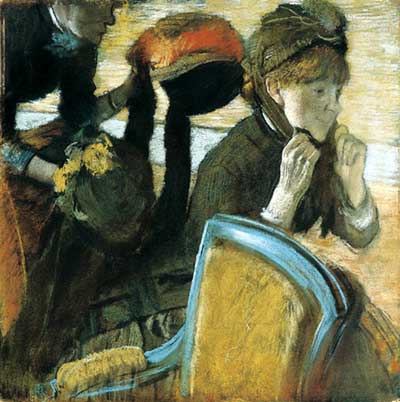
This late 19th century work, At The Milliner’s, was done by Hilaire-Germain-Edgar Degas with pastel on paper. Pastel was an important medium at this time due to the new preoccupation with color. The subject of this painting is American artist Mary Cassatt, who tries on hats while the attendant waits apprehensively behind her. Cassatt’s contentment and self-assurance is contrasted by the uneasy posture of the shop girl behind her, who is obscured by the painting’s edge and the lack of specific facial features. Degas often accompanied his female friends to the dress and hat shops, perhaps heeding the advice of critic Edmond Duranty to make pictures of everyday people at everyday events, in the streets or at home, in the midst of social surroundings.

Bicycle Wheel was made in 1951 by Marcel Duchamp, after the 1913 original was lost. It is constructed of a metal bicycle wheel mounted on a painted kitchen stool. Though not the first to turn everyday objects into art, this was Duchamp’s first Readymade. Readymade implies that nothing more is needed than good selection for a work of art. The components of the piece are mass produced and are thus anonymous, being identical or similar to numerous others. The fact hat this is not the original piece does not decrease the surprise of the visual experience. Indeed, the work maintains an absurd visual shock, while its real power rests in the concept.
Next Museum
Email:
trprice@bluefield.edu

