
Fran, what is the title of your position?Return to Main Page
It's Coordinator for Elementary Technology.Could you tell me the responsibilities of your position?
Overall, anything related to technology in the elementary schools: teacher training, budgeting, ordering equipment, ordering software. In general, managing the technology in the 133 Fairfax County elementary schools.
You do all this by yourself?
I have two assistants.What is your background? How did you get to be a "technologist"?
By being in the right place at the right time. I was a classroom school teacher. I taught fifth and sixth grade for 12 years. During that time I also worked with summer curriculum development in math and science. I thought I was going to be the "metric specialist" for the county, but we know where metrics went.
One of the summers I was working on curriculum for math, I worked with a gentleman who was the computer science specialist for the county. He asked me if I’d be interested in doing something with computers at the elementary level. I said, “...sure, and let me know if anything comes up.” Eight years later, when I wanted to transfer schools, called to see if anything was happening, and transferred to a school that was working on computer literacy. Then I started learning myself.
I came in to this position in 1981. I tried to find research for technology in elementary schools at that time while I was getting my masters, but it just wasn’t there.
Could you give me some background on the use of computer technology in Fairfax County elementary schools? When did they introduce computers into the elementary schools?
In 1977. I transferred to Wolftrap School specifically to develop a computer literacy course for the gifted/talented students. At the same time during the summer, I worked with a curriculum team to develop computer literacy. And using my experiences in my classroom and with the G/T kids (who I only had one hour a week), we put together the computer literacy curriculum. That was in place to about 1984.
Back then, if a school bought a computer, we would provide the training in computer literacy. We taught them about computers, basic programming, and then Logo. We never got the buy-in, even though we correlated everything to the Program of Studies.
We got a federal grant and then started looking at specific things like word processing, and just doing LOGO as part of the math program. That started the integration. We got grants from the state of Virginia in 1988-89 and we put computers in the sixth grade classrooms and then in the fifth. In 1991-92 we started the "Tech Plan". That developed a model technology school project. That’s where we put four computers in a classroom, and we’ve been working on that project since that time. We have two more years to go to get to all the schools.
How are computers and technology integrated into the curriculum today? Is computers/technology taught as a separate subject?
In all the four Core Areas (math, language arts, social studies, and science), as they revise the curriculum, they are putting in objectives, activities, and strategies that require the use of computer technology.We do not have a computer technology curriculum as such. We use the technology as a tool for teaching the Program of Studies(POS) and now the Standards of Learning (SOLs). For example, the Windows on Science program (a laser disk basal program) is integrated into the science program, and is connected into the television and the computer.
We have identified pieces of basal software that the teachers are to be using. If they--the teachers--were doing the Program of Studies totally (as they should) they would have to be using technology every day. But we know that everybody’s at different levels; and, it’s like getting a new textbook-- they don’t all buy into it the first time. We use the technology as a tool, not a "drill-and-practice", although some of the schools are running programs such as CCC (that’s an area project, not a central project). It all depends on how comfortable the teachers are with the curriculum and with the technology.
Where do you think the emphasis is placed today in the schools?
The internet. E-mail gotten more people on board than anything else. Word Processing is used extensively in the classrooms.Hardware
What is the average number of computers per classroom?
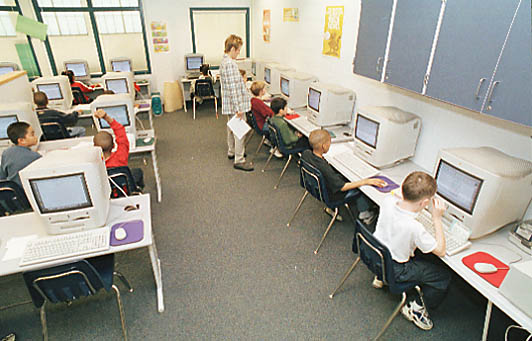
Four. Or will be four when the Tech Plan project is completed in two years.Do the schools have computer labs?
Last year we looked a total school environment and developed profiles: what they should have in the classroom, what they should have in a computer lab, and what they should have in the media center (library). Based on the student population, we came up with the number of computers they should have. It was determined that there should be four computers in a classroom and also a 30-station computer lab.The biggest problem emerging was that the schools don’t have room for the 30-station lab, and so we say "equivalent" meaning the computer in the lab could be a hand-held device such as a Palmtop, Palm Pilot, E-Mate or AlphaSmart . We haven’t defined that at this point in time. Most schools do not have the luxury of having the newer computers. They have the old Apples and the early Macs. We have not budgeted for the labs at the elementary level yet. We’ve been concentrating on four computers per classroom
Are the computers acquired by the individual schools from the Safeway and Giant programs calculated in the inventory?
Yes. We do a complete inventory, and look for the high end computers like the 486 or the Power Mac. That is a change in policy. Originally we did not count any computers acquired from Safeway, Giant, local school purchases, or donations by the PTA, because we’d never get to our goals. We started to count them because we do maintain them and we do replace them so we felt they should be counted.Are the schools all wired for access to the internet?
Everybody has at least one drop in the classroom. As we put in new computers--this year for instance, 33 schools got computers for Model Tech--every classroom was assessed for its electrical needs and its networking needs. Most of our classrooms have two plugs--one in the front and one in the back. We went in and we upgraded their electrical system. We put additional drops in or hubs. We sometimes had to run new wires back to the wiring closet because they didn’t have enough capacity. There was a surcharge for that, and a new process was put in place.Any school that wanted to buy or add computers from the Giant or Safeway program had to submit a DC407, a facilities modification form, to have this assessment done, and then they would pay the cost for that. If it’s part of the Model Tech Plan, though, the cost comes out of my budget. It averages about $500. per computer for this infra-structure work. It has taken a large chunk out of our budget, but it if it wasn’t done, it probably would have brought the whole system down.
In grades K-12 we installed over 8000 computers this past year, and we really did not have the capacity and infrastructure to do that. We had to slow things down and get the infrastructure in place before we could install the computers. We have close to 3000 this year, and that’s just the Tech Plan and local purchasing. Over 2500 were elementary last year. Next year we have 1167 more to install.
Is there internet access in the library, computer lab, or classrooms?
All of the above. The intent is to have every computer connected to the internet.Is there enough room in the classroom for all this hardware?
Well, it’s been a challenge. The renovations and newer construction have built-in countertops. We’ve put in trapezoidal tables. We’ve had people having to throw out bookcases. Teachers have had to reorganize their classrooms to make room for the hardware.It has been a problem in some of the classrooms. Teachers have had to be resourceful, especially the ones who have pie-shaped classrooms like the ones built in the 80’s. We have moveable carts. Some like the low tables, but most seem to favor the trapezoidal tables. Many like the moveable carts better than the built-in counters because that gives them a little more flexibility. We have to keep the computer setups up against the wall so the wires are secure, and we don’t have fire hazards. The teacher’s station is usually where ever the cable drop is.
Who is your server for the internet?
We originally had some free service with Erols, but now we are working with Bell Atlantic with a switching device called "The Cloud". Erol’s had offered a free account for all schools originally.Are the majority of computers in the classrooms Apple computers?
Yes. It’s only in the last two years that we’ve allowed the schools to have PCs in their classrooms at the elementary level. The superintendent, Dr. Dominech, mandated that we would become a single platform school system, that we would all be moving to the PC platform. He felt that it would be easier to support the system if were all using the same software and the same platform.Traditionally, the middle and elementary schools have been MacIntosh based. The middle schools were told they could remain on MacIntosh for computer graphics if they had a need. The elementary schools, if they were heavily invested in Mac and their teacher training was in Mac, could remain Mac at this time, but every year it would have to be reassessed. Last year only 2 schools chose to switch to PCs. This year it’s been about 50-50.
The turning point was that the five basic pieces of software can be used on both platforms and the training is applicable to both. The MacIntosh people seem to be able to implement faster than the PC. The ones who have the MacIntosh are further along in their integration than the PC users. It could be that the PC users have to focus so much on the new hardware that they are slowed down.
Software
What types of software are used in the schools?
Mostly tool software. We have five basal pieces of software we put in the Model Tech classrooms including; "Appleworks", "KidPix", "HyperStudio", "Story Book Weaver", and "Inspiration". Those are basal pieces. In science they use "Windows on Science" and "Discovery".Each discipline has identifying key pieces of software. This office doesn’t provide it for them, but if they have money, this is what we would like them to have.
We also have a list of approved software. I have a standing committee called the Technology Review Committee that meets four times a year. It is made up of curriculum people and classroom teachers who review software we get from the various companies, and if it is approved, it goes on this list and the schools can purchase from that. If it’s not listed, they’re not supposed to buy it because it’s deemed not appropriate for our Program of Studies.Is there a standard or criteria for the purchase of software?
Yes, there is a school board regulation for the review of supplementary material, regulation #305.3. The primary criteria is: does it match our Program of Studies? Does it match our philosophy of pedagogy? We meet four times a year, and we have a standardized form that we use. The form is based on the ISTE form, the International Society for Technology in Eduction. We adapt the form as new technology come out like the DVD. Regulations require that at least three people sign off on it. The curriculum staff has identified key classroom teachers as well as technology people. I have about 20 people who serve on the committee.Does the county have to approve purchases by the individual schools? What does that involve?
Yes and no. They’re supposed to purchase off our approved list. It goes through our accounting system. It goes down to General Services and they first check to see if it is on the approved list. If it isn’t, they usually call me and ask if it’s being looked at. With the advent of charge cards at the schools, like everything else, they do their own thing, and even if we say it’s not approved, they may do it. But they do so at their own risk. If there is a challenge, and there is a regulation for challenged materials, they would have to assume that responsibility.It will take some a while to acquire the culture of adhering to the approved list. The majority of schools are good about it. Sometimes it depends on the kids. It might match what they really need. The principal and the area office have the ability to override anything we say. The schools have money in their budgets to buy software.
Is there an evaluation system for software? Is there feedback from schools, teachers, students?
There is an evaluation form that is filled out at the school level and sent to us.Personnel
Who is in charge of computers/technology?
At the area level - I am in charge at this level. In each area (Fairfax has three administrative levels since the county is so large) we have pyramid training specialists who feed a high school, a middle school, and their feeder schools. There are 23 pyramids. They are housed in the area office, but they support our technology programs. I have no jurisdiction over them, however. A unique situation.They will be dispersed this September and will be school-based technology training specialists, and will be assigned at the school level. At the school level - Some schools use an "out-of-ratio" teacher, they’ve given up a classroom teacher to use that position as a school-based technology person. Some use an instructional aide, and some have nothing. This coming year, with the new school-based tech training specialists, each school will have a half-time specialist so each will actually share with another school.
The following year we will get the other half...as soon as the funding goes through. It was on the cut list, but we got it back. We also have technical support people. There are 23 of these. Their primary responsibility, along with the pyramid people is teacher training. Although they do fix stuff. And there is often a lot of stuff to fix. Up until this time we’ve been at the mercy..., no, the "creativity" of the principals. They’ve had to rely on the "out-of-ratio" teacher or the good will of some person who has had to take this responsibility on.
I assume that most of the people at the school level haven’t been trained for this position, so what is their background?
Some have training. When we were reorganized in l990, we began a program called "Computer Lead Teacher", and they took a 3-credit course. Over the course of the past five years we’ve taught 400 teachers under the guise of Computer Lead Teacher. We also offer staff development courses through our Fairfax Academy. Some people are in programs like yours at UVA, or in George Mason, or they’ve gotten it on their own. There is a lead teacher in every building. We don’t offer the course any more because everyone’s in all these other courses. And a lot of them are coming out of Model Tech.What are their responsibilities?
They are responsible for being in the lab and in the classroom. We would prefer that they be in the classrooms modeling lessons for the teacher and planning with the teacher, and providing school-based opportunity for teachers to learn first-hand. Some have been “locked” in a lab either because that was their choice, or that’s where the focus of the school was. Some schools, to get teachers “on board”, decided to pool equipment in a lab to get started and then move it out to the classroom. In one area we have CCC "Success Maker" software in a lab.The preference for the new positions is that they will be out in the classrooms and they will be working directly with teachers. Even if the students come to a lab, the teacher is still to come to the lab and lead the teaching, and the technology person should be there only to guide and assist. Too often in the past we found teachers dropping the kids off and taking a coffee break. Many of the aides who were given this job didn’t have the teaching experience or training, and besides we don’t pay them enough to take that kind of responsibility.
At this point, how would you evaluate the proficiency level of the teachers in their understanding of computers and technology?
We are using the state technology competency standards. Two years ago, the state put out technology standards for instructional personnel. Anyone who is licensed to teach in the state of Virginia, if they want it [their license] renewed, must show competency in these standards.There are eight of them. Five are operational and three are integration. That is now our benchmark, and as we do training, we cover the standards. The teachers must show proof that they have covered each standard. What we’re finding is that seat time doesn’t equate to competency. Even though they take the training and can do it in front of us, if they can’t replicate it or continue to do it, the principal has the option of denying. The principal has to fill in this chart and form that is then attached to their recertification. Everybody has to have this by the year 2003.
There is a gray area here because our HR department and the state haven’t given much direction on how we collect that information. We’ve have an edict in this county that 40% of our staff, which is close to 5,000 teachers, must meet that proficiency level by the end of this year. And we did that. We’ve done more training...We’ve started these boot camps to get people up and running. Because now that it’s tied to certification, it certainly has made an impact on people, that this is serious business and that this is not going to go away. There are expectations and we are going to use them.
It varies from school to school and from teacher to teacher what the competency level is. They’re probably using it [the training] for word processing and e-mail. E-mail is something that jumpstarted a lot of teachers. We cover spreadsheets, we do database with it, but most of them never look at it again after they come out of training.
The Students
Are the students taught:
- Word processing? Yes.
- Spreadsheets? Yes. In the different grade levels as it is a function of math or science. In that context they are exposed to it.
- Data processing? Yes.
- How early do they start data processing?
We have programs like "Claris Works" so the kids can make charts and graphs as early as kindergarten. Overall it probably comes in to the Program of Studies at about third grade. Maybe some simple surveys.
- Programming? Didn‘t the county used to teach Logo? Right, we dropped it out of the Model Tech Training. Around 1995 we stopped supplying it. We did have a Logo curriculum we were working through before, but it just never caught on. It was killing the program because teachers saw the computer as just a programmer. Unless a teacher is really hooked on it or knew Logo before, they may still do some Logo, but we don’t do it centrally any more.
- Is any other programming taught? At the high school level it’s part of computer science. I think it was dropped from the middle school curriculum, unless it’s in a club of some sort.
- The internet? Are students taught formally how to use the internet? Yes, along with the security issues. That’s one of the teacher competencies, to talk about the ethics. It’s also one of the fifth grade standards of learning (SOL) to know about telecommunications and the ethics of using the internet.
How do you insure the security of the students while they are on the internet?
We’ve put in a program called "Internet Content" that blocks certain sites. There’s "I-Gear" that blocks certain keyword searches and it goes several levels. For instance, at my daughter’s school they used to use "Instant Messenger", but because the chat rooms are blocked, she can’t use it any more. "Images" at Alta Vista is also blocked because some of the images that come up are inappropriate, as in the Renaissance art. Now, if an art teacher was teaching about some of them, and it was part of her lesson, she could override it. There are ways for teachers to get permission to unblock it. Generally, however, it’s blocked.There is a "use policy" that children and their parents sign at the beginning of the year that is attached to their "Students Rights and Responsibilities" booklet. That is part of the protection, particularly if a child goes to the wrong place or misuses the computer in any way, you have that piece of paper that says “I will, etc...) and it gives us some legal grounds to stand on anyway.
I don’t know where the content filtration project is going at this point, if it’s going to be expanded or cut. I think it’s been fairly successful. It was calculated that when we put it in place, the number of incidents in schools--based on referrals for suspension or expulsion because of inappropriate use--there were 28 kids out of 150,000 a year. And they weren’t major problems.
How are the students evaluated as to proficiency?
We have a fifth grade technology Standards of Learning test. All schools--but not all kids--passed it. Fifth and eighth graders have been taking this test for the past two years. It is not counted towards their accreditation. Otherwise, it is more subjective and based on what they have done from a curriculum point of view.Thank you for your time, Fran. This has been a very informative interview.
Editor's Note: The website for the Fairfax County Public Schools is www.fcps.k12.va.us.
