

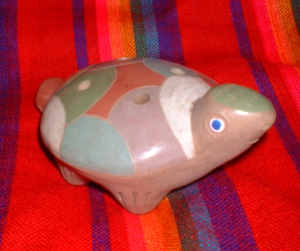
 From the time of its earliest use by ancient Indian tribes to the present day, the ocarina has maintained a unique mystique all its own. Its mellow, haunting sound has found its way into folk traditions around the world. The ocarina has been around since the Stone Age. They can be found in Asia, South America, Europe, Africa, and maybe even some places that haven't been discovered! Most are made from clay, although ocarinas have been found of bone, wood, antler, seed pod, seaweed, jade, quartz, metal, fimo, and plastic. They have been credited with magical as well as whimsical properties, imitating bird calls, and used as courting instruments. The Mayans of South America used them for special ceremonies. Travelers from Europe brought some South American whistles back to Europe, where the instrument was refined so as to play the Western do-re-mi scale. We offer ONE OF A KIND - Hand Made Ocarinas from the original place of its birth "Mexico"
Among the archeological relics,there is an egg shaped wind instrument- the Xun, made of earthenware clay with six tone holes and a blowing (embouchure) opening in it.The Xun has a history of more than 7000 years. At various times in Chinese history, musical culture is known to have been flourishing. In the Zhou Dynasty (256.B.C) there already appeared large-scale a orchestra in the imperial court. Musical culture in the Tang dynasty (618-907A.D) was so developed that it ranked among the best in the world and exerted great influence on the development of music in the countries in Southeast Asia. Although Europeans may have seen and heard of the Chinese Xun -"tschuan" or "tsing" aùll of 700 years ago,The sound and manner of playing was unknown in Europe.The same was true for the ancient Indian versions. Many native.american makers sculpted various forms of zoomorphic (animals,reptiles or birds) and anthromorphic (human) shapes for their fifes, trumpets ,whistles and ocarinas. Through the development of ritual, early culture produced "dancers' whistles"-the first ceramic fippled instruments*-leading to ocarinas and double-chambered whistling vessels. These were native to the cultures in Central (Mayan Ocarinas go back as far as 12,000 years) and South America in a society so distinct from other world cultures of the time, although similar in that music had grown from both physical and ritual roots. Of the Maya, Aztec and Inca peoples it was the Aztecs who brought the ocarina to Europe-though it is unlikely the Aztecs posessed any of the superior Mayan type. Cortes sent a large party of Aztec dancers and musicians to emperor Charles V to demonstrate the nature of Charles' new subjects from the New World. In 1527 their performance for the court at Valladolid astounded everyone- even more than the vast collection of looted treasure that had so impressed Albrect Durer when it was exhibited in Brussels seven years earlier. The Aztec singing was in perfect harmony ,the huge flowing ensemble of dancers moved in virtually absolute synchronicity. The Aztec musicians had ocarinas with them -descendants of fippled pottery whistles and vessel instruments with mouthpieces which had been developed millenia previously by the "alto-plano bird dancers" 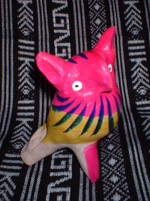 They became famous and were sent to perform a series of exhibitions all around Europe and were seen in Rome by Clement VII. One scenario runs that a baker in a noble Roman household was so impressed by the sound and sight of the Aztec clay instrument,that he immediately made some claõy whistles of his own-it was common at the time to utilise the hot ashes of the bakers' ovens to make low fired pottery items-mostly toys-and the novelty swept into fashion among bakers all over Europe and were an amusing new toy -the word 'ocarine' means 'little goose' in the Italian Emilian dialect. These sweet sounding toys sold at Markets and Fayres spreading to other makers throughout Europe. They remained a popular toy for more than 340 years until 17 year old Musician-Baker *Guiseppe Donati* of Budrio (near Bologna) Italy, transformed them from a toy which only played a few notes,into a real instrument which could play more than an octave accurately: Donati originated the first pitched diatonic scale ocarinas. Other makers too,developed consorts of ocarinas in eleven different sizes for group and solo concert performance.Various tutors were published and the ocarina became an 'instrument of the people'. In 1870 two ocarina ex- apprentices, ex-members of the Budrio ocarina ensemble, Ercole and Alberto Mezzetti began to make ocarinas in Paris.Their ocarinas won many important prizes in Paris and Edinburgh and other exhibitions. Another maker was Luigi Silvestri. from Camisano Vicentinowho invented the double ocarina, and his ocarinas were sold all over the world. In 1874,a journalist wrote of an ocarina concert at the Crystal Palace in "The London Daily News" that the 'Mountaineers of the Apennines' ocarina consort 'played a selection of operatic morceaux with a perfect skill and execution'. The consort included Cesare Vicinelli, one of Budrio's famous ocarina maker/players and the brothers Ercole and Alberto Mezzetti. Alberto settled in England to patent,make in Stafford ,and publish ocarina tutors and to spread ocarina playing in Britain ,leaving Ercole's Paris workshop to do the same in France . The first maker of ocarinas , Giuseppe Donati, won a gold medal at the Bordeaux exhibition of 1875 and later he received a diploma of honour. He signed his ocarinas in gold. In one of his catalogues published in Milan we find the several types of the `real ocarinas of Budrio'. in the keys" do Piccolo, Si, La, Sol, Fa, Mi, Re and Do Basso"; "ocarinas in terracotta, black ebony (deluxe with golden finish and box in china) in aluminium;í and the latest types: pump ocarinas, flute ocarinas, double ocarinas (with 2 octaves), `bottle' ocarinas and three voice ocarinas". 'Donati always stated in his catalogues, stationary and letters that his ocarinas were `entirely hand-crafted' without `the aid of any machinery'. In 1878, when Giuseppe Donati had a workshop in Bologna, Cesare Vicinelli began to make ocarinas at a place not far from Budrio known as "Fornace Silvani" ["The Silvani Kiln"]. His father had been a baker and he was an experienced baker himself, Cesare's expertise as a kilnman and as a multi-instrument musician placed him in an excellent position to become an ocarina maker and player. He accordingly invented proper moulds, which vastly increased his output. Antonio Canella was making ocarinas in Ferrara from about 1878 to 1940 . Like Donati he made various types; double ocarinas (one above the other), with a metal piston to alter pitch, etc. He made up to 100 ocarinas daily and exported them far and wide. He alîso made artistic ocarinas for special commissions. C. Mathieu was making ocarinas in 'fin de seicle' Paris - he patented a metal ocarina shaped like a bird, mounted on a metal support, that stood more than one metre high. A `Compagnie Generale de L'Ocarina' was formed to promote ocarina playing in France. In Pistoia. G.Boscherini, in Milan. Ghezzi, Epaminonda Bezzi in Ravenna, in Vienna, H.Viehn, and other makers in Italy and the rest of the world were beginning, or in, full production. Ottorino Respighi Antonio Certani Ligeti, Penderecki and Janacek are only a few of the Composers who wrote parts for ocarina in their orchestral works. When Cesare Vicinelli died in 1920 Guido Chiesa, his assistant for twenty-four years, was heir to his studio,his tools,his house and his tradition. Chiesa was then thirty-six,having been born into a market-gardening family in 1884. Vincinelli had not been too keen to teach the subtle secrets of fine ocarina making to his erstwhile apprentice who had to shïine for the honour of the Sylvani studio and the Budrio tradition. Another luminary of Budrio, Emilio Cesari,was a contemporary of Chiesa. While a student at the Bologna Conservatorio,he had worked for Cesare Vicinelli. Cesari manufactured the `Ocarinton', an ocarina with 2 pistons to change key, invented by Canella, and a 2-octave ocarina-" Flautino".( Luigi Silvestri had originated a double ocarina, with two octaves, with a smaller ocarina inside a bigger one; the model then inspired Antonio Canella to originate a " Bi- ocarina ", made of two ocarinas, one above the other with two mouthpieces close together, and from it Emilio Cesari. developed the triple ocarina.) He also wrote a tutor and composed several pieces for both solo and group playing. His studio was in a place near Budrio called "Le Creti" for seven years from 1920-27 when he removed (aged 39)to S.Remo via Bologna for his last performance as conductor and player of the "Gruppo Ocarinistico Budriese". He then discontinued oca rina making becoming a member of S.Remo's "Orchestre di Casino" Luigi Avalli from Cremona (1840-1917) , created a double voice ocarinas in 'Terre' (1/3) and 'Gemelle' (1/1) that were much prized abroad, especially in Germany. He won several local prizes. Servicemen in WW1 Europe had moulded plaster or metal ocarinas(made by H.Viehnor C. Mathieu among others) to lift their morale as much as could be expected. Japanese sculptor Aketa began ocarina making in 1928. In S.Remo in 1940 Cesari began to produce ocarinas again and gained distinction and recognition. American servicemen brought bakelite (first moulded plastic) versions to Europe during the Second World War.They were made byGretch and issued together with special military ocarina tutor books.The same ocarinas were sold by mail from Sears Roebuck after the war. Bing Crosby used "the little ocarina song" in "The Road To Bali". In 1963 Arrigo Mignani,who had been a member of the "Gruppo Ocarinistico Budriese"got in touch with Chie£sa and made a proposal for both his knowledge and his business-Chiesa had done well,he was probably ready to retire. Unfortunately,the grand old Chiesa at eighty wanted twenty million lira- a figure which stunned Mignani. Mignani eventually produced his first complete range of ocarinas a year later with tools he obtained for a mere million from the heirs of Emilio Cesari. In London England, John Taylorwho had started making ocarinas in 1963 after seeing some in the Museum, made the first English four-hole (proportionally tuned) ocarina in 1964 . Makers inspired often by him or his friends all round the world experimented during the 1960's and 1970's to find their individual expression in various forms of ocarina. "There have always been special types of Ocarinas because the inventor and maker always tries to explore the possibilities of the instrument. The best Ocarinas are those made by artisans; the original inv[entors and the first craftsmen have always made them exclusively by hand. To make them one does not need any particular specialist tool but only a good musical ear, the ability to do concentrated but relaxed work consistently and to make `concert', because to craft several ocarinas perfectly in tune is full of nicities". Instruments appeared invarious geometric forms and in the shape of birds,dolphins, hamadryads, bats,turtles and dinosaurs- etcetera. Various doubles, triples, chord pipes and experimental,and an ocarina to be played by 4 people (square torus with 4 mouthpieces) "Wild Thing" catapaulted the ocarina of Reg Presley to fame with the "Troggs" and in 1976 Berthold Bertolucci's film opus "1900" displayed the traditional Italian ocarina sound to marvellous effect.
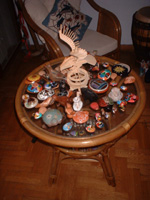
How Our Ocarinas are Made The Ocarina in Several Languages (Greek Included)
JEWELRY ||
PRINTS || CLOTHING || BOOKS || CRAFTS || LEATHER || OCARINAS || FOOT WEAR |

