        |
|
|
|
War Crime Tribunals: In 1998 the UN General Assembly voted in favour of a treaty authorizing a permanent international court for war crimes. The United States, China, and five other nations opposed the treaty, and 21 nations abstained. The court, to be called the International Criminal Court and to be located at The Hague, will prosecute war crimes, genocide, crimes of aggression, and crimes against humanity. |
|
|
The records of the war crimes trials after World War II provide one of the most comprehensive formulations of the concept of war crimes. During that war the Allies agreed to try Axis war criminals. In August 1945, Great Britain, France, the USSR, and the United States established a tribunal at Nuremberg to try military and civilian Axis leaders whose alleged crimes were directed at more than one national group. The trial opened in November 1945. Voluminous evidences were presented to prove the plotting of aggressive warfare, the extermination of civilian populations (especially the Jews), and the widespread use of slave labour, the looting of occupied countries, and the maltreatment and murder of prisoners of war. Critics have questioned the legal basis of some of the charges at the post-World War II trials. Individuals were found guilty of acts considered legal, or even required, by their nation at the time; such findings represent a violation of the concept of sovereignty. Critics have also termed the trials an act of vengeance by the victors and questioned their practical use as a precedent. Personal liability for national action is very difficult to prove conclusively, and a nation will be reluctant to try its own leaders. In the 1990s, in reaction to war atrocities committed by various parties during the break-up of Yugoslavia, the United Nations established a tribunal in The Hague, the Netherlands, and attempted to gather evidence for prosecutions; Serbs, Croats, and Muslims have been charged, including top civilian and military Bosnian Serb and Bosnian Croat leaders.
|
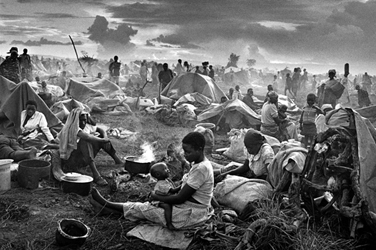
Many of the accused have not been extradited by their governments, and the suspects themselves are in charge of essential evidence. In 2000 the Hague tribunal officially established rape, which was rampant during the Yugoslav civil strife, as a war crime. A UN tribunal was also set up in Tanzania to bring to trial those responsible for Hutu massacres of Tutsis in Rwanda in 1994.
|
| ©2003 CRY JUSTICE Email Us | Home • Contents • Picture Gallery • News and Events • Feedback |