        |
|
|
|
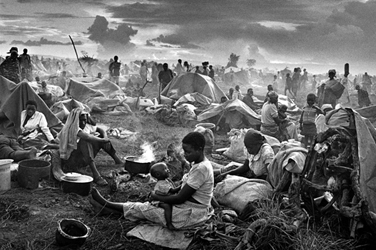
The Srebrenica Massacre: The Srebrenica massacre of approximately 8,000 Muslim men and boys, and the torture, rape, and killing of many women and children, which occurred from July 12 through July 18, in and near the UN declared "safe area" of Srebrenica. The massacre was carried out after the commander of the UNPROFOR (United Nations Protection Force), General Bertrand Janvier, refused to carry out UNPROFOR's mandate to defend the Safe Area and handed it over to Serbian army General Ratko Mladic. |
|
|
Why did the United Nations leave it’s first-ever ‘Safe Area’ virtually unprotected with the fate of 25,000 refugees in the balance? Few imagined Serb General Ratko Mladic would make such a blatantly aggressive move under the scrutiny of the UN. Dismissing Mladic’s advance as mere “probing,” officials repeatedly denied the Dutch peacekeepers’ urgent requests for air support, allowing the Serb army to capture the enclave with little resistance. Then, the deception unfolded as Mladic staged empty negotiations with peacekeepers and local leaders, guaranteeing the refugees’ safety in exchange for the town. Meanwhile, thousands of Muslim men were being systematically massacred in nearby death camps. The siege, which lasted no more than a few days, caught the world by surprise. The UN responded to the crisis with bungling inaction, demonstrating both inability and unwillingness to support its fledgling global police force. In the words of Yasushi Akashi, head of UN operations in Bosnia, “The UN was there to keep the peace, but not to enforce it.” French general Bernard Janvier, the senior UN corrsnander in the former Yugoslavia, repeatedly recommended that the UN abandon Srebrenica and two other UN "safe areas" for Muslim civilians in eastern Bosnia. Janvier's standing orders from the UN Security Council (Resolution 536) were to use "the necessary measures, including the use of force," to defend the safe areas. But the night before Srebrenica fell, Janvier turned down a crucial request from UN peacekeepers in Srebrenica for NATO close air support to bait attacking Bosnian Serbs. Janvier cited darkness, a pause in the Serb attack, and a telephone call with General Zdravko Tolimir as his reasons. "He says they do not intend to take the enclave," Janvier told his aides. "I believe him. If I'm wrong I'll draw my conclusions in the morning." Srebrenica fell the following day Janvier then called for the UN to withdraw from the two remaining safe areas in eastern Bosnia.
|
Finally, in a previously unknown July 4 letter, Janvier instructed his subordinates not to use NATO close air support to protect the UN safe area of Zepa. Eleven days later, Zepa's defenders finally succumbed to better-armed Serbs after NATO planes failed to appear. The conclusion is that either Janvier carried out his own recommendation to abandon the safe areas with the permission of the UN Security Council or he was incompetent. U.S. and UN intelligence failed utterly in identifying the threat posed to Srebrenica by Bosnian Serb forces gathering around the enclave. Even on the day the town fell, U.S. and UN analysts were misjudging Bosnian Serb intentions. Several weeks before the fall of Srebrenica, officials in the National Security Council privately discussed early versions of an "end game strategy" that involved the Muslim-led Bosnian government trading the three UN safe areas of Srebrenica, Zepa, and Gorazde to the Serbs. But U.S. Officials have denied that they intentionally or tacitly allowed Srebrenica and then Zepa to fall to the Serbs. No concrete evidence that U.S. officials were involved in a secret conspiracy to sacrifice Srebrenica or Zepa has been found, but a secret cable from U.S. Ambassador to Croatia Peter Galbraith pleading with U.S. officials to save Zepa exists; it was ignored. It was a poor performance by both U.S. intelligence and UN peacekeeping operations. Both bureaucracies – especially UN peacekeeping – are seemingly in need of major reform. Responding to worldwide outrage over events in Bosnia, the United Nations formed the International Criminal Tribunal for the former Yugoslavia (ICTY) in 1993. The international court of law has handed down 92 indictments for crimes against humanity, yet it wields little power. Intractable national sovereignty issues make it difficult to extradite suspects, and the inherent dilemma of punishing murder committed during wartime brings into question the morality of ICTY’s rulings.
|
| ©2003 CRY JUSTICE Email Us | Home • Contents • Picture Gallery • News and Events • Feedback |