        |
|
|
|
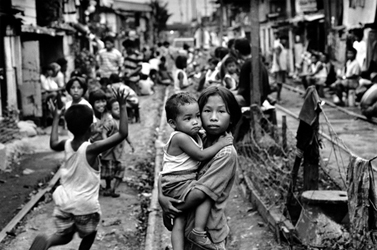
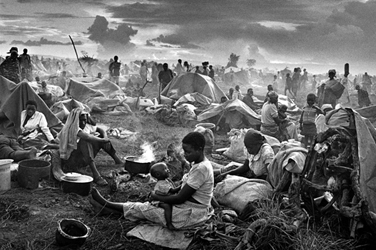
Global inequality: The richest 1% of the world have income equivalent to the poorest 57%. Four fifths of the world's population live below what countries in North America and Europe consider the poverty line. While 1.3 billion people struggle to live on less than US$1 a day, the world's richest 200 people doubled their net worth between 1994 and 1998 to more than $1 trillion. The world's top three billionaires alone possess more assets than the combined Gross National Product of all the least developed countries and their combined population of 600 million people. |
|
|
According to the latest annual United Nations Human Development Report (UNHDR), "Global inequalities in income and living standards have reached grotesque proportions”. "Some have predicted convergence. Yet the past decade has shown increasing concentration of income, resources and wealth among people, corporations and countries," the report states. While
1.3 billion people struggle to live on less than US$1 a day, the world's
richest 200 people doubled their net worth between 1994 and 1998 to more
than $1 trillion. The world's top three billionaires alone possess more
assets than the combined Gross National Product of all the least developed
countries and their combined population of 600 million people. The richest 1% of the world have income equivalent to the poorest 57%. Four fifths of the world's population live below what countries in North America and Europe consider the poverty line. The poorest 10% of Americans are still better off than two-thirds of the world population. The assets of the 200 richest people in 1998 were more than the total annual income of 41% of the world’s people. The richest 20% of the world population now receives 150 times the income of the poorest 20%. The share of the poorest 20% of the world's people in global income now stands at a miserable 1.1%, down from 1.4% in 1991 and 2.3% in 1960. It continues to shrink. The world’s riches and wealth continues to become more polarized, monopolized into the hands of the haves while the suffering of the have-nots only exacerbates. The World Bank and IMF are two agencies that determine whether developing countries get access to aid money and how it is spent. Northern governments use them to carry out certain foreign and commercial policy objectives, but as multilateral institutions they have the potential to foster cooperative international approaches on key issues such as environmental change. Structural adjustment programs (SAPs) are a set of economic policies required by the World Bank and the IMF as a condition of loans these institutions make to developing countries. These programs often include austerity measures such as high interest rates and reduced access to credit, which result in slower economic growth as well as increased poverty and unemployment. Other adjustment policies include cuts in government spending on health care and education, increases in the cost of food, health care and other basic necessities, mandates to open markets to foreign trade and investment, and privatization of state-run enterprises. But, is structural adjustment working? Structural adjustment has exacerbated poverty in most countries where it has been applied, contributing to the suffering of millions and causing widespread environmental degradation.
|
The wealthy Northern countries which control the World Bank and IMF dictate the agendas of these institutions, and their interests are best served by defending the status quo. Furthermore, the Bank's staff is currently dominated by economists who have spent their careers defending the validity of neoclassical economics, the foundation of the World Bank model of development. This orthodox view holds sacred the efficiency of free markets and private producers and the benefits of international trade and competition. Given the lack of accountability to outside parties, there is little incentive for the Bank and IMF to alter the design of structural adjustment, even when faced with mounting evidence attesting to the failure of these programs. Development projects undertaken with World Bank financing typically include money to pay for materials and consulting services provided by Northern countries. U.S. Treasury Department officials calculate that for every U.S.$1 the United States contributes to international development banks, U.S. exporters win more than U.S.$2 in bank-financed procurement contracts. Why is this bad? Given this self-interest, the Bank tends to finance bigger, more expensive projects--which almost always require the materials and technical expertise of Northern contractors--and ignores smaller-scale, locally appropriate alternatives. The mission of the World Bank to alleviate poverty, not provide business for U.S. contractors. The huge gap between rich and poor - with 84% of the world receiving only 16% of its income - has become more worrying since the world has faced the threat of organised terror from groups based in some of the world's poorest countries. The world is becoming a more unequal place, with a growing gap between rich and poor households. The gap is so big that the richest 1% of people (50 million households), who have an average income of $24,000 (£16,000), earn more than the 60% of households (2.7 billion people) at the bottom of the income distribution. The biggest source of inequality is the difference between the income of people in the five major economies (USA, Japan, Germany, France and Britain) and the poor in rural India, China and Africa. Studies point that the world per capita real income increased by 5.7%. But all the gains went to the top 20% of the income distribution, whose income was up 12%, while the income of the bottom 5% actually declined by 25%. At a time when trade and technology have linked the world more closely together than ever before, reality view the fortunes of the world as drifting downward.
|
| ©2003 CRY JUSTICE Email Us | Home • Contents • Picture Gallery • News and Events • Feedback |