|
Reform of the
Commission on Human Rights
On the last day of the 58th session of the Commission on Human Rights (the
Commission), a resolution was adopted aimed at enhancing "the effectiveness
of the working methods of the Commission".(1) The resolution noted that
while the number of documents submitted to the Commission had increased
significantly, the time available for the work of the Commission had been
drastically reduced. It therefore called for a thorough review of the
working methods of the Commission and requested the Office of the High
Commissioner for Human Rights (OHCHR) to solicit ideas and proposals from
governments, the Bureau of the 58th session, regional groups and
organizations, including non-governmental organizations.
Amnesty International welcomed this opportunity to contribute to the debate
around enhancing the effectiveness of the Commission and made submissions to
both the Bureau of 58th session(2) and to the OHCHR. In its submissions
Amnesty International focused its recommendations on two main areas:
strengthening the special procedures of the Commission and seeking concrete
expressions of commitment to human rights by the members of the Commission.
Since its creation, the Commission has played an important role in the
promotion and protection of human rights, including through the elaboration
of international human rights treaties and the development of the special
procedures to examine specific country situations and thematic concerns.
Yet, in contrast to what has been described by UN Secretary-General as the
Commission's "glorious history",(3) is a less honourable record of political
interest triumphing over action against human rights violations.
In recent years, members of the Commission have taken no action in the face
of grave human rights violations(4); they have blatantly refused to
co-operate with the terms of Commission resolutions;(5) they have not
renewed the mandates of country experts in situations where human rights
violations are rife;(6) and they have undermined their own human rights
experts by imposing severe limitations on their oral presentations.(7)
In 1998, a similar review of the functioning of the Commission was
undertaken by the Bureau of the 54th session.(8) That review produced a
number of pertinent observations and recommendations aimed at "enhancing the
capacity of the UN to promote and protect internationally recognized human
rights and contribute to the prevention of their violation".(9) Many of
these recommendations remain unimplemented. The present review of the
working methods of the Commission offers an opportunity to revisit the
recommendations of the 1998 review and to consider afresh how the Commission
can be best deliver its mandate to promote and protect human rights.
Membership of the Commission
Membership of the Commission carries particular responsibilities for those
53 states which sit on the body and in particular those which comprise its
Bureau. As a concrete commitment to internationally recognized human rights
and to the Commission itself, those standing for election to the Commission
should be expected to have already taken, or to announce their intention to
take, some or all of the following steps:
· Extend a standing invitation to all the Commission's special procedures
and co-operate with their requests to undertake visit, including follow-up
visits;(10)
· Provide written information about implementation of the recommendations by
the special procedures;(11)
· Respond promptly to requests for information by the special
procedures;(12)
· Ratify key international human rights treaties(13) and their optional
protocols, and provide for communications procedures and on-site
investigation, as relevant;
· Submit periodic reports to the treaty monitoring bodies on time and in
accordance with reporting guidelines;
· Implement the recommendations of the treaty monitoring bodies following
consideration of periodic reports and communications; and
· Ratify the Rome Statute of the International Criminal Court.
Membership of the Bureau of the Commission
The expectation that members of the Commission will undertake these steps is
particularly pertinent in relation to the five states elected to serve on
the Bureau of the Commission. A number of special duties are conferred upon
the Chair of the Commission, including the appointment of individuals to
special procedures posts, and it is imperative therefore that the
Chairperson is, and is perceived to be, an exponent of human rights at the
domestic and international levels.
The Special Procedures of the Commission
As noted in the 1998 Review of the Commission, the creation of the special
procedures has been one of the Commission's major achievements and
constitutes an essential cornerstone of UN efforts to promote and protect
human rights.(14) The value of the special procedures lies in their
independence and impartiality; their ability to act on violations, including
urgent cases, wherever and whenever they occur; the fact that they can speak
out publicly against human rights violations and undertake on-site visits.
As such, they remain the most dynamic tool that the Commission has at its
disposal to tackle human rights violations.
Amnesty International would like to see increased efforts made in this
review to place the special procedures firmly at the heart of the Commission
process. In particular, the Commission must address the recommendation in
the Vienna Declaration and Programme of Action calling for adequate
means for the special procedures and for follow up to recommendations by the
special procedures as a matter of priority. This will require both political
will and increased financial resources. In practical terms, it would entail
the following:
· Providing more time for the presentation and discussion at the Commission
of the special procedures reports and raising the quality of that dialogue,
e.g. by expanding the current time allocation(15) to a minimum of one hour
per mandate.
· Building on the 1998 review and recommendations, the Commission's
deliberations of reports of the special procedures should follow a set
agenda including a more focused dialogue on (a) observations and
recommendations of each mechanism, (b) the extent to which current and
relevant past recommendations have been addressed by the concerned parties,
and (c) the degree of co-operation with the Commission and its mechanisms by
the relevant governments, including with respect to requests for visits.
· Reflecting the recommendations of the special procedures in the
resolutions and decisions of the Commission, as relevant.
In order to facilitate a meaningful dialogue, the reports of the special
procedures must to be available sufficiently in advance of the Commission
session. Specifically:
· Reports and recommendations of the special procedures should be available
no later than six weeks before the start of the Commission, preferably in
all UN languages.
· All reports should continue to have an executive summary listing the
principal conclusions and recommendations of the mechanism concerned.
· The OHCHR should produce a comprehensive and regularly updated compilation
of the recommendations made by the thematic mechanisms.(16)
· The OHCHR should also produce a compilation by country of concerns and
recommendations made by the special procedures, including (a) a summary of
cases raised by the special procedures, (b) a summary of recommendations
arising from missions, (c) government replies, (d) the extent to which
recommendations made by the special procedures have been implemented,
including information from UN agencies, (e) requests for visits, including
whether the government has issued a standing invitation, (f) the status of
ratification of international human rights treaties, (g) the number of
overdue reports to the treaty monitoring bodies, and (h) information
regarding technical co-operation programs run by OHCHR
Apart from providing the
basis for a better quality debate at the Commission, this information could
also be a useful tool for drawing up technical co-operation programs within
the UN system.
Amnesty International calls on the Commission on Human Rights to adopt a
resolution to:
· Strengthen the special procedures of the Commission including through
allocating adequate resources to assist their effective functioning,
facilitating a meaningful discussion at the Commission of the reports and
recommendations of the special procedures, and ensuring the production of
timely and relevant documentation, including compilations of the
recommendations of the special procedures;
· Call on members of the Commission to take concrete steps to express their
commitment to human rights, including through cooperating fully with the
special procedures of the Commission, ratifying and implementing the key
human rights treaties and cooperating fully and promptly with the treaty
monitoring bodies.
Human rights and counter-terrorism
Both before and after 11 September 2001 governments have enacted and applied
security legislation and measures to counter "terrorist"(17) acts. Amnesty
International condemns in the strongest possible terms the terrorist attacks
on the USA on 11 September 2001 and recognizes that states have a duty to
protect the right to life of all people within their jurisdiction. However,
the organization notes that measures taken by states in response to real or
perceived terrorist threats, both before and after 11 September 2001, have
long had serious human rights implications. According to Amnesty
International's research, such measures often have a negative impact on the
peaceful and non-violent exercise of human rights. Amnesty International
condemns unreservedly attacks on civilians, whether committed by states or
by non-state actors, whatever the cause for which the perpetrators are
fighting, and whatever justifications they give for their actions.
International human rights law imposes two sets of obligations on states
with respect to acts commonly described as "terrorism": first, to take
measures to prevent and respond to terrorist acts and second, to ensure that
measures taken conform to state obligations under international and regional
human rights instruments.
International human rights treaties permit states parties to derogate from
or suspend certain rights in times of "emergency". For example, Article 4 of
the International Covenant on Civil and Political Rights (ICCPR) permits
derogation when there is a "public emergency which threatens the life of the
nation" but requires that the measures are not inconsistent with the states'
other obligations under international law or involve "discrimination solely
on the ground of race, colour, sex, language, religion or social origin."
Article 4 also specifies that some rights can never be suspended. These
include freedom from arbitrary deprivation of life (Article 6); freedom from
torture and cruel, inhuman or degrading treatment or punishment (Article 7)
and the right to freedom of thought, conscience and religion (Article 18).
Human rights violations as a result of counter-terrorism legislation
Evidence collected by Amnesty International over 40 years of monitoring of
laws and practices in response to real or alleged threats to security in all
regions of the world reveals a resulting pattern of serious human rights
violations.
Amnesty International is concerned that the so-called international "war on
terrorism" since the 11 September attacks has created significant new
pressure on governments to erode the protection of human rights, and
significant new opportunities for them to do so. Security legislation
frequently jeopardizes the rights of those suspected of security offences.
The definitions of ''terrorism'' in national security legislation are often
both broad and vague and this can lead to the criminalization of peaceful
activities that amount to no more than the exercise of rights that are
protected by international standards. Amnesty International is particularly
concerned that security legislation and measures may undermine specific
human rights notably:
- the right
to life, liberty and security of person;
- the right
not to be subjected to torture or other cruel, inhuman or degrading
treatment or punishment;
- the right
not to be subjected to arbitrary arrest or detention;
- the right
to seek asylum, and not to be forcibly returned to a country where the
individual is at risk of serious human rights violations.
Extrajudicial executions and "disappearances"
State authorities have frequently responded to "terrorism" by
extra-judicially executing people suspected of being or supporting
"terrorists" or by making them "disappear". Extra-judicial killings and
"disappearances" are often committed by members of security forces who hide
their identities, or by paramilitary groups acting with official complicity
and assistance.(18)
Torture
Torture has frequently occurred in the responses of states around the world
to "terrorism" and to real or alleged threats to national security. People
suspected of being "terrorists" have been tortured to force them to confess
or to provide information. People suspected of sheltering and aiding
"terrorists" have also been tortured and ill-treated in revenge, to obtain
information or to deter them from continuing to provide support. States
generally deny that they condone the use of torture as a means of
interrogation or to deter opposition. However, they often fail to take
effective measures to prevent it by such measures as prohibiting
incommunicado detention, requiring judicial supervision of all detainees and
ensuring prompt and independent investigation of complaints.(19)
Detention without charge or trial
The term "administrative detention" is commonly applied to the detention of
people who the authorities allege are involved in "terrorism" or other acts
considered to threaten public order or national security, but whom the
authorities do not intend to prosecute for criminal offences. Governments
around the world have for many years used administrative detention during
periods of international and domestic armed conflict and in times of civil
unrest. A key justification used by governments for administrative detention
is that they cannot present the evidence necessary to secure convictions
because that would jeopardize national security and intelligence
gathering.(20)
Extradition and other transfers of suspected "terrorists"
A key element of international, regional and bilateral measures to counter
"terrorism" is the establishment of procedures to transfer alleged
perpetrators. Amnesty International is concerned that in their efforts to
facilitate extradition procedures, states will not put in place or will
weaken human rights guarantees and may result in extradition to
jurisdictions where the alleged perpetrator may face serious human rights
violations.(21)
International response to terrorism and counter-terrorism
Security Council
Within weeks of the 11 September attacks, the UN Security Council adopted a
far-reaching resolution(22) setting out measures that states must take to
combat terrorism, including preventing and suppressing the financing of
terrorist acts; denying safe-haven to those who plan, support or commit
terrorist acts; sharing information and assisting other states in criminal
investigations or proceedings relating to terrorist acts; and preventing the
movement of terrorists. The Security Council also established the Counter
Terrorism Committee (CTC) to monitor implementation of the resolution and to
draft guidelines for states on what action to take to implement the
resolution, including in the field of legislation, executive action,
immigration law and practice, and law enforcement. However, states are not
required to consider or report on any human rights implications of the
measures they take to implement this resolution. Moreover, the CTC did not
consider that its task included assessing whether state actions were in
compliance with human rights standards and has declined to appoint a human
rights expert to assist and advise states in ensuring such compliance.
58th session of the Commission on Human Rights 2002
In view of the CTC's refusal to consider the human rights implications of
counter-terrorism measures by states, Amnesty International and other NGOs
looked to the Commission on Human Rights, the UN's main human rights body,
to address this crucially important issue. At the 58th session of the
Commission, in March-April 2002, the then UN High Commissioner for Human
Rights Mary Robinson invited the Commission to consider establishing a new
mechanism to monitor the implementation of the Resolution 1373 "from a human
rights perspective".(23) UN Secretary-General Kofi Annan also reaffirmed the
duty of states to protect their citizens, but stressed the need for states
to "take the greatest care to ensure that counter-terrorism does not [...]
become an all-embracing concept that is used to cloak, or justify,
violations of human rights".(24)
Mexico drafted a resolution on human rights and counter-terrorism which
called for the OHCHR to analyse the effects of counter-terrorism measures
and make recommendations. Although the draft resolution received broad
support from a large number of delegations, a few states were unhappy with
the draft and the short time available to discuss it. These factors and
various proposed amendments which Mexico considered would significantly
weaken the text led to the resolution being withdrawn before it could be put
to a vote. The Commission's failure to respond to one of the key human
rights challenges in today's world means that there is currently no
international mechanism "with a clear mandate to assess whether measures
taken and justified by a State as necessary to combat terrorism are in
violation of human rights standards which that State has accepted", as noted
by the then High Commissioner for Human Rights.(25) The challenge therefore
remains for the 59th session of the Commission to take concrete action to
address the issue of human rights and counter-terrorism.
57th session of the UN General Assembly 2002
At the start of the session, Mexico revived the proposal it had had to
abandon at the Commission and tabled a resolution on human rights and
counter-terrorism. Amnesty International welcomed the unanimous adoption by
the UN General Assembly of this resolution(26) which reaffirmed the
importance of respecting human rights, fundamental freedoms and the rule of
law in combating terrorism. The resolution stressed states' obligations to
ensure that certain non-derogable rights are fully observed at all times,
and that if states derogate from their obligations, they must meet all the
requirements of Article 4 of the ICCPR. The resolution also asks the High
Commissioner for Human Rights to monitor the protection of human rights
while countering terrorism and to make recommendations to states. Finally
the resolution requests the UN Secretary-General to submit reports on the
implementation of the resolution, both to the 59th session of the Commission
on Human Rights and to the 58th session of the General Assembly in 2003.
Amnesty International calls on the Commission on Human Rights to adopt a
resolution to:
· Call on all states to ensure that in taking counter-terrorism measures
they must ensure protection of both the security and the human rights of all
people within their jurisdiction, ensure that non-derogable rights are
strictly observed, and take account of relevant recommendations by the human
rights treaty monitoring bodies, including General Comment 29 of the Human
Rights Committee;
· Establish a new mechanism with a mandate to monitor and analyze the impact
on human rights of measures taken by states to combat terrorism, and to make
recommendations to states on safeguarding human rights in this context;
· Request relevant special procedures of the Commission on Human Rights to
monitor and report, as appropriate, on the impact of counter-terrorism
measures on human rights and to make recommendations for their effective
observance;
· Request the UN High Commissioner for Human Rights to ensure high-level
capacity at the OHCHR to support and coordinate efforts by various UN bodies
to monitor and analyse the impact on human rights by counter-terrorism
measures by states.
The death penalty
Each year since 1997 the Commission on Human Rights has adopted a resolution
on the question of the death penalty(27). These resolutions are important
indications of the views of member states on how to achieve the agreed UN
goal of abolition of the death penalty.(28) A similar draft resolution is
expected to be presented to the 59th session of the Commission in 2003.
The resolutions call upon states that retain the death penalty to establish
a moratorium on executions and to observe agreed safeguards in death penalty
cases. In 2002 for the first time, language was added urging retentionist
states not to impose the death penalty for "non-violent acts such as . . .
sexual relations between consenting adults".(29)
For the Commission's consideration of the question, an important source of
information will be the yearly supplement to the Secretary-General's
quinquennial report on capital punishment, to be submitted to the 59th
session of the Commission.(30) Amnesty International's own information
indicates continuing progress towards worldwide abolition. In 2002 Turkey
abolished the death penalty in peacetime, while the death penalty was
abolished for all crimes in Cyprus and the Federal Republic of Yugoslavia.
By mid-December 2002, 76 countries had abolished the death penalty for all
crimes; 15 had abolished it for ordinary crimes only and 20 were
abolitionist in practice, giving a total of 111 countries abolitionist in
law or practice. Eighty-four countries retained the death penalty, but many
of these did not carry out executions during the year.
Another important development was the adoption in February 2002 by the
Council of Europe of Protocol No. 13 to the European Convention on Human
Rights, the first international treaty to provide for the abolition of the
death penalty in all circumstances without exception. By the end of 2002,
the protocol had been ratified by 5 of the 44 Council of Europe member
states and signed by a further 34 states. The other three abolitionist
treaties - the Second Optional Protocol to the International Covenant on
Civil and Political Rights (ICCPR), Protocol No. 6 to the European
Convention on Human Rights and the Protocol to the American Convention on
Human Rights to Abolish the Death Penalty - had been ratified by 49, 41 and
8 states respectively.
Despite these positive developments, executions have continued, and in some
countries the safeguards referred to in resolution 2002/77 have not been
respected. The death penalty has been applied against the mentally ill and
the mentally retarded, against people convicted of non-violent crimes and in
many cases in which the defendants have not received a fair trial.
Amnesty International remains deeply concerned about the use of the death
penalty against child offenders - people convicted of crimes committed when
they were under 18 years old. Such use is contrary to resolution 2002/77 as
well as the Commission's resolutions 2002/36, 2002/47 and 2002/92.(31)
Amnesty International believes it is also a violation of customary
international law:
· 192 states are now parties to either the ICCPR or the Convention on the
Rights of the Child, both of which exclude the use of the death penalty
against child offenders.
· When the USA on ratifying the ICCPR entered a reservation to exempt itself
from the relevant provision of that treaty, 11 other states objected to the
reservation. The Human Rights Committee recommended that the USA withdraw
the reservation and stated that it believed the reservation to be
incompatible with the object and purpose of the ICCPR.(32)
· Executions of child offenders are very rare in comparison to the number of
executions carried out worldwide. In 2002 Amnesty International learned of
only three executions of child offenders, all in the USA.
· Very few countries still execute child offenders. Of the seven countries
reported to have done so since 1990, two (Pakistan and Yemen) have since
raised the minimum age to 18, as has China, and others have denied that they
execute child offenders. Only one country, the USA, regularly executes child
offenders and acknowledges doing so.
· The Inter-American Commission on Human Rights held in October 2002 that "a
norm of international customary law has emerged prohibiting the execution of
offenders under the age of 18 years at the time of their crime".(33)
Amnesty International has also been concerned about expansions of the scope
of the death penalty. Contrary to the agreed UN position that "the main
objective to be pursued in the field of capital punishment is that of
progressively restricting the number of offences for which the death penalty
may be imposed with a view to the desirability of abolishing this
punishment",(34) at least two countries extended the scope of the death
penalty to "terrorist"-related crimes in 2002 (Guyana and Indonesia), and
several other countries are currently discussing the possibility of
expanding its scope.
At the 59th session of the Commission, Amnesty International will be working
together with other members of the World Coalition against the Death
Penalty. This organization, founded in Rome in May 2002, is a coalition of
human rights organizations, trade unions, bar associations and local and
regional authorities from different parts of the world which have pledged to
work for the abolition of the death penalty worldwide.
Along with the other members of the World Coalition against the Death
Penalty, Amnesty International calls on the Commission on Human Rights to:
· Adopt a resolution on the question of the death penalty which reiterates
the provisions of the Commission's previous resolutions on the subject, as
well as:
· Affirm that the imposition of the death penalty on those aged under 18 at
the time of the commission of the offence is contrary to customary
international law, as stated by the Commission's Sub-Commission on the
Promotion and Protection of Human Rights;(35)
· Call upon states that still maintain the death penalty not to extend its
application to crimes to which it does not presently apply as the Commission
has repeatedly called on states which maintain the death penalty
"progressively to restrict the number of offences for which the death
penalty may be imposed";(36) therefore as a minimum requirement, they should
not extend its application to crimes to which it does not presently apply as
also provided in Article 4(2) of the American Convention on Human
Rights;(37)
· Decide to discuss the issue the issue again at its 60th session in 2004.
Amnesty International and the other members of the World Coalition against
the Death Penalty urge all members of the Commission to vote in favour of
such a resolution, and appeal to all states to co-sponsor it.
An optional protocol to the International Covenant on Economic, Social
and Cultural Rights
The 57th session of the Commission (2001) appointed an Independent
Expert(38) to examine the question of a draft optional protocol to the
International Covenant on Economic, Social and Cultural Rights (ICESCR) and
to submit a report to the 58th session (2002). In his report, the
Independent Expert noted that the system of economic, social and cultural
rights had lagged behind in development compared to the system which is in
place for civil and political rights. Only in 1985 did ECOSOC decide to
establish the Committee on Economic, Social and Cultural Rights to monitor
compliance by states parties with the provisions of the ICESCR, and to date
there is no procedure for individuals to submit communications about
violations of the rights contained in the ICESCR. The Independent Expert
also raised a number of issues which he considered warranted further study,
including which specific set of rights in the ICESCR should be covered by
the proposed new procedure, whether the Committee on Economic, Social and
Cultural Rights would be the appropriate body to consider individual
complaints, the criteria for such complaints and the nature and scope of any
remedies. In conclusion, the Independent Expert recommended that the
Commission should extend his mandate for one more year to allow these issues
to be further examined.
The resolution on economic, social and cultural rights(39) adopted by the
58th session of the Commission included several references to the need to
elaborate an optional protocol to the ICESCR:
· It extended the mandate of the Independent Expert and requested him to
address in his report to the 59th session "the question of the nature and
scope of state parties' obligations" under the ICESCR, the conceptual issues
of "justiciability of economic, social and cultural rights", and "the
benefits and practicability of a complaint mechanism under the Covenant";
· It further decided to establish, at its 59th session, an open-ended
working group of the Commission to consider options relating to the
elaboration of an optional protocol to the ICESCR.
NGOs have long campaigned for an optional protocol to the ICESCR, and
Amnesty International has now joined them in calling for this mechanism,
including at the 54th session of the Sub-Commission on the Promotion and
Protection of Human Rights (2002) where a resolution was adopted which urged
the Commission to mandate the open-ended working group to "proceed with the
drafting of the substantive text of an optional protocol to the ICESCR".
(40)
Why is an Optional Protocol to the ICESCR important?
The Vienna Declaration and Programme of Action, adopted by the World
Conference on Human Rights in June 1993, confirmed the universality,
indivisibility, interrelatedness and interdependence of all human rights(41)
and called on the Commission, in cooperation with the Committee on Economic,
Social and Cultural Rights, "to continue the examination of optional
protocols to the ICESCR".(42) Yet, nearly a decade later there is still no
initiative underway to draft an individual complaints procedure under this
Covenant. The benefits of an optional protocol have been enumerated by both
the Committee on Economic, Social and Cultural Rights and by NGOs:
· An optional protocol to the ICESCR would provide individuals and groups
with international recourse with respect to violations of economic, social
and cultural rights;
· It would mark an important step towards strengthening the principle of
progressive realization of social, economic and cultural rights to which
states parties to the ICESCR have committed themselves;
· The consideration of specific cases of violations of economic, social and
cultural rights would contribute to the development of jurisprudence;
· It would strengthen the relationship between the Committee on Economic,
Social and Cultural Rights and states parties by creating an impetus at the
national level for states parties to ensure effective national
implementation of the rights guaranteed in the ICESCR; and,
· It would further support the interdependence and indivisibility of civil,
political, economic, social and cultural rights;
Amnesty International calls on the Commission on Human Rights to adopt a
resolution to:
· Establish without delay an open-ended inter-sessional working group of the
Commission to elaborate a draft optional protocol to the ICESCR, as
established by Resolution 2002/24, in close cooperation with the Committee
on Economic, Social and Cultural Rights, the Independent Expert, and
relevant Special Rapporteurs, and on the basis of the guidelines contained
in the annex to the report of the Committee on Economic, Social and Cultural
Rights(43);
· Request the working group to meet between sessions for a minimum of two
weeks before the 60th session of the Commission;
· Request the Secretary-General to provide the working group with the
necessary assistance.
Human rights of refugees and asylum-seekers
The Commission on Human Rights and its subsidiary body, the Sub-Commission
for the Promotion and Protection of Human Rights (Sub-Commission) have been
seized of the issues relating to various aspects of displacement for some
time now. These bodies have examined issues relating to Internally Displaced
Persons (IDPs), migrants, forced population transfer, mass exodus, and
detention of asylum seekers, amongst others. In addition, Palestinian
refugee issues, which are specifically excluded from the mandate of the
United Nations High Commissioner for Refugees (UNHCR), have been considered
by the Commission.(44) It is clear, therefore, that the global refugee
problem and the human rights of refugees and asylum seekers do not fall
exclusively within the mandate of the UNHCR, but also come within the remit
of the UN's human rights bodies. Issues relating to the human rights of
refugees and asylum seekers have come up repeatedly within these bodies over
the last few years, but only as aspects of broader human rights themes.
Amnesty International would therefore urge that the Commission place
specific emphasis on refugee protection as a human rights issue, and of
asylum seekers and refugees as part of the larger group of non-nationals
protected by human rights standards.
Amnesty International's work for the protection of refugees, asylum seekers
and other categories of displaced persons is an essential component of its
work for the protection of human rights. Amnesty International calls on the
Commission to bring greater prominence to the human rights of refugees and
asylum seekers, an issue which traditionally has not been granted much
focused space within the work of the UN human rights bodies. The rationale
for approaching the Commission is to ensure, in a post-Cold War and post-11
September world, that a human rights framework is brought to bear on matters
of the protection of displaced persons. This is especially relevant at a
time where states are attempting to roll back many of the protection-related
aspects of the international refugee regime. It is Amnesty International's
position that respect for the human rights of refugees, asylum seekers and
other categories of displaced persons is necessary to protect the safety,
dignity and integrity of all individuals from abuses of power, and to
shield this specific category of individuals from the particular
vulnerability of their situation.
No comparable monitoring body to the range of mechanisms established under
international human rights law exists within international refugee law.
Thus, while Amnesty International continues to approach the 1951 Convention
relating to the Status of Refugees as a human rights instrument, and
continues to press states to uphold their obligations under this Convention,
the organisation also advocates increased use of international human rights
bodies and mechanisms to ensure the protection of refugees and asylum
seekers.
Human rights and root causes of displacement
Amnesty International is concerned that the human rights abuses in countries
of origin that, together with displacement during armed conflict, most often
are the root causes of forced displacement are permitted by governments and
the international community to flourish unchecked. In West Africa a series
of armed conflicts in several of the states in the region has resulted in
decades of displacement for millions of people. Refugees and IDPs have been
deliberately targeted by government forces and armed groups, while the
principle of non-refoulement, a fundamental precept of international
human rights law as well as international refugee law, has been flouted with
impunity.
Voluntary repatriation and 'durable solutions'
The search for solutions to the problem of refugee flight is often distorted
by the fact that the 'solutions' proposed by governments and the
international community do not uphold fundamental standards of human rights
and hence are not durable. For return to be sustainable, the safety, dignity
and full respect for the human rights of the persons concerned must be taken
into effective consideration. A failure to ensure this will most often lead
to further cycles of displacement, leaving refugees and asylum seekers
vulnerable to sexual and other forms of exploitation. In the case of
refugees and asylum seekers from Afghanistan, the haste with which states in
the European Union and others are negotiating agreements for the return of
such persons, in the absence of durable change in the situation on the
ground, appears to be at odds with the requirement that return should be
sustainable and consistent with principles of international refugee and
human rights law.
Arbitrary detention
Due to the situation of heightened vulnerability in which they find
themselves, refugees and asylum seekers are often at risk of being subject
to arbitrary detention. Under international human rights law, the rights to
liberty and freedom from arbitrary detention have been a core element of
formal human rights standards since they were enshrined in Articles 3 and 9
of the UDHR. Amnesty International has voiced its opposition to the 'Pacific
Solution' operated by Australia on the grounds that, in the absence of
fundamental human rights safeguards (such as independent periodical review
of detention in individual cases), such detention is arbitrary and violates
international law.
Economic, social and cultural rights of displaced persons
The denial of economic, social and cultural rights in the country of asylum
can result in people being effectively forced to return to countries where
they may face serious human rights violations. Further, the denial of such
rights in countries where asylum seekers first seek refuge can result in the
onward movement of such persons to country after country in a seemingly
endless search for protection. The interdependence and indivisibility of all
human rights - civil, political, economic, social and cultural, and the
domino effect of grave violations of the full spectrum of rights, has been
tragically illustrated by the sexual exploitation of displaced women and
girl children in West Africa and Nepal by humanitarian aid workers.
Amnesty International calls on the Commission on Human Rights to:
· Adopt a resolution on human rights and refugees which recognises that
everyone is entitled to human rights and fundamental freedoms without
distinction of any kind and that refugees and asylum seekers, because of
their particular need for international protection, enjoy certain additional
and specific rights, including the right to seek and enjoy asylum from
persecution as stated in Article 14 of the Universal Declaration of Human
Rights;
· Call on relevant Special Procedures of the Commission to give specific
attention to the human rights of refugees and asylum seekers;
· Request the UN High Commissioner for Human Rights to prepare an analytical
report on the protection of the human rights of refugees and asylum seekers,
based on the various references to refugees and asylum seekers in Commission
and Sub-Commission resolutions and reports, and to submit it to the 60th
session of the Commission.
Country situations
Colombia
At the 58th session of the Commission on Human Rights, a Chairperson's
statement on the human rights situation in Colombia(45) was adopted by
consensus. The statement urged that the cooperation between the Colombian
Government and the OHCHR be further strengthened and that the
recommendations by the OHCHR be urgently complied with. It condemned the
persistence of impunity and continued violations of human rights and
international humanitarian law. It encouraged the parties to the conflict in
Colombia to negotiate a political solution, and called on all armed
opposition groups to comply with international humanitarian law. It further
expressed concern about alleged links between the military and the
paramilitaries and deplored attacks on human rights defenders, trade union
leaders and church dignitaries.
Amnesty International is deeply concerned to note that following the
collapse in February 2002 of peace talks between the government and the
armed opposition group, Fuerzas Armadas Revolucionarias de Colombia(46)
(FARC), the internal conflict has further intensified with
devastating consequences for the civilian population in the areas affected
by the conflict. Amnesty International has observed little or no progress
with regard to implementing the recommendations of the UN. Amnesty
International has continued to receive information which reveals widespread
and systematic violations of human rights by the security forces and their
paramilitary allies and abuses of international humanitarian law by armed
opposition groups.
Moreover, Amnesty International is deeply concerned that measures taken by
the new government under President Dr. Alvaro Uribe to address the internal
conflict are in fact exacerbating the human rights crisis as well as being
contrary to UN recommendations to end impunity, dismantle the
paramilitaries, and guarantee the safety of vulnerable groups. President's
Uribe's so-called doctrine of "Democratic Security", aimed at ending the
armed conflict, does not include a program to combat abuses of human rights
and international humanitarian law, and as such marks the failure of the
government to acknowledge that security cannot be guaranteed without full
respect for human rights. Rather than shielding the civilian population from
the armed conflict the government's measures risk dragging civilians further
into the conflict. The creation of a network of civilian informants and
"peasant soldiers" required to collaborate with the security forces puts
them in danger of attacks by the other side in the conflict; the
proposed granting of judicial police powers to the armed forces; and the
restricted access to conflict areas serve only to compound the already
serious human rights situation in Colombia.
The FARC continues to be responsible for serious violations of international
humanitarian law, including killings of civilians whom they accuse of
collaborating with their enemies, and for indiscriminate and
disproportionate attacks which have resulted in the killing and wounding of
hundreds of civilians. Moreover, the FARC and the Ejército de Liberación
Nacional(47) (ELN) are responsible for well over 1,500 cases of
kidnapping and taking of hostages each year.
Impunity for human rights violations
On 25 November 2002, the Constitutional Court declared key parts of Decree
2002(48) unconstitutional, most importantly those granting judicial police
powers to the armed forces, and in December Congress failed to approve
government proposals to defer such powers to the security forces. However,
the government has recently announced its intention to reintroduce these
proposals to Congress in March 2003. Previous administrations have also
sought to give judicial police powers to the armed forces. However, on each
occasion these efforts have been declared unconstitutional by the
Constitutional Court.(49) In the past, the Human Rights Committee has
expressed its concern that the Colombian "military exercise the functions of
investigation, arrest, detention and interrogation".(50)
Despite ample evidence of military culpability in human rights violations,
either directly or in collusion with the paramilitary, few members of the
security forces have ever been brought to justice. The fact that those
responsible for widespread political killings and "disappearances" are
seldom punished has undermined public confidence in the administration of
justice and the rule of law.
Over the last year, the ability or willingness of the Fiscalía General de
la Nación(51) to advance investigations into human rights violations has
increasingly been called into question. In its 2002 Report, the Colombia
Office of the OHCHR expressed its concern "about the changes that have
occurred since the appointment of the new Attorney-General(52) - affecting
the orientation of his Office and involving the dismissal of certain
officials, among other things - which have raised serious fears about the
prospects for strengthening the institution and its commitment to combating
impunity."(53)
Amnesty International has received reports that the Fiscalía General de
la Nación has sought to block or hinder investigations into human rights
violations in which senior military officers are implicated. Prosecutors
working on such cases have frequently been removed from cases or dismissed
from their posts; some have received death threats. Witnesses and colleagues
working on these investigations have also been killed.
Lack of access to conflict zones
Amnesty International is concerned that the creation of Rehabilitation and
Consolidation Zones is designed to screen off these areas from observation
by national and international human rights organizations and the media and
to make it difficult for them to monitor and document human rights
violations. In this way "dirty war" tactics carried out by paramilitaries in
conjunction with the armed forces can continue unhindered. People living in
these areas, including local human rights workers, could now be required to
report any planned travel outside a municipality to the authorities. This
may facilitate surveillance of their legitimate work and expose them to
increased risk of reprisal should they try to travel outside a region to
monitor human rights violations. The government has also decided that
foreign human rights and humanitarian NGO workers must seek special NGO
visas - which are bureaucratic and expensive to obtain - to travel to the
country. Several foreigners have been deported from Colombia prior to and
since the creation of the Rehabilitation and Consolidation Zones.
Links to paramilitary groups
Illegal paramilitaries, backed by the army, have tortured, killed and
"disappeared" for decades with virtual impunity. Their collaboration with
the security forces has been well documented by Amnesty International, as
well as in reports by the UN and the Organization of American States, and
criminal and disciplinary investigations continue to implicate high-ranking
security force officers in serious human rights violations committed by
paramilitary units. In her report to the 58th session of the Commission, the
Special Representative of the Secretary-General on human rights defenders
recommended that the government should "dismantle paramilitary groups for
good by arresting, prosecuting and punishing anyone who encourages, leads,
participates in, support or finances them".(54)
Over recent years, the security forces have captured increasing numbers of
alleged paramilitaries.(55) However, it is unclear how many of these are in
detention, and how many are under investigation or have been charged with
violations of human rights. The Ministry of Defence has also provided
statistics indicating an increase in the numbers of paramilitaries killed in
the course of security force operations.(56) However, the fact that
paramilitaries have been killed and captured by the security forces over the
last two years has not prevented the continued spread and consolidation of
paramilitary forces throughout the country, including in areas with a heavy
military presence.
Civilians caught up in the conflict
The armed forces' counter-insurgency strategy is aimed at undermining what
they perceive to be the civilian population's continued support for the
armed opposition groups. Failure to actively collaborate with the state and
the military often leads to the systematic harassment of the civilian
population and to its stigmatization as "guerrilla sympathizers".
The government's policies do not appear to respect the right of the civilian
population not to be drawn into the conflict. In fact, in a letter sent to
Amnesty International on 16 October 2002, President Uribe stated: "Nobody
can be neutral in the state's fight against criminality."
During Alvaro Uribe's presidential campaign, he announced his intention to
create a million-strong network of civilian informants to compile and pass
on intelligence information on illegal armed groups to the security forces.
The creation of this network gives civilians a direct role in the conflict,
blurring the distinction between civilians and combatants and making them
liable to be viewed as targets by armed opposition groups. The government
has also announced plans to recruit 150,000 "peasant soldiers" who would
participate in the war against armed opposition groups while continuing to
live within their own communities. This will place them at increased risk of
attack by armed opposition groups.
During the last decade some two and a half million people have been
internally displaced by the conflict, and the rate of forced displacement
continues to increase dramatically.(57)
Attacks on civil society
Amnesty International fears that the government's policies will legitimize
attacks against those sectors of the civilian population labelled as
"guerrilla collaborators" by the security forces and their allies. Since
Decree 2002 was implemented Amnesty International has received numerous
reports of mass detentions, many undertaken without judicial warrants. Some
of those detained have been held without charge for extended periods of time
and on occasions detainees have been kept in conditions which could
constitute inhuman and degrading treatment.
Amnesty International has documented cases of human rights violations
against human rights defenders, trade unionists and other social activists
committed by the security forces or their paramilitary allies. Frequently
these attacks have followed accusations by the security forces that the
victims were "guerrilla collaborators".
The Special Representative of the Secretary-General on human rights
defenders urged the government "to adopt appropriate measures to disseminate
and ensure full observance of the Declaration on Human Rights Defenders" and
to "initiate and maintain a constant dialogue with NGOs in order to respond
to their concerns and to coordinate measures which would strengthen their
protection and their activities".(58)
Amnesty International calls on the Commission on Human Rights to:
· Adopt a resolution expressing grave concern at the deepening human rights
crisis in Colombia;
· Express profound disappointment that the recommendations adopted by the
58th session of the Commission remain unimplemented and urge the government
to draw up a national plan of action for full and prompt implementation of
the recommendations made by the UN and other international organizations;
· Call on the government and armed opposition groups to sign a humanitarian
agreement that would protect the civilian population and ensure full respect
for human rights and international humanitarian law, as called for by the UN
Secretary-General;(59)
· Urge the government to take urgent steps to end impunity for human rights
violations by undertaking prompt and impartial investigations into all
allegations of human rights violations, ensuring that those responsible
stand trial in civilian courts in accordance with international standards
for fair trial;
· Urge the government to take effective and decisive action to combat and
dismantle paramilitary groups and to sever the links between the security
forces and the paramilitaries;
· Urge the government to take all necessary measures to guarantee the
protection of human rights defenders and to implement in full the
recommendations of the Special Representative of the UN Secretary-General on
human rights defenders;
· Urge the government to abandon measures that risk dragging the civilian
population further into the conflict, including the networks of civilian
informants and the army of "peasant soldiers";
· Urge the government to fully implement the Guiding Principles on
Internal Displacement(60), including prevention of forced displacement,
protection of the internally displaced, access to humanitarian aid and the
right to return or resettlement;
· Urge the government to give access to international human rights and
humanitarian organizations to conflict zones and remove restrictions on
movement, including those contained in Decree 2002;
· Encourage the government to cooperate fully with the UN including issuing
standing invitations to all the thematic mechanisms of the Commission to
visit Colombia;
· Secure adequate funding for and continue to strengthen the mandate of the
Colombia Office of the OHCHR, including through increased field presence;
· Request the High Commissioner for Human Rights to submit a report on
Colombia to the 60th session of the Commission and an interim report to the
58th session of the UN General Assembly.
Democratic Republic of the Congo (DRC)
At the 58th session of the Commission on Human Rights, a resolution was
adopted(61) which called on all parties to the conflict to respect
international human rights and humanitarian law, end the use and recruitment
of child soldiers, allow the safe return of refugees and internally
displaced people, and allow free access to areas under their control. It
further called on the government of the DRC to end impunity, reform and
restore the judicial system, respect freedom of expression and association,
and cooperate with the Human Rights field office. Finally it called on the
Commission to extend the mandate of the Special Rapporteur on the DRC,
request a joint mission by the Special Rapporteur on extrajudicial, summary
or arbitrary executions and the Working Group on enforced or involuntary
disappearances, and support the Human Rights field office in the DRC.
Amnesty International remains deeply concerned by systematic and widespread
human rights abuses, including the unlawful killing of hundreds of thousands
of unarmed civilians, and the displacement of as many as one million people
from their homes while hundreds of thousands others have fled the country.
Various armed forces, particularly those under the command of the
governments of the Democratic Republic of the Congo, Rwanda, and Uganda, as
well as Congolese and other foreign armed political groups, are responsible
for systematic and countrywide human rights violations. Deliberate reprisals
against the civilian population are a common reaction by all sides to
military setbacks and many unarmed civilians are deliberately and
arbitrarily killed or "disappeared" in revenge attacks. Torture, including
rape, is widespread. All sides have used the war to justify the repression
of political dissent and the imprisonment of opponents remains routine.
Amnesty International welcomes the decision of the UN Security Council(62)
on 4 December 2002 to expand the deployment of United Nations Organization
Mission in the Republic Democratic of the Congo (MONUC) to 8,700 military
personnel. According to the resolution the expanded MONUC will reinforce the
existing task force in the disarmament, demobilization and reintegration
process, assist in the destruction of impounded weapons and munitions, and
monitor the withdrawal of foreign troops from the territory of the DRC.
Human rights violations in regions controlled by the DRC government
The trial of those suspected of involvement in the assassination of former
President Laurent-Désiré Kabila which began in March 2002 was closed to
independent observers for the initial five months. Amnesty International is
concerned that it did not meet international standards of fair trial. On 11
October 2002, the prosecution wound up its case by requesting the death
penalty for 115 of the 135 accused. Earlier, on 23 September, the government
announced that it had lifted a moratorium on executions, which had nominally
been in place for the past three years. The government also announced that a
law had been promulgated to abolish the Cour d'ordre militaire(63)
(COM), on 18 December 2002. Although Amnesty International welcomes the
abolition of the COM, the organization is concerned that death sentences
imposed by the court before its dissolution might still be implemented.
Members of the security forces carry out unlawful killings of unarmed
civilians and use excessive force, and in virtually all cases the government
has failed to take action against suspected perpetrators. On 10 November
2002, dozens of unarmed civilians were unlawfully killed by government
forces during armed clashes in Ankoro in the south-eastern Katanga Province,
between the pro-government soldiers and Congolese armed political groups
known as the Mayi-Mayi militia. Tens of thousands were forced to
flee. In Mbuji-Mayi, the hub of the DRC's diamond trade, guards employed by
the Société Minière de Bakwanga(64) (MIBA), the largely state-owned
mining company, have frequently used excessive and lethal force against
unauthorized miners, killing dozens and injuring many more. Yet, not a
single MIBA guard is known to have been brought to justice.
Torture and ill treatment continue to be widespread, especially in
unofficial detention centres run by the security forces. Detainees are
almost invariably held incommunicado and are routinely refused medical care.
Beatings, including whippings with cordelettes (military belts), are
particularly common. There are numerous reports of women in custody being
raped by members of the security forces. Psychological torture, such as
death threats and mock executions, is also frequent. Conditions in many
detention centres are appalling. At least 46 prisoners are reported to have
died between March and June 2002 in Kinshasa's main prison, Centre
Pénitentiaire et de Rééducation de Kinshasa(65) (CPRK), previously known
as Makala Prison. They reportedly died as a result of ill-treatment, lack of
medical care and lack of food.
Human rights defenders are routinely harassed, threatened and detained for
investigating human rights violations by government security forces and
press freedom remains under threat as journalists continue to face detention
and ill-treatment.
Human rights violations in regions controlled by foreign government
forces
In areas of eastern DRC, controlled by armed political groups supported by
foreign government forces, particularly from Burundi, Rwanda and Uganda,
human rights abuses are widespread and include unlawful killings of unarmed
civilians, arbitrary arrests, unlawful detention and torture, including
rape, and recruitment of child soldiers. Amnesty International is also
deeply concerned for the safety of human rights activists who are routinely
threatened by armed political group leaders for investigating and expressing
concern about the abuses.
Killings of unarmed civilians in the armed conflict between members of the
Hema and Lendu ethnic groups continue in the Ugandan-created Kibali-Ituri
province, previously part of Oriental province. Political armed groups and
their allies have frequently clashed over leadership of the region, which is
rich in minerals and timber. These groups are responsible for massacres,
summary executions, rape, torture and other forms of cruel, inhuman and
degrading treatment. They have targeted human rights defenders and carried
out abduction and massive recruitment of child soldiers. Ugandan government
troops support rival armed factions and also participate in extrajudicial
executions and other human rights violations. As many as 50,000 people are
reported to have been killed since June 1999, and around 500,000 have been
forcibly displaced, often with no access to humanitarian assistance. In
November 2002, staff from humanitarian NGOs were arrested and briefly
detained by the armed groups in Bunia.
Human rights violations in the region controlled by the RCD
In the region controlled by the RCD–Goma,(66) human rights abuses are
widespread and include unlawful killings of unarmed civilians, arbitrary
arrest, unlawful detention and torture, including rape. These abuses are
often committed in response to attacks by armed groups opposed to the
RCD-Goma, including Rwandese and Burundian Hutu-dominated armed political
groups and the Mayi-Mayi militia.
Over a 10-week period from 10 February 2002, a local human rights network
reported more than 500 killings, over 100 rape cases and several abductions,
as well as destruction of villages by fire and looting in the Kivu region
under RCD-Goma occupation. Amnesty International is also concerned that in
the South-Kivu province, long-standing tensions between Congolese Tutsi
known as Banyamulenge and Rwandese government and allied Congolese forces
have degenerated into a serious armed conflict in the hauts plateaux
near Uvira. Large numbers of Banyamulenge civilians were killed in the
fighting and tens of thousands were either internally displaced or forced to
flee to neighbouring Burundi.
Congolese refugees belonging to the Banyamulenge community have also been
arrested in the Burundian capital, Bujumbura, by the Burundi authorities,
and in Uvira (DRC) by members of the RCD-Goma and transferred to different
detention centers in Burundi, and the DRC. During their transfer into
custody some of them were badly beaten and tortured.
In June 2000, some 1,200 people were killed by Rwandese and Ugandan troops
and their RCD allies in Kisangani, northeastern DRC, and again in mid-May
2002, over 200 people were killed in the same city, reportedly by members of
the RPA and combatants loyal to the RCD-Goma. The abuses occurred in the
aftermath of a brief mutiny by soldiers opposed to RCD-Goma's refusal to
become party to a power-sharing agreement between the DRC government and the
Mouvement pour la Libération du Congo(67) (MLC).
In June 2002, the Security Council drew the attention of the High
Commissioner for Human Rights to the massacres in Kisangani, which led to
the Special Rapporteur on extrajudicial, summary or arbitrary executions
undertaking a fact-finding mission to the DRC in June 2002.(68) In her
report, the Special Rapporteur describes the situation in Kisangani as
"still explosive" and emphasizes the urgent need for the government to
tackle the issue of impunity which, she states "is virtually guaranteed to
those in positions of authority, even when they commit such serious human
rights violations as massacres in broad daylight".
|
Violations against women and girls
Rape and other forms of sexual violence against girls and women have been
used systematically as a weapon of war in the on-going armed conflict.
Thousands of girls and women have been raped and forced into sexual slavery
by combatants. The consequences for the victims are often rejection by their
families or communities and infection by HIV/AIDS. The Committee on the
Elimination of Discrimination against Women, following its review in 2000 of
the DRC's periodic report, expressed its grave concern at "reports of women
who were raped, assaulted or severely tortured during the war".(69)
Child soldiers
All parties to the conflict continue to recruit and use child soldiers,
although demobilization programs are supposed to be in place in both
government and opposition held areas. However, the on-going conflict, as
well as generalized poverty, degradation of basic socio-economic
infra-structure, leads often to re-recruitment. In its concluding
observations, in June 2001, the Committee on the Rights of the Child
expressed its deep concern "at the direct and indirect impact of the armed
conflict on almost all children" in the DRC, including "the deliberate
killing of children by armed forces of [the DRC], armed forces of other
[states] involved in the conflict and by other armed groups". The Committee
further expressed concern at "the recruitment and use of children as
soldiers by [the DRC] and by other actors in the armed conflict, including
children under 15."(70) The Special Rapporteur on the DRC recommended in her
report to the 57th session of the General Assembly that "all child soldiers
must be demobilized and reintegrated in society".(71)
Amnesty International calls on the Commission on Human Rights to:
· Adopt a resolution expressing concern at the continuing human rights
crisis in the DRC;
· Support the establishment of an international commission of inquiry into
allegations of grave abuses of human rights and international humanitarian
law in the context of the conflict in the DRC, and to report back to the
60th session of the Commission in 2004;
· Call on all parties to the conflict in the DRC to instruct their
combatants to end all human rights abuses and to adhere to international
human rights and humanitarian law;
· Call on all governments involved in the conflict to ensure prompt and
impartial investigations into all allegations of human rights violations and
that those found responsible are brought to justice in accordance with
international standards for fair trial;
· Call on all parties not to recruit anyone under the age of 18 into their
armed forces, and to demobilize anyone who was under the age of 18 at the
time of their recruitment;
· Emphasize that human rights must have a central role in the United Nations
Organization Mission in the DRC (MONUC) and to strengthen the cooperation
between MONUC and the Human Rights Field Office of the OHCHR in the area of
humanitarian and human rights monitoring in accordance with the agreed terms
of reference
· Urge the government to re-introduce a moratorium on the death penalty with
a view to its complete abolition;
· Call on the government to ensure respect of the rights of women, including
as specified in Commission Resolution 2002/52 "to promote and protect the
human rights of women and [to] exercise due diligence to prevent,
investigate and punish acts of all forms of violence against women", and in
situations of armed conflict, as emphasized by Security Council's Resolution
1325 to "take special measures to protect women and children from
gender-based violence, particularly rape and other forms of sexual abuse,
and all other forms of violence in situations of armed conflict";
· Call on the government to issue a standing invitation to the thematic
mechanisms of the Commission to visit the DRC, to facilitate the joint
mission to the DRC by the Special Rapporteur on extrajudicial, summary or
arbitrary executions and the Working Group on enforced or involuntary
disappearances, and to assist the work of the Special Rapporteur on the DRC,
including by responding promptly and in full to her communications;
· Urge the government to cooperate fully with the treaty monitoring bodies,
including by submitting those periodic reports that are overdue, to promptly
implement the recommendations by the relevant treaty bodies and by the
thematic mechanisms of the Commission, and to monitor implementation of
these recommendations;
· Renew the mandate of the Special Rapporteur on the DRC and ensure the
provision of adequate financial support to enable her to undertake her work
effectively and make her reports widely available;
· Ensure adequate resources for the Human Rights field office in the DRC to
enable it to carry out its work effectively;
Israel and the Occupied Territories
The human rights crisis in the context of the Palestinian uprising (known as
the al-Aqsa intifada) against Israeli occupation, has continued to
worsen. From 29 September 2000 to mid-December 2002, some 1,800 Palestinians
have been killed by members of the Israeli army, most of them unlawfully,
including more than 300 children. In the same period more than 600 Israelis,
some 440 of them civilians, including 82 children, have been killed by
members of Palestinian armed groups in targeted or indiscriminate attacks.
In addition, tens of thousands of Palestinians and Israelis have been
injured, many maimed for life.
At the 58th session of the Commission the human rights crisis in Israel and
the Occupied Territories was discussed extensively in light of the
deterioration of the situation during the session. Several resolutions were
passed, including one which mandated the UN High Commissioner for Human
Rights to lead a visiting mission to the area and report back to the
Commission while it was still in session. At the same time the UN Security
Council passed a resolution(72) which, among other things, welcomed the
Secretary-General's initiative to develop accurate information regarding the
events in Jenin through sending a fact-finding team. The EU, the Council of
Europe's Parliamentary Assembly, the League of Arab States and several
governments expressed concern at the grave deterioration of the situation
and called for initiatives to restore peace and security.
Amnesty International's call for international human rights monitors to be
urgently deployed was widely supported by both NGOs and governments. The
Special Rapporteur on the situation of human rights in the Palestinian
territories occupied by Israel since 1967 stated that "[t]he need for an
international presence, either in the form of monitors or peacekeepers is
surely imperative to reduce violence, restore respect for human rights and
create conditions in which negotiations can be resumed".(73)
However, neither the delegation headed by the UN High Commissioner for Human
Rights nor the fact-finding team established by the UN Secretary-General
could travel to the area due to Israel's refusal to facilitate their
visits.(74) Israel also continues to oppose the deployment of international
monitors and has increasingly targeted human rights and humanitarian workers
and activists, including by imposing restrictions on their movements and
activities and expelling or refusing them access to the country.(75)
Killings
The Israeli Defence Force (IDF) has continued to routinely use F16 fighter
jets, helicopter gunships and tanks to bomb and shell densely populated
Palestinian areas. Contrary to claims by the IDF and the Israeli government
that IDF members only open fire in situations of imminent danger to their
lives and only against identified sources of Palestinian fire, members of
the IDF have fired high calibre live ammunitions, shells and missiles into
densely populated civilian areas and at unarmed Palestinians, including in
their homes, who posed no threat to IDF members or to others. Such practices
have been witnessed and documented by Amnesty International delegates, UN
workers, representative of local and international NGOs, and journalists.
Palestinian armed groups, for their part, have also increased their attacks
on Israeli civilians. In the past year, most of the Israeli civilian victims
have been killed in deliberate and indiscriminate attacks, including suicide
bombings on buses, in restaurants, shopping malls or streets. Groups who
have claimed responsibility for such attacks include Izz-al-Din al-Qassam
Brigades, the military wing of Hamas, Islamic Jihad, the
al-Aqsa Martyrs Brigades, an offshoot of Fatah, and the Popular
Front for the Liberation of Palestine (PFLP).
Extrajudicial executions and targeted assassinations
Some 100 Palestinians have been deliberately targeted in extrajudicial
executions; scores of bystanders, including dozens of children, have also
been killed in such attacks, often carried out in a manner that made it
virtually impossible not to kill bystanders. Initially the IDF claimed that
they assassinated wanted Palestinians who lived in areas under the
jurisdiction of the Palestinian Authority, out of the IDF reach. However,
since the IDF retook control of most of those areas in early 2002 they have
continued, and in fact increased, the practice of extrajudicial executions.
Assassinations of Palestinians by the IDF have contributed to aggravating
the cycle of unlawful killings. Palestinian armed groups have routinely
responded to assassination with suicide bombings and other deliberate
attacks against Israeli civilians. Palestinian armed groups have also killed
scores of Palestinians suspected of having assisted the Israeli army and
intelligence to assassinate wanted Palestinians.
Killings of children
In the period from 29 September 2000 to mid-December 2002 more than 300
Palestinian children and 82 Israeli children were killed.(76) In addition,
thousands of Palestinian children and hundreds of Israeli children have been
injured, many of whom have been left maimed or paralyzed.
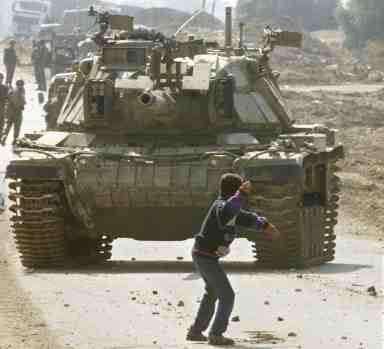
The majority of Palestinian children have been killed in the Occupied
Territories when members of the IDF have responded to demonstrations and
stone-throwing incidents with excessive use of force, and as a result of the
IDFs reckless shooting, shelling and aerial bombardments of residential
areas. Others have been killed as bystanders during Israels extrajudicial
execution of Palestinians, or when their homes were destroyed. Others still,
including new-born babies, died after their access to medical care was
denied or impeded by the IDF.
The Israeli children have been killed in direct and indiscriminate attacks,
including suicide bombings, and shootings by members of Palestinian armed
groups, both inside Israel, in settlements or on roads leading to
settlements in the Occupied Territories.
In its concluding observations in October 2002, the Committee on the Rights
of the Child strongly urged Israel and all relevant non-state actors to
"investigate immediately and effectively all killings of children and bring
the perpetrators to justice" and "take all necessary measures to provide
child victims of these human rights violations with adequate compensation,
recovery and social reintegration".(77)
Impunity
The Israeli authorities, Palestinian armed groups, and the Palestinian
Authority have systematically failed to comply with the obligations and
safeguards set down in international human rights and humanitarian law and
standards.(78) Since the outbreak of the current intifada the problem
of impunity has become further entrenched.
In October 2002, in response to Amnesty International's report on the
killing of children(79), Israeli Minister of Justice Meir Shetrit publicly
stated that all killings of children would be investigated. However, in
spite of such commitments, few judicial investigations are known to have
been carried out and only a few soldiers are known to have been brought to
trial. In the rare known cases of prosecution of soldiers only light
sentences were imposed. Israel's failure to prosecute those responsible for
killings and other grave violations contradicts Israels obligations under
international human rights treaties which include articles which cannot be
derogated from, even in time of public emergency which threatens the life of
the nation".(80)
For its part, the Palestinian Authority has consistently failed to take the
necessary steps to arrest and bring to justice those responsible for killing
Israeli civilians. They have repeatedly claimed that the operational
capacity of their security forces has been greatly impaired by the IDFs
systematic bombing and destruction of their security installations and
prisons, the targeting of their security forces, and the restrictions
imposed on their movements.
Destruction of houses and agricultural land
Since the beginning of the intifada, the IDF has destroyed more than
3,000 Palestinian homes in the Occupied Territories, as well as large areas
of agricultural land, public and private properties, and water and
electricity infrastructure in urban and rural areas. Thousands of
Palestinians, many of them children, have been made homeless. At times the
IDF has demolished houses on top of the inhabitants and left them to die
under the rubble. In most cases no warning was given to the inhabitants, who
had to flee their homes within minutes, often at night and without being
allowed to salvage any of their belongings.
Hundreds of houses and large areas of cultivated land in the Occupied
Territories have been destroyed in the vicinity of Israeli settlements or
along roads used exclusively by Israeli settlers. Others, including an
entire quarter of the Jenin refugee camp, were destroyed during IDF
incursions.(81)
In 2002 the IDF blew up scores of houses belonging to the families of
Palestinians known or suspected of involvement in attacks against
Israelis;(82) often nearby houses have also been destroyed by the
explosions. Israeli authorities have stated that this measure is intended to
deter other potential attackers.
Many other houses, mostly in East Jerusalem and surrounding areas, have been
destroyed as part of a discriminatory planning policy which prohibits the
building of Palestinian houses while freely allowing and encouraging the
construction of Israeli settlements on confiscated Palestinian land.
In June 2002 the Special Rapporteur on adequate housing as a component of
the right to an adequate standard of living called for "a moratorium on land
confiscations and house demolitions for any purpose, and the cancellation of
all existing demolition orders".(83)
In November 2001 the Committee against Torture had called on the Israeli
government to desist from the policy of house demolition and noted that such
policy "may, in certain instances, amount to cruel, inhuman or degrading
treatment or punishment".(84)
In 2002 large areas of agricultural land have also been destroyed by the IDF
in the West Bank to make way for a wall/fence which is being built to the
East of the Green Line, inside the West Bank, destroying and cutting off
large areas land from local farmers, for whom land is their main or sole
means of subsistence.
Closures and curfews
In 2002 extensive and prolonged closures and curfews have been imposed on an
unprecedented scale inside the Occupied Territories. Most Palestinian towns
and villages have been cut off from each other and from surrounding villages
for most of the year, and prolonged curfews have been imposed on the major
population centres. These prolonged, sweeping measures of collective
punishment affect millions of Palestinians, whose access to work, school and
medical care has been denied or severely restricted.
The closures and curfews which prevent or curtail the freedom of movement of
more than three million Palestinians within the Occupied Territories do not
affect the Israeli settlers who live in the West Bank and Gaza in violation
of international law.(85) As a result of the rapid expansion in recent years
of Israeli settlements throughout the Occupied Territories Palestinian
cities and villages are cut off from each another.(86) This has multiplied
the points of friction between Israeli settlers and the Palestinian
population and the Israeli army has responded by imposing increasingly
extensive closures and curfews on the Palestinian population, effectively
confining them to a form of town or house arrest for prolonged periods of
time.
As a result of closures and curfews, tens of thousands of Palestinians have
lost their jobs and the Palestinian economy has collapsed. The rate of
unemployment has spiralled and about half of the Palestinian population is
currently living under the poverty line.
Arrests, ill-treatment, administrative detention and prisoners of
conscience
Tens of thousands of Palestinians, hundreds of them children, have been
detained in mass arrests and often subjected to ill-treatment. Most have
been released without charge and often without having been questioned. In
2002 the number of administrative detainees increased from about 30 to
around 1,000. No criminal charges are filed against them. Administrative
detention orders of up to six months are renewable indefinitely. Detainees
are held on the basis of "secret evidence" which the Israeli military
authorities claim cannot be revealed so as not to compromise the source.
Hence the detainees and their lawyers cannot effectively challenge the
reasons for the detention.
In its conclusions in 1998 the Committee against Torture stated that [t]he
practice of Administrative Detention in the Occupied Territories should be
reviewed in order to ensure its conformity with article 16".(87)
In 1994 the Working Group on Arbitrary Detention stated that "individual
liberty cannot be sacrificed for the governments inability either to collect
evidence or to present it in an appropriate form".(88)
Israeli Conscientious objectors imprisoned as prisoners of conscience
Since September 2000, some 180 Israeli conscripts and reservists have been
imprisoned for up to six months for refusing to perform military service or
to serve in the Occupied Territories, on the grounds that they believe they
would be participating in human rights violations. Amnesty International
considers them to be prisoners of conscience.
Amnesty International calls on the Commission on Human Rights to:
· Adopt a resolution condemning the grave violations of international human
rights and humanitarian law in Israel and the Occupied Territories;
· Support the urgent deployment of international observers to monitor,
investigate and report on the human rights situation;
· Urge the Israeli government to end unlawful killings, including by taking
effective measures to ensure that its armed forces do not bomb, shell and
shoot indiscriminately into residential areas and at unarmed Palestinians;
and ensure effective supervision of measures taken by the Israeli
authorities to do so;
· Urge the Palestinian Authority to take measures to prevent Palestinian
armed groups based in the areas under its jurisdiction from carrying out
attacks against Israeli civilians, and ensure effective supervision of such
measures;
· Urge the Israeli government and the Palestinian Authority to take measures
to ensure that prompt and impartial investigations are carried out into all
killings and that those responsible are brought to justice in trials which
meet international standards of fairness, and ensure effective supervision
of such measures;
· Urge the Israeli government to put an immediate end to the unlawful
destruction of Palestinian houses, land and other properties in the Occupied
Territories and to compensate those whose properties have been destroyed;
· Urge the Israeli government to put an end to the extensive, prolonged and
punitive closures and curfews imposed on Palestinians within the Occupied
Territories;
· Urge the Israeli government to release all administrative detainees unless
they are promptly charged with a recognizable criminal offence and tried
within a reasonable time in accordance with international standards;
· Urge the Israeli government to immediately and unconditionally release all
detained conscripts and reservists who are prisoners of conscience and who
are refusing to serve in the army on grounds of their conscientiously held
beliefs;
· Urge the Israeli government to ensure that all UN and other human rights
and humanitarian workers present in Israel and the Occupied Territories are
allowed to carry out their tasks safely and without restrictions;
· Urge the Israeli government to issue a standing invitation to all the
thematic mechanisms of the Commission to visit Israel and the Occupied
Territories;
· Encourage the Special Rapporteurs on extrajudicial, summary or arbitrary
executions; on torture; on violence against women; on religious intolerance;
on contemporary forms of racism; and on adequate housing; the Representative
of the Secretary-General on internally displaced people; and the Working
Group on arbitrary detention to undertake visits to Israel and the Occupied
Territories.
Nepal
The breakdown of peace talks and the deployment of the army in November 2001
marked a new phase in the armed conflict between the Communist Party of
Nepal (CPN) (Maoist) and the security forces which began in 1996. The
government declared the CPN (Maoist) a "terrorist" organization and gave the
security forces wide powers under new "anti-terrorism" legislation. (89) A
state of emergency was declared(90) and the police and the paramilitary
Armed Police Force (APF) were brought under the army's operational command.
Since then, the people of Nepal have experienced unprecedented levels of
political violence. By the end of October 2002, according to figures made
public by the Ministry of Home Affairs and the Royal Nepal Army, the number
of people killed in the conflict since November 2001 had reached 4,366.
Amnesty International believes that at least half of these killings may have
been unlawful. The vast majority of the victims were civilians targeted for
their real or perceived support to the CPN (Maoist); others were Maoists
deliberately killed after they were taken prisoner or killed instead of
being arrested. In addition, torture is widespread and at least 66 people
are reported to have "disappeared" since November 2001 after they were seen
being taken into custody by the security forces. The total number of
"disappearances" reported to Amnesty International in the context of the
"people's war" is over 200.
Human rights abuses by the Maoists have included deliberate killings of an
estimated 800 civilians considered "enemies of the revolution",
hostage-taking for ransom, torture of people taken captive and deliberate
killings of members of the security forces after they were taken captive.
The international community has not responded adequately to the impending
human rights crisis in Nepal, despite the following statement by the UN
Secretary-General in his report to the 57th session of the UN General
Assembly: "I am increasingly concerned by the escalation of violence between
the government and the armed insurgency. If requested, I would positively
consider the use of my good offices to help achieve a peaceful
solution."(91) Amnesty International is pleased to note that on 10 December
2002, the Resident Representative of UNDP in Nepal presented a
"multi-faceted strategy for peace building in Nepal", emphasizing five
priorities for a resolution to the crisis, including human rights.
CPN Maoist abuses
The "people's war" aimed at establishing a "new democracy"(92) was declared
by the CPN (Maoist) on 13 February 1996, and since then the Maoists have
gained control over large areas of the countryside, especially in the
Mid-Western region. Fighting has further escalated after the state of
emergency was declared, with heavy casualties reported among army and police
personnel.
Deliberate killings of civilians considered to be "enemies of the
revolution" has been a prominent feature of the "people's war". Teachers and
politicians have been among those most frequently targeted. In July 2002 the
Maoists stepped up attacks on members of mainstream political parties after
elections were announced for November 2002.
Recruitment of children by the Maoists has been reported on a regular
basis.(93) Amnesty International was informed that in the areas under its
control, the CPN (Maoist) exercise a recruitment policy of "one family, one
member". Children, including girls, are deployed in combat situations, often
to help provide ammunition or assist with evacuating or caring for the
wounded.
Unlawful killings
The Commander of the Armed Services told Amnesty International in September
2002 that it is the army's mission to "disarm and defeat" the Maoists.
According to army commanders interviewed by Amnesty International a "Maoist"
is anyone who gives shelter, food or money to the armed Maoists. The fact
that much of this "assistance" may be given under threat from the Maoists
was not fully recognized.
Killings of Maoists in "encounters" with the security forces are reported on
a daily basis compared to very few reports of Maoists being injured or
arrested, which suggests that at least some units of the security forces
have adopted a policy of deliberately killing suspects rather arresting
them. Many of the victims are civilians, including women and children,
deliberately killed on suspicion of providing food, shelter or financial
assistance to the Maoists.
The Special Rapporteur on extrajudicial, summary and arbitrary executions
noted in her report to the 57th session of the Commission following her
mission to Nepal in February 2000 that there was "an urgent need to put in
place strong, independent and credible mechanisms to investigate and
prosecute alleged human rights abuses, including extrajudicial executions
and disappearances".(94)
"Disappearances"
A disturbing pattern has emerged of "disappearances" and long-term
unacknowledged detention in the context of the "people's war". Between 1998
and mid-2001 Amnesty International recorded more than 130 "disappearances",
and during the state of emergency from November 2001 to August 2002, Amnesty
International recorded a further 66 cases of "disappearances". Many of those
recently reported as "disappeared" may still be alive in army custody.
Others are feared to have been killed in custody and their bodies disposed
of in secret. Among those reported "disappeared" since November 2001, eight
of the "disappeared" are women and six are children.
In its report to the 58th session of the Commission, the Working Group on
enforced or involuntary disappearances stated that it was "deeply concerned
that disappearances have continued at such alarming numbers in 2001".(95)
According to the report of the Working Group it clarified a total of 21
cases while 87 cases were still outstanding.
Torture and death in custody
Torture by the army, APF and police is reported almost daily. The army is
reported to hold people blindfolded and handcuffed for days, weeks or even
months. Torture methods used include rape, falanga (beatings on the
soles of the feet), electric shocks, belana (rolling a weighted stick
along the prisoner's thighs causing muscle damage), beating with iron rods
covered in plastic and mock executions.
Amnesty International has documented several cases of torture, including
rape, in custody. In early November 2002, it submitted 57 such reports to
the heads of the security forces urging for them to be investigated and for
Amnesty International to be informed of the outcome. In mid-December 2002,
these cases were also submitted to UN Special Rapporteur on torture.
Arbitrary arrest and detention
According to official figures released in August 2002, 9,900 "Maoists" had
been arrested, of whom 1,722 remain in custody.
Most arrests and initial periods of detention take place outside any legal
framework, especially when suspects are held in army custody. The army
denies holding detainees beyond the legally permitted period of 24 hours
specified in the Army Act. However, there is overwhelming evidence of people
being held incommunicado in army barracks for extended periods of time.
Those who are transferred to police custody or prison are given a detention
order under the TADA or, exceptionally, are charged under other legislation
such as the Arms and Ammunition Act. Under Section 9 and 12 of the TADA
respectively, people can be held in preventive detention for up to 90 days
and in detention for the purpose of investigation for 60 days. However, at
the time of writing, hundreds of suspected Maoists have spent more than one
year in detention without being taken to court.
Impunity
In Amnesty International's view, impunity for human rights violations is the
single most destructive factor affecting the human rights situation. Members
of the security forces feel entirely shielded from outside scrutiny for
their actions. The heaviest sanction they face is an internal inquiry.
The UN Special Rapporteur on extrajudicial, summary or arbitrary executions
expressed her concern that "measures taken by the authorities to investigate
and prosecute police officers accused of human rights abuses remain
seriously wanting, and that the mechanisms and avenues of redress open to
victims and their families are weak and inadequate. In this way, the
criminal legal system extends impunity for serious human rights violations,
including extrajudicial, summary or arbitrary executions, which in turn
perpetuates the vicious circle of violence. The Government needs to take
prompt and effective action to curb this emerging trend."(96)
Internal police or army investigations into complaints of human rights
violations lack credibility. Under pressure from the international
community, the army set up a Human Rights Cell in July 2002. When Amnesty
International met with the Commander of the Armed Services in September
2002, the Human Rights Cell had investigated between six and ten cases.
However no courts martial or criminal trials had been initiated.
Especially since November 2001, the courts in Nepal have failed to uphold
human rights protection enshrined in the Constitution. This is most clearly
illustrated by the way in which the remedy of habeas corpus remains
largely ineffective, not only in relation to "disappearances" but for those
detained under the TADA. Furthermore, there is no crime of perjury in Nepali
law; rather the law specifies that "no one can be punished for any statement
made in court".
Cooperation with the international community
Despite being a party to the main human rights treaties, Nepal has so far
largely escaped scrutiny by the UN. It has not issued a standing invitation
to the thematic mechanisms of the Commission and has been negligent in its
reporting duties to the treaty bodies.(97) For instance, when Nepal appeared
for the first time before the Committee against Torture in April 1994, its
initial report was described by the Committee as "scant on detail" and
recommended that a supplementary report be submitted within 12 months.(98)
To Amnesty International's knowledge, no such report was ever submitted.
Amnesty International calls on the Commission on Human Rights to:
· Adopt a resolution expressing grave concern at the deepening human rights
crisis in Nepal;
· Call on both parties to the conflict in Nepal to uphold human rights and
humanitarian standards as a confidence-building step towards peace talks;
· Call on the UN Secretary-General to step up efforts to ensure respect for
human rights is part of the international community's integrated approach to
address the crisis in Nepal;
· Support the establishment of an office in Nepal of the OHCHR, to monitor
respect for international human rights and humanitarian law and to build the
capacity of the judiciary, National Human Rights Commission and other
relevant institutions to combat impunity;
· Appoint a Special Rapporteur for Nepal as a complementary measure to
support the proposed office of the OHCHR;
· Urge the government to take urgent steps to end impunity for human rights
violations by undertaking prompt and impartial investigations into all
allegations of human rights violations, ensuring that those found
responsible stand trial in accordance with international standards for fair
trial, and providing compensation to the victims;
· Call on the government to ensure respect of the rights of women/women's
human rights, including as specified in Commission Resolution 2002/52 "to
promote and protect the human rights of women and [to] exercise due
diligence to prevent, investigate and punish acts of all forms of violence
against women", and in situations of armed conflict, as emphasized by
Security Council's Resolution 1325 to "take special measures to protect
women and children from gender-based violence, particularly rape and other
forms of sexual abuse, and all other forms of violence in situations of
armed conflict";
· Urge the CPN (Maoist) to
uphold minimum humanitarian standards applicable to the situation in Nepal,
including those contained in Article 3 common to the four Geneva Conventions
of 1949;
· Urge the CPN (Maoist) not to recruit anyone under the age of 18 into their
armed forces, and to demobilize anyone who was under the age of 18 at the
time of their recruitment;
· Urge the government to ratify the Optional Protocol to the Convention on
the Rights of the Child on the involvement of children in armed conflicts;
· Urge the government to cooperate fully with the treaty monitoring bodies,
including by submitting those periodic reports that are overdue, to promptly
implement the recommendations by the relevant treaty bodies and by the
thematic mechanisms of the Commission, and to monitor implementation of
these recommendations;
· Encourage the government to issue a standing invitation to the thematic
mechanisms of the Commission to visit Nepal. In particular, the government
should be encouraged to invite the Special Rapporteurs on extrajudicial,
summary or arbitrary executions, and on torture, and the Working Group on
Arbitrary Detention.
Russian Federation
At the 58th session of the Commission on Human Rights a resolution
condemning the grave abuses of international human rights and humanitarian
law in Chechnya was narrowly defeated.(99) Amnesty International deplored
the failure of the Commission to hold Russia's human rights record in
Chechnya to account, and continues to be seriously concerned at the human
rights situation in the Chechen Republic and elsewhere in the Russian
Federation.
Impunity for human rights violations
Impunity continues to be a main underlying factor in the persistence of
human rights violations across the Russian Federation. The failure of the
authorities to ensure effective measures are taken to thoroughly investigate
allegations of human rights violations and to bring to justice those
responsible has created a climate of impunity in which perpetrators believe
they can act without being held to account for their actions.
Torture and ill-treatment are frequent in the administration of criminal
justice, but such violations rarely result in convictions of those
responsible. Even when criminal investigations are initiated, they are
frequently closed due to lack of evidence. Victims who continue to seek
justice often spend years going through seemingly endless rounds of
investigations, closures and appeals. The rare conviction of torturers
usually results in sentences that are not commensurate with the gravity of
the crime.
Failure to bring to justice those responsible for committing human rights
abuses was also raised by both the Committee against Torture(100) and the
Committee on the Elimination of Discrimination against Women(101) which
considered reports of the Russian Federation during 2002. Both called on the
government to take action to combat impunity.
In addition, the UN Special Rapporteur on violence against women reported in
2001 that "despite strong evidence of rape and other sexual violence
committed by Russian federal forces in Chechnya, the Government of the
Russian Federation has failed to conduct the necessary investigations or to
hold anyone accountable for the vast majority of cases."(102)
Human rights violations in Chechnya
The human rights situation in Chechnya has failed to improve over the past
year and in some respects has further deteriorated following the Moscow
theatre hostage crisis in October 2002. Members of the Russian security
forces continue to commit serious violations of human rights in Chechnya,
but are almost never prosecuted. In other parts of the Russian Federation,
Chechens have been subjected to discrimination, harassment and arbitrary
detention, including in the wake of the hostage crisis.
While independent verification of human rights violations in Chechnya itself
is gravely hampered by the security situation and lack of cooperation from
the Russian authorities, Amnesty International has received reliable and
consistent reports of "disappearances", extrajudicial executions and
torture, including rape committed by Russian forces. These violations would
be serious breaches of the Geneva Conventions, and constitute war crimes.
Many of the violations have been reported in the context of raids (zachistki),
purportedly conducted to check personal registration documents, that have
continued unabated during more than three years of this conflict. During
such raids on villages or neighbourhoods, ostensibly to search for Chechen
fighters, Russian security forces have allegedly subjected the civilian
population to beatings, arbitrary detention, "disappearance" and
extrajudicial executions. Despite the introduction of measures by the
Russian authorities, such as Order No 80 and Decree No 46(103) both of which
are aimed at protecting civilians, the violations continue as noted, among
others, by bodies and mechanisms of the Council of Europe, and these
measures are not consistently implemented.(104)
Chechen forces are also reported to have committed abuses of international
humanitarian law. Chechen fighters who have been operating in and around
populated areas have reportedly failed to take measures to protect
civilians. According to reports, they have targeted civilian members of the
pro-Moscow administration in attacks that have resulted in dozens of
fatalities and serious injuries, and kidnapped civilians and held them
hostage. Chechen forces also claim to have executed captured members of the
Russian armed forces. Such abuses can constitute war crimes.
Since the outbreak of the second Chechen armed conflict in 1999, hundreds of
thousands of civilians have been forced to flee their homes. At the time of
writing, approximately 110,000 Chechens were displaced in Ingushetia, mainly
citing security concerns as the reason for not returning to Chechnya.
Amnesty International is extremely concerned at reports of involuntary
repatriation of thousands of internally displaced persons. In July 2002, the
camp at Znamenskoye in northern Chechnya was closed down, and in December
2002, the Aki Yurt camp in Ingushetia was also closed. Many of the
internally displaced in these camps were reportedly forced to return. The
Russian authorities have threatened to close all camps for the internally
displaced by the end of January 2003.
The Moscow theatre hostage crisis triggered a backlash against Chechens.
While the government warned against turning all Chechens into scapegoats,
the situation on the ground was very different. Many were detained, and some
had reportedly had drugs planted on them in order to give the police an
excuse to arrest them.
Women's rights
Each year, tens of thousands of women in the Russian Federation become
victims of serious human rights abuses by state as well as non-state actors.
Women in police custody are known to have been subjected to torture and
ill-treatment, including rape, and thousands of women die each year as a
result of domestic violence.
In 2002 while reviewing the Russian Federation's fifth periodic report, the
Committee on the Elimination of Discrimination against Women stated that it
was "deeply concerned by the fact that, despite credible evidence that
police officials have used violence against women in custody, the Government
has not, as a rule, investigated disciplined or prosecuted offenders."(105)
Thousands of cases of domestic violence are never reported, let alone
brought to court. The police are often reluctant to interfere in domestic
situations, and women may be equally reluctant to report such cases. Not
only is the legislation inadequate, but there is an urgent need for improved
practices under existing laws. In 2002, the Committee on the Elimination of
Discrimination against Women was extremely disturbed at "the high level of
domestic violence against women" and was concerned about "the prevalent
tendency, including by law enforcement officials to view such violence not
as a crime, but as a private matter between the spouses".(106)
Children's rights
Contrary to international law and standards protecting children's rights,
Amnesty International is aware of cases where children detained by Russian
police have been denied the most basic rights, including the right to have a
lawyer, adult relative or other appropriate adult present during
questioning, which among other things serves as a safeguard against torture
and ill-treatment. Amnesty International has also documented cases where
children have been tortured or ill-treated by police in such circumstances.
As a state party to the Convention on the Rights of the Child, Russia is
obliged to ensure that arrest, detention or imprisonment of a child is used
only as a measure of last resort and for the shortest appropriate period of
time.(107) Despite some recent improvements, tens of thousands of children
in the Russian Federation continue to be deprived of their liberty. Many of
them languish for months or years in pre-trial detention centres, while
others are sentenced to long terms of imprisonment for relatively minor
offences.
Following his visit to the Russian Federation in June 2002, the Special
Representative of the Secretary-General for children and armed conflict
noted that the "combined impact of the two periods of armed conflict in
Chechnya have left a very extensive and serious impact on children",
including some 150,000 displaced children in Chechnya and Ingushetia, more
than 3,000 children dead in the hostilities, and some 1,600 left as
orphans.(108)
On reviewing the second periodic report of the Russian Federation, in
September 1999, the Committee on the Rights of the Child encouraged the
government "to ensure that children and other civilians are protected during
periods of conflict and that support and rehabilitative assistance,
including psychological aid, is made available to internally displaced
children and children living in regions of armed conflict".(109)
Racial discrimination
Ethnic or national minority groups in the Russian Federation are routinely
subjected to racial discrimination. Victims of such abuse include students,
asylum-seekers and refugees from Africa, but also citizens of the Russian
Federation (including ethnic Chechens and Jews), as well as people from the
south Caucasus, from South, Southeast and Central Asia, from the Middle East
and from Latin America.
As in many other countries, law enforcement agencies in the Russian
Federation often reflect rather than challenge discriminatory attitudes in
society at large. Amnesty International's research indicates that many
racist attacks are not reported to the police because the victims fear
further abuses by the police themselves. Racist attacks are often dismissed
as the actions of drunken "hooligans" which the police fail to investigate
or even register as racially motivated. As a result, victims of racist
crimes rarely see justice done and the police and members of the public are
left to assume that racism is tolerated.
Some positive measures against racism have been initiated. For example, in
2001 the authorities initiated a five-year State Program on Tolerance and
Prevention of Extremism in Russian Society, which envisages a wide-ranging
program of reforms under the auspices of the Ministry of Education.
President Vladimir Putin and the Prosecutor General Vladimir Ustinov have
recently made public statements that racist offences will not be tolerated
and that those responsible will be treated with "the maximum strictness
allowed by law."
However, these statements stand in stark contrast to practices in a number
of regions in the Russian Federation, where influential people inflame
prejudices against members of ethnic minorities for reasons of political
expediency.
Amnesty International calls on the Commission on Human rights to:
· Adopt a resolution condemning the grave human rights situation in Chechnya
and elsewhere in the Russian Federation;
· Establish an
international commission of inquiry into allegations of grave abuses of
human rights and international humanitarian law in the context of the armed
conflict in Chechnya, and report back to the 60th session of the Commission
in 2004;
· Urge the government of
the Russian Federation to take urgent steps to end extrajudicial executions,
"disappearances", torture and ill-treatment, including rape, in Chechnya,
including by ensuring prompt and impartial investigation into all
allegations and by bringing those responsible to justice in trials that meet
international standards of fairness;
· Urge Chechen armed
groups to respect the requirements of international humanitarian law, in
particular those protecting civilians and captured combatants;
· Urge the government to
stop attempts to forcibly return internally displaced people from Chechnya,
and to provide adequate protection and humanitarian assistance to them in
accordance with the UN Guiding Principles on Internal Displacement and other
relevant international standards;
· Urge the government to
ensure that people who have fled the conflict are not returned to Chechnya
or other parts of the Russian Federation unless and until their safe and
durable return with dignity is assured;
· Urge the government of
the Russian Federation to take urgent steps to end torture and
ill-treatment, including rape, in the Russian Federation, including by
ensuring prompt and impartial investigation into all allegations and by
bringing those responsible to justice in trials that meet international
standards of fairness;
· Urge the government to
ensure full implementation of the Convention on the Elimination of All Forms
of Discrimination against Women, timely submission of periodic reports, and
full and prompt implementation of the recommendations of the Committee on
the Elimination of Discrimination against Women, in particular those
relating to violence against women in custody and in armed conflict and to
domestic violence;
· Call on the government
to ensure that children are deprived of their liberty only as a measure of
last resort and for the shortest appropriate time;
· Urge the government to
ensure full implementation of the Convention on the Rights of the Child,
timely submission of periodic reports and full and prompt implementation of
the recommendations of the Committee on the Rights of the Child and to
ratify its Optional Protocols on the involvement of children in armed
conflicts and on the sale of children, child prostitution and child
pornography;
· Urge the government to
ensure prompt and impartial investigations into all allegations of racial
discrimination whether by state or non-state actors and that the
perpetrators are brought to justice in trials that conform to international
standards of fairness;
· Urge the government to
ensure full implementation of the International Convention on the
Elimination of All Forms of Racial Discrimination, timely submission of
periodic reports, full and prompt implementation of the recommendations of
the Committee on the Elimination of Racial Discrimination, as well as
dissemination throughout the Russian Federation of the conclusions and
recommendations of the Committee;
· Call on the government
to issue a standing invitation to the special procedures of the Commission
to visit the Russian Federation;
· Urge the government to
facilitate without further delay visits to the Russian Federation, including
Chechnya, by relevant special procedures of the Commission, as called for
previously by the Commission, in particular the Special Rapporteurs on
torture, on extrajudicial, summary or arbitrary executions, and on violence
against women, and the Representative of the Secretary-General on internally
displaced persons;
· Call on the OHCHR to
ensure that technical assistance programs to the Russian Federation in the
area of education include training on international human rights law and
standards, particularly at tertiary level.
Further background information
The following documents are available from Amnesty International section
offices, the International Secretariat in London, and the AI UN Offices in
Geneva and New York. Most of the documents are available on the AI website:
www.amnesty.org
General
· Amnesty International Report 2002 (AI Index: POL 10/001/2002)
· Statements and press releases issued by Amnesty International during the
58th session of the UN Commission on Human Rights (AI Index: IOR
41/021/2002)
· The United Nations Thematic Mechanisms 2002 (AI Index: IOR 40/009/2002)
Human rights and counter-terrorism
· Indonesia: Impunity and human rights violations in Papua (AI Index: ASA
21/015/2002)
· Nepal - A spiralling human rights crisis (AI Index: ASA 31/016/2002)
· The Russian Federation - Denial of justice (AI Index: EUR 46/027/2002)
· USA: Memorandum to the US Government on the rights of people in US custody
in Afghanistan and Guantánamo Bay, 15 April 2002 (AI Index: AMR 51/053/2002)
· USA: Beyond the law, Update to AI's April Memorandum to the US Government
on the rights of detainees held in US custody in Guantánamo Bay and other
locations (AI Index: AMR 51/184/2002)
· Rights at Risk: Amnesty International's concerns regarding security
legislation and law enforcement measures (AI Index: ACT 30/001/2002)]
· People's Republic of China: Serious human rights violations and the
crackdown on dissent continue (AI Index: ASA 17/047/2002)
· United Kingdom: Memorandum to the UK Government on Part 4 of the
Anti-terrorism, Crime and Security Act 2001 (AI Index: EUR 45/017/2002)
· Pakistan: No protection against targeted killings (ASA 33/030/2002)
Human Rights of Refugees and asylum-seekers
· Afghanistan: Continuing need for Protection and Standards for Return of
Afghan Refugees (AI Index: ASA 11/014/2002)
· Australia-Pacific: Offending human dignity - the "Pacific Solution" (AI
Index: ASA 12/009/2002)
· Bhutan: Ten years later and still waiting to go home. The case of the
refugees (AI Index: ASA 14/001/2002)
· Liberia: Civilians face human rights abuses at home and across the border
(AI Index: AFR 34/020/2002)
· Socialist republic of Viet Nam/Kingdom of Cambodia: No sanctuary: The
plight of the Montagnard minority (AI Index: ASA 41/011/2002)
The death penalty
· USA: Indecent and internationally illegal - the death penalty against
child offenders (AI Index: AMR 51/144/2002)
· Children and the death penalty - Executions worldwide since 1990 (AI
Index: ACT 50/007/2002
· Death Penalty Developments in 2001 (AI Index: ACT 50/001/2002)
· Human Rights vs the Death Penalty: Abolition and Restriction in Law and
Practice (AI Index: ACT 50/013/1998)
· Facts and Figures on the Death Penalty (AI Index: ACT 50/004/2002)
Colombia
· Colombia: Human Rights and USA Military Aid to Colombia III, published
jointly by Amnesty International, Human Rights Watch and the Washington
Office on Latin America (AI Index: AMR 23/030/2002)
· Colombia: Open letter to the President of the Republic of Colombia, Dr.
Álvaro Uribe Vélez (AI Index AMR 23/084/2002)
· Colombia: San Vicente del Caguán after the breakdown of the peace talks --
a community abandoned (AI Index: AMR 23/098/2002)
· Open Letter to the Revolutionary Armed Forces of Colombia-People's Army
(AI Index: AMR 23/124/2002)
· Colombia: Security at what cost? The government's failure to confront the
human rights crisis (AI Index: AMR 23/132/2002)
Democratic Republic of the Congo (DRC)
· Democratic Republic of Congo, From assassination to state murder? (AI
Index: AFR 62/023/ 2002).
· Making a killing - The diamond trade in government-controlled DRC, (AI
Index: AFR 62/017/2002).
· DRC: Memorandum to the Inter-Congolese Dialogue: Amnesty International's
recommendations for a human rights agenda (AI Index: AFR 62/030/2001)
Israel and the Occupied Territories
· Israel and the Occupied Territories and the Palestinian Authority: Killing
the future: Children in the line of fire (AI Index: MDE 02/005/2002)
· Israel and the Occupied Territories: Shielded from scrutiny: IDF
violations in Jenin and Nablus (AI Index: MDE 15/143/2002)
· Israel and the Occupied Territories and the Palestinian Authority: Without
distinction: Attacks on civilians by Palestinian armed groups (AI Index: MDE
02/003/2002)
Nepal
· Nepal: A deepening human rights crisis, Time for international action (AI
Index: ASA 31/072/2002)
· Nepal: A spiralling human rights crisis (AI Index: ASA 31/016/2002)
Russian Federation
· The Russian Federation: Denial of Justice (AI Index: EUR 46/027/2002)
· Justice for everybody: Human rights in the Russian Federation (AI Index:
EUR 46/023/2002)
· Russian Federation: Failure to protect or punish - human rights violations
and impunity in Chechnya (AI Index: EUR 46/004/2002)
· Torture and Ill-treatment - AI report to the UN Committee against Torture.
(AI Index EUR 46/015/2002)
|