|
|
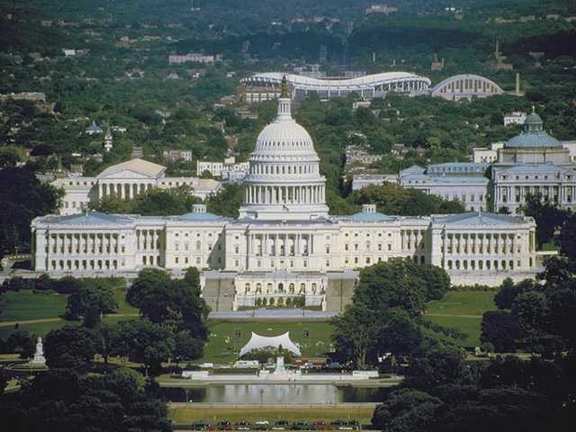
WASHINGTON DC
Two hundred years ago, the world wondered why America had chosen this swampy locale as its capital.
It took its first hundred years for Washington to evolve from bumpkin backwater status to an international hub of power, diplomacy, and beauty.
Today, Washington fully commands center stage.
This bustling metropolis that serves as the seat of the nation's government is also home to more than 570,000 people, 400 technology firms, scores of vibrant neighborhoods,
a thriving cultural and arts scene, and some terrific restaurants.
No wonder Washington has been winning recognition lately: as the fourth best American city for business (Fortune magazine, Nov 2000)
and as the second best metropolitan region in which to live in North America (a recent survey by Places Rated Almanac).
Washington's revitalization in the past few years is largely due to Mayor Anthony A.
Williams, his city council, and Congresswoman Eleanor Holmes Norton,
whose herculean efforts to revive the economy and provide better services around the city have encouraged developers and entrepreneurs to invest here.
Their success has led Congress to contemplate handing over more control of the District to the District itself.
Since D.C. is not a state, Congress oversees the city's budget and legislation.
Residents elect a mayor and council, who govern the nonfederal responsibilities of the city, but Congress's micromanagement of these local issues tends to impede planning and progress.
Residents also elect a delegate to Congress (Norton is the current representative), who introduces legislation and votes in committees, but who cannot vote on the House floor. This unique situation, in which residents of the District pay
federal income taxes but don't have a vote in Congress, is increasingly a matter of local concern--you may notice D.C. license plates bearing the inscription "Taxation without Representation."
Congresswoman Norton and others have begun to push for D.C.'s statehood or, at the very least, a true vote in Congress.
Whether or not Washington eventually wins voting rights and statehood, its dual roles as nation's capital and independent city have always been and will ever be intertwined with American history.
Kayakers tackle the Potomac River as it winds past the elegant marble tributes to America's great leaders.
|
Although these are organized attractions by theme ("the three houses of government," "the Smithsonian museums," and so on) rather than by neighborhood, you're probably going to want to tour the city by covering one area at a time,
visiting your first-choice attractions in a particular neighborhood and checking out whatever other sights are nearby.
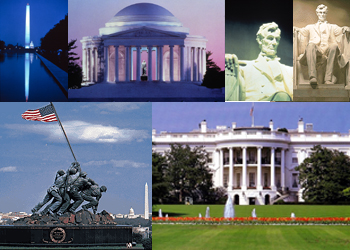
Right away, you'll notice that most of Washington's attractions fall nicely into geographic clusters--seven major clusters, to be exact. These are: Memorials (the Lincoln, Jefferson, FDR, Korean, a
nd Vietnam Memorials, the Washington Monument, and Arlington National Cemetery); the National Mall (all the Smithsonian museums, plus the National Archives,
the National Gallery, the Holocaust Museum, and the Bureau of Engraving & Printing);
Capitol Hill ( The Capitol, The Library of Congress, the Supreme Court, the Folger Shakespeare Library, Union Station, and the Postal Museum);
the White House (the White House and Visitor Center,
the Corcoran Gallery, the Renwick Gallery, Decatur House, and the Kennedy Center);
Dupont Circle (the Phillips Gallery, the Textile Museum, Woodrow Wilson House,
the Historical Society of Washington, Anderson House, and the National Geographic Society);
Downtown (the FBI, Ford's Theatre and Petersen House, the National Museum of Women in the Arts, and the Navy Memorial);
and Georgetown (Tudor House, Dumbarton House, Dumbarton Oaks, and the C&O Canal).
Six of the seven sections are doable in a day. The National Mall cluster is the only one that is not (in fact, you could spend a week and still not get to all of its 13 museums).
Naturally, the National Mall is the cluster with the capital's most popular attractions, so chances are that you're going to want to see at least some of its museums, and chances are, you don't have a week to do it.
So here's what you do: Read this section, then pick the cluster that holds most of your top choices, and decide which of these you want to visit.
Look at neighboring clusters,
like the National Mall and Memorials, or the
Downtown and the National Mall, and see whether there aren't other sites near your top choices where you might like to go. (You can use the suggested itineraries that follow as a guideline for ways to mix and match things to see around the city.)
Think about how much time you have and what you can fit into the allotted time. My descriptions within this chapter roughly estimate the amount of time you should allow for touring each place.
Now write it down. Voilą--you've got your strategy.
Except for one or two little things.
A handful of sights, like the Newseum, the Pentagon, the Washington National Cathedral, Hillwood Museum, the National Zoo, and the Vatican Center,
don't fit nicely into an attraction-filled neighborhood, but are certainly worth a trip. So be sure to consider those.
And then, maybe you have a special interest, like American portraiture in the late 17th century, which, when the time comes, keeps you in the National Gallery when, according to your schedule, you're supposed to be across Pennsylvania Avenue taking an FBI tour.
Maybe you get terribly hungry or thirsty while standing in line for a trip to the top of the Washington Monument, and you absolutely must wander up 15th Street for a bite to eat RIGHT NOW, even though it means relinquishing your spot. Or maybe you had not pictured your family becoming
quite so fascinated by the insects at the National Museum of Natural History, which means that a tour of the Capitol (where you had envisioned your children would be enthralled, asking lots of astute questions about U.S. history)
is off, at least for the day.
When these things happen, there's only one thing to do: Relax. Because isn't this really what you came for? To become fascinated? To be caught up in the experience? To take in new territory? In the end, a plan is just a way to get started,
and serendipity is more important than adhering to a rigid schedule.
|


 WASHINTON DC