|
|
|
|
Seven Wonders of Medicine
The discovery /
invention following is usually referred to as the Seven Wonders of Medicine:
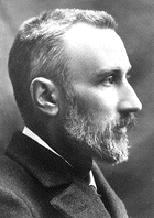
Radium and Radioactive Isotopes Born in Poland during a time of Russian domination,
Marie Sklodowska (1867-1934) They spent much of their careers studying radioactivity (a term coined by Marie), examining the particles and energy produced as radioactive atoms decayed, and in the process learned about the building blocks of matter. They established that the heavy element thorium was radioactive and discovered two new elements: polonium and radium. They refined techniques for extracting radium from ores. Marie won Nobel Prizes in both physics and chemistry for
their work. (Pierre failed to share in the second simply because he was dead.)
Yet despite living in near povertyَthey spent most of their money on further
researchَ they were idealistic enough to refuse to patent any of their
potentially lucrative discoveries. Pierre was killed when he was run down by a
horse-drawn carriage. Marie died of leukemia, almost certainly the result of a
lifetime of exposure to high levels of radiation. Ironically, one of the
enduring applications of their work has been in the treatment of cancer with
radiation. X-ray Electromagnetic waves of short wavelength, capable of penetrating some thickness of matter. Medical x-rays are produced by letting a stream of fast electrons come to a sudden stop at a metal plate; it is believed that x-rays emitted by the Sun and stars also come from fast electrons.
An x-ray machine, like that used in a doctor's or a dentist's
office, is really very simple. Inside the machine is an x-ray tube. An electron
gun inside the tube shoots high energy electrons at a target made of heavy
atoms, such as tungsten. X-rays come out because of atomic processes induced by
the energetic electrons shot at the target. X-rays are just like any other kind
of electromagnetic radiation. They can be produced in parcels of energy called
photons, just like light. There are two different atomic processes that can
produce x-ray photons. One is called Bremsstrahlung, which is a fancy German
name meaning "braking radiation." The other is called K-shell emission. They can
both occur in heavy atoms like tungsten. Entire or partial loss or absence of feeling or sensation; a state of general or local insensibility produced by disease or by the inhalation or application of an anaesthetic. The first herbal anaesthesia was administered in prehistory. Opium and hemp were two of the most important herbs used. They were ingested or burned and the smoke inhaled. Alcohol was also used, its vasodilatory properties being unknown. In China, Taoist medical practitioners developed anaesthesia by means of acupuncture. In South America preparations from datura, effectively scopolamine, were used as was coca. In Medieval Europe various preparations of mandrake were tried as was henbane (hyoscyamine).
The development of effective anaesthetics in the 19th century was, with
Listerian techniques, one of the
Another
dentist, William E. Clarke, performed an extraction in January, 1842 using a
different
Ether had a number of drawbacks and was quickly replaced with chloroform. Discovered in 1831 its use in anaesthesia is usually linked to James Young Simpson. Who, in a wide-ranging study of organic compounds, found chloroform's efficacy in 1847. Its use spread quickly and gained royal approval in 1853 when John Snow gave it to Queen Victoria during the birth of Prince Leopold.
Antitoxins
Psychiatry Psychiatry is
a branch of medicine concerned with the study, treatment and
prevention of mental illness. Some psychiatrists specialize further in the
treatment of certain age groups or illnesses. Some famous
psychaitris are Emil Kraepelin, Sigmund Freud, Joseph Workman (The Father of
Canadian Psychiatry), Dr. Benjamin Rush (The Father of American Psychiatry) Antibiotics and Other Chemical Therapy Antibiotics is defined as any of a variety of natural or synthetic substances that inhibit the growth of, or destroy microorganisms. The search for antibiotics began in the late 1800s, with the growing acceptance of the germ theory of disease, a theory which linked bacteria and other microbes to the causation of a variety of ailments. As a result, scientists began to devote time to searching for drugs that would kill these disease-causing bacteria. The goal of such research was to find so-called “magic bullets” that would destroy microbes without toxicity to the person taking the drug.
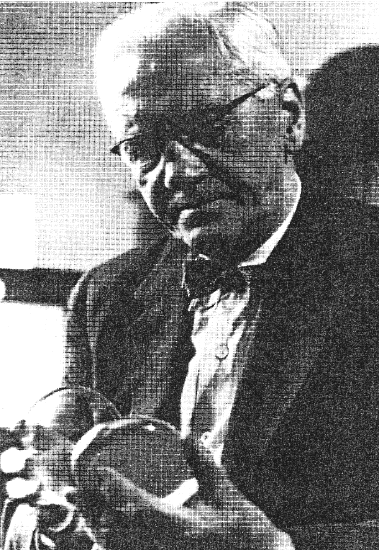
Fleming’s second discovery, though, would change the course of medicine. In 1928, Fleming serendipitously discovered another antibacterial agent. Returning from a weekend vacation, Fleming looked through a set of old plates that he had left out. On one such plate, he found that colonies of Staphylococcus, which he had streaked out, had lysed. Fleming observed that bacterial cell lysis occurred in an area adjacent to a contaminant mold growing on the plate and hypothesized that a product of the mold had caused the cell lysis. While Fleming generally receives credit for discovering penicillin, in fact technically Fleming rediscovered the substance. In 1896, the French medical student Ernest Duchesne originally discovered the antibiotic properties of Penicillium, but failed to report a connection between the fungus and a substance that had antibacterial properties, and Penicillium was forgotten in the scientific community until Fleming’s rediscovery. Through follow-up work, Fleming showed experimentally that the mold produced a small substance that diffused through the agar of the plate to lyse the bacteria. He named this substance penicillin after the Penicillium mold that had produced it. By extracting the substance from plates, Fleming was then able to directly show its effects. Important to its discovery was the penicillin had destroyed a common bacterium, Staphylococcus aureus, associated with sometimes deadly skin infections.
Surgical Techniques Medicine is about 2,400 years old. Some of the first recorded medicine was practiced on a Greek island named Coy. Galen was born in A.D. 130. He studied at Alexandria and practiced in Rome. He practiced mostly on animals (apes, dogs, and pigs) but sometimes he practiced on humans. Galen found out that the brain controlled the body. He was also the head doctor and treated the Emperor. Pare was born in 1510. He studied Barber Surgery. He was a surgeon in the army for twenty-five years. He wrote two books, Works on Surgery (1515) and The Apology and Treatise (1585). He learned a new way to treat bullet wounds, and was the first to amputate body parts. Harvey was born in 1578, studied at Padua, and practiced in London. He compared animals to humans. He had learned about valves. He was also the first to have the idea that the heart is a pump. In 1940 Charel Drew invented fake blood plasma to be used in blood transplants instead of whole blood transplants. Leonard Bailey performed the first transplant of an animal organ into a human in 1984. The patient was an infant which was given a baboon's heart. The transplant was fatal because of the different blood types. The first operation under anasthesia was performed by Dr. Robert Liston in England (1846). |







 had no real opportunity
f
had no real opportunity
f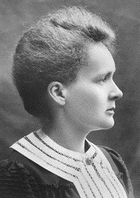 or
an education after high school. She saved her hard-earned money to help pay for
her older sister's medical studies in Paris, then followed her to France in
1891, studying at the Sorbonne. In 1894, she met the French chemist Pierre Curie
(1859-1906), and they were married a year later. Although Pierre had already
made a name for himself, their collaboration proved far more fruitful than his
solo career.
or
an education after high school. She saved her hard-earned money to help pay for
her older sister's medical studies in Paris, then followed her to France in
1891, studying at the Sorbonne. In 1894, she met the French chemist Pierre Curie
(1859-1906), and they were married a year later. Although Pierre had already
made a name for himself, their collaboration proved far more fruitful than his
solo career.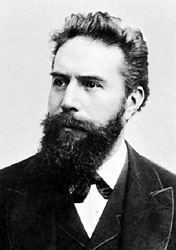 On 8 Nov, 1895, Wilhelm Conrad Röntgen (accidentally)
discovered an image cast from his cathode ray generator, projected far beyond
the possible range of the cathode rays (now known as an electron beam). Further
investigation showed that the rays were generated at the point of contact of the
cathode ray beam on the interior of the vacuum tube, that they were not
deflected by magnetic fields, and they penetrated many kinds of matter.
On 8 Nov, 1895, Wilhelm Conrad Röntgen (accidentally)
discovered an image cast from his cathode ray generator, projected far beyond
the possible range of the cathode rays (now known as an electron beam). Further
investigation showed that the rays were generated at the point of contact of the
cathode ray beam on the interior of the vacuum tube, that they were not
deflected by magnetic fields, and they penetrated many kinds of matter.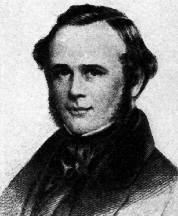
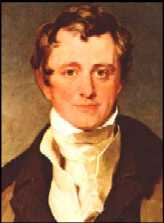 keys to
successful surgery. Henry Hill Hickman experimented with carbon dioxide in the
1820s. The anaesthetic qualities of nitrous oxide (isolated by Joseph Priestley)
were discovered by the British chemist Humphry Davy about 1795 when he was an
assistant to Thomas Beddoes and reported in a paper in 1800. But initially the
medical uses of laughing gas were limited - its main role was in entertainment.
It was used in December 1844 for painless tooth extraction by American dentist
Horace Wells. Demonstrating it the following year, at Massachusetts General
Hospital, he made a mistake and the extractee suffered considerable pain. This
lost Wells any support.
keys to
successful surgery. Henry Hill Hickman experimented with carbon dioxide in the
1820s. The anaesthetic qualities of nitrous oxide (isolated by Joseph Priestley)
were discovered by the British chemist Humphry Davy about 1795 when he was an
assistant to Thomas Beddoes and reported in a paper in 1800. But initially the
medical uses of laughing gas were limited - its main role was in entertainment.
It was used in December 1844 for painless tooth extraction by American dentist
Horace Wells. Demonstrating it the following year, at Massachusetts General
Hospital, he made a mistake and the extractee suffered considerable pain. This
lost Wells any support. 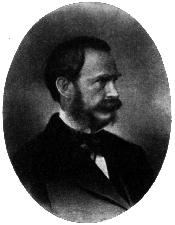 chemical, ether (discovered in 1540). In March, 1842 in Danielsville,
Georgia, Dr. Crawford Williamson Long was the first to use anaesthesia during an
operation; giving it to aboy before excising a cyst from his neck. In October
1846 yet another dentist, William Thomas Green Morton, removed a tumour from an
patient under ether. Despite Morton's claims of a new gas called 'Letheon' the
use of ether spread to Europe in late 1846. Here respected surgeons including
Liston, Dieffenbach, Pirogoff, and Syme undertook numerous operations with
ether.
chemical, ether (discovered in 1540). In March, 1842 in Danielsville,
Georgia, Dr. Crawford Williamson Long was the first to use anaesthesia during an
operation; giving it to aboy before excising a cyst from his neck. In October
1846 yet another dentist, William Thomas Green Morton, removed a tumour from an
patient under ether. Despite Morton's claims of a new gas called 'Letheon' the
use of ether spread to Europe in late 1846. Here respected surgeons including
Liston, Dieffenbach, Pirogoff, and Syme undertook numerous operations with
ether.
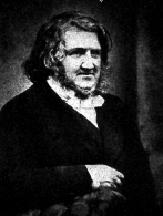
 The
First Antitoxins?
The
First Antitoxins?