|
|
|
|
The Eiffel Tower of Paris
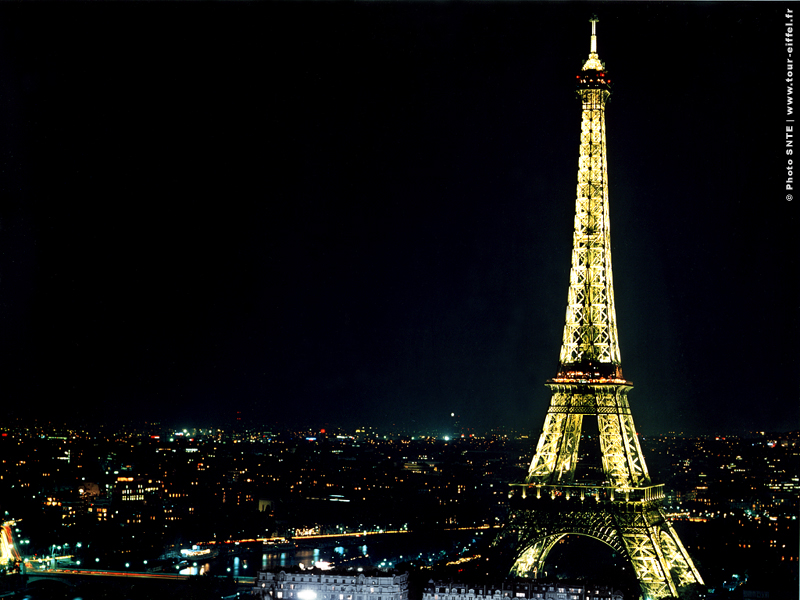
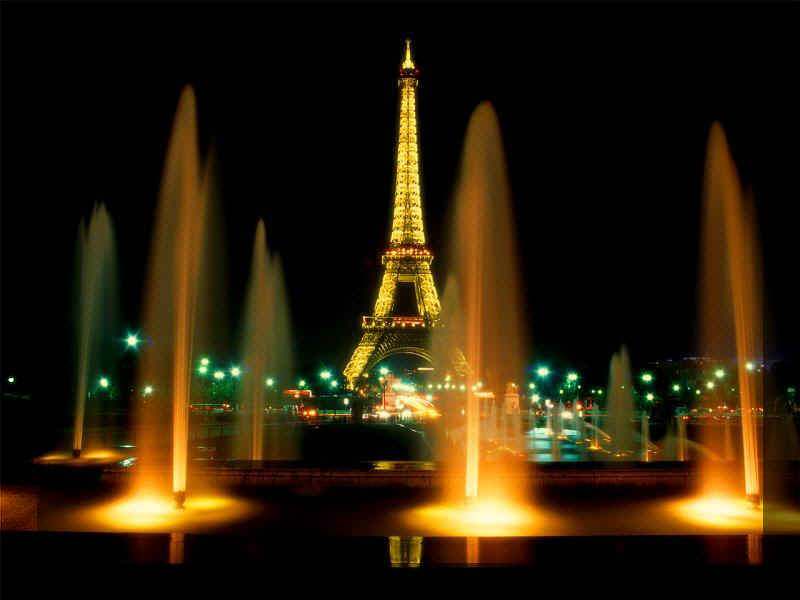
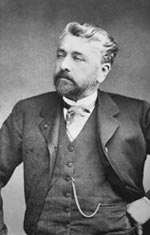
An engineer by training, Eiffel founded and developed a company specializing in metal structural work, whose crowning achievement was the Eiffel Tower. He devoted the last thirty years of his life to his experimental research. Born in Dijon in 1832, he graduated from the Ecole Centrale des Arts et Manufactures in 1855, the same year that Paris hosted the first world's Fair. He spent several years in the South West of France, where he supervized work on the great railway bridge in Bordeaux, and afterwards he set up in his own right in 1864 as a "constructor", that is, as a business specializing in metal structural work. His outstanding career as a constructor was marked by work on the Porto viaduct over the river Douro in 1876, the Garabit viaduct in 1884, Pest railway station in Hungary, the dome of the Nice observatory, and the ingenious structure of the Statue of Liberty. It culminated in 1889 with the Eiffel Tower. After the end of his career in business, marred by the failure of the Panama Canal, Eiffel began an active life of scientific experimental research in the fields of meteorology, radiotelegraphy and aerodynamics. He died on December 27 1923. The Tower as a Laboratory After the end of his career in business, Eiffel pursued an active life of methodically executed scientific research. As early as 1889, the Eiffel Tower served as a laboratory for scientific measuring and experimenting. A certain number of scientific devices were present on the site for these purposes : barometers, anemometer, lightning conductors…Three avant-garde domains found their laboratory quite naturally suited for the Tower. Meteorologists were able to employ numerous instruments testing the variation in pressures and humidity, whereas radiotelegraphy and aerodynamics researchers observed falling objects at great heights. With the recognition of the Tower's scientific utility, it had won the right to be preserved as a monument. The Tower was to have originally been torn down after 20 years of existence. He also kept himself a studio on the third level to make astronomical and physiological observations, and in 1909 he had a small wind tunnel built at the foot of the Tower. The Eiffel Tower as a Radiobroadcaster Eiffel strongly encouraged research into radio transmission by proposing the use of his tower as a monumental radio mast. After the success of the first radio signals broadcast to the Pantheon by Eugène Ducretet in 1898, Eiffel approached the military authorities in 1901 with a view to making the Tower into a long-distance radio antenna. In 1903 a radio connection was made with the military bases around Paris, and then a year later with the East of France. A permanent radio station was installed in the Tower in 1906, thus ensuring its continuing survival. Eiffel lived long enough to hear the first European public radio broadcast from an aerial on the Tower in 1921. Illuminating The Eiffel Tower The Tower's artificial illuminations have been constantly revised and improved throughout the years, taking advantage of the latest innovations in lighting. From gas to electricity, incandescent lamps to neon and not forgetting the sodium lamp. At the dawn of the 20th century, the Eiffel Tower adopted quite quickly the new electric technology.
|










 Gustave
Eiffel
Gustave
Eiffel