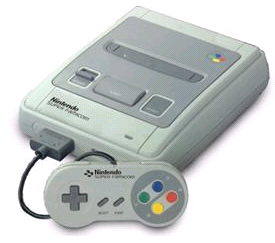
Having watched the Nintendo Entertainment System (NES) become one of the most popular gaming consoles, Nintendo believed they could continue this success for years to come. That was until the 16-bit Sega Mega Drive began to overtake the market place. Nintendo were forced to act, and that they did, releasing the Super Famicom in late 1990 in Japan.
The Super Famicom basically took off where the original Famicom had left, consisting of 80% of the market by the time it was firmly established.
It was the 1st of September 1991 when the Super Famicom was released in America under the name of Super Nintendo Entertainment System at a price of US$200.
Although the Super Nintendo Entertainment System (SNES) took time to catch up with the well-established Sega Genesis, it finally did, and, due mainly to the original games brought out by Nintendo, it sold almost twice as many consoles. Even today, some of these games are considered to be among the best ever made.
Specifications:
- CPU: 16-bit Custom 65C816 running at 1.79, 2.68 or 3.58 MHz (changeable)
- RAM: 1 Mbit (128 Kbyte)
- Memory Cycle Time: 279 ms
- Picture Proccessor Unit: 16-bit
- Video RAM: 0.5 Mbit (64 Kbyte)
- Resolution: 256x224, 512 x 448 pixels max hi res and interlaced modes
- Colours Available: 32,768 colours
- Max colours on screen: 256 colours
- Max sprite size: 64 x 64 pixels
- Max sprites: 128 (32 per line)
- Min/Max Cart Size: 2 Mbit - 48 Mbit
- Audio RAM: 512 Kbit
- Sound chip: 8-bit Sony SPC700
- Sound channels: 8, uses compressed wave samples
- Controller Response: 16 ms
- Pulse Code Modulator: 16-bit
- Power Input: 120V AC, 60Hz, 17 Watts
- Power Output: 10V DC, 850 mA (NTSC), 9V AC (PAL)