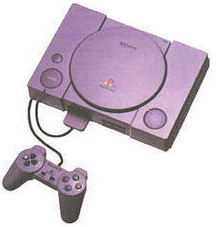
The Sony PlayStation began as the SNES Playstation, an add-on for the ever-popular Super Nintendo Entertainment System (SNES). However, after a dispute between Sony and Nintendo over control of licences, Sony was dropped from the project.
Sony researcher, Ken Kutaragi, who had worked on the SNES PlayStation (and the sound chip for the SNES) did not want to give up. He wanted to continue working on this project and so, after some debate, Sony President Norio Ogha approved the start of the Sony Computer Entertainment Division, which would one day account for around half of Sony's revenues. This was Sony's entry into the world of video game consoles and would also mean competition for Nintendo.
Kutaragi worked on this secret project to create a new 32-bit console that was simple yet powerful, easy to program for and cheap. His original concept was first shown at the Tokyo International Electronics Show in October 1991 and due for release in January 1993 for a price of US$200. The system was still going to allow the play of SNES games and was also aimed at educational software, with titles such as: Compton's Enemy Encyclopaedia, Software Toolworks World Atlas, Microsoft BookShelf 1991, Languages of the World, National Geographic Mammals of the World and Mixed up Mother Goose.
The PlayStation as we know it today is very different and was finally released in December, 1994 in Japan for 39 400 Yen. It was then released to America in late 1995 for $299. The Sony Playstation was hugely popular, selling over 100 000 units in the first weekend of sale. Its release was not good news for Sega, whose Saturn console had only just been released. The PlayStation is better than the Saturn in some ways, but the Saturn still has some technical advantages over the PlayStation such as the capability to handle more polygons and better sprite handling in 2D games. But the PlayStation's main edge over the Saturn was that it was much easier to program for, thus developers could make great games very easily for the system and therefore more sales would be made. Unlike the Saturn, the PlayStation has no built-in memory for saving games. Instead, it relies on Memory Cards (sold separately, thus making even more money).
The PlayStation was hugely popular due to its huge library of games (almost 1000) and its cheap price. Just before Sony released the PlayStation 2, they also re-released a newer version of the PlayStation called the PSone. The PSone (released 1999) was a smaller, cheaper version of the system which allowed people who could not afford the more expensive PlayStation 2 to still get a piece of the PlayStation action. Games for the PlayStation were still continuing to be produced even after 8 years since the release of the original PlayStation.
Specifications:
- CPU: 32-bit R3000A RISC running at 33.8688 MHz, 30 MIPS, bus bandwidth 132 Mb/sec
- RAM: 16 Mbits
- VRAM: 8 Mbits
- Operating System ROM: 4 Mbits
- Geometry Engine: 3D Geometric Transfer Engine clearing 66 MIPS, 1.5 million flat-shaded polygons per second, 500 000 texture-mapped/light-sourced polygons per second
- CD-ROM: XA2 double speed CD-ROM, 256K CD-ROM buffer
- Data Engine: MDEC clearing 80 MIPS, CPU direct bus connection
- Graphics Processing Unit: GFX processor unit
- Sound: ADPCM, 24 channels, 4 Mbits Sound RAM, 44.1 KHz sampling frequency
- Colour Palette: 16.7 million colours
- Resolution: 256x224 - 640 x 480 (max) Resolution: 256 x 224 - 740 x 480 (max 1,677k colours)
- Sprite/BG drawing
- Adjustable frame buffer
- No line restriction
- Unlimited CLUTs (Colour Look-Up Tables)
- Sprites: 4,000 8 x 8 pixel sprites with individual scaling and rotation
- Simultaneous backgrounds
- 360,000 polygons/sec
- Memory Cards: 128 Kbyte flash-memory cards