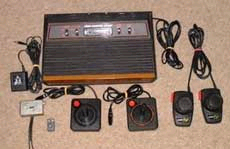
The Atari 5200 SuperSystem premiered in 1982, and was the successor to the venerable VCS (2600) which dominated the first wave of cartridge-based home videogame systems. The 5200 offered improved graphics and several features not found on any other system during its time.
When the 5200 was first unveiled, Atari had solid reasons for optimism. After all, beneath the sleek, uncluttered exterior of the unit lurked the throbbing power of a 16K computer designed specifically to play high-quality games.
The heart of the Super System was, in essence, an Atari 400/800 computer, the most powerful 8-bit home computer system of its era, and thus games could theoretically be easily (and rapidly) ported between the two machines.
The controllers have a small calculator-sized numeric keypad and two fire buttons are located at each side. The controller was a gallant attempt at cross-breeding the trak-ball and conventional joystick. It uses an analog control mechanism, offering a full 360 degrees of mobility instead of the usual 4 or 8 positions. There is a speed control built-in, which, on specific cartridges, allows the player to speed up the action. The harder the stick is pushed to any given direction, the faster the on-screen moving object will zip across the playfield.
Also found on the controller is a "pause" button which enables the player to put any game on hold for as long as he likes. This now-standard feature on modern systems was first pioneered on the 5200. Atari's attempt at revolutionizing the joystick, however, turned out to be a mixed bag. The controllers do not self-center, making games like Pole Position and Star Raiders a joy to play. On the other hand, games that demand precise, 4-way input from the player (like Pac-Man) can be an exercise in frustration for many gamers.
In addition, the joysticks are infamous for being among the most unreliable controllers ever made.
In addition to the then-futuristic but flakey controllers, the SuperSystem offered several other advancements in hardware design. 4-port 5200 systems utilized a special switch box where the power supply plugs directly into the switch box and not the system itself.
Furthermore, the switch box was automatic, meaning the user was no longer required to walk to the back of the television and select between "TV" or "Game" each time to select the mode he or she desired (later 2-port systems reverted back to the standard RF switchbox found in just about ever other game console.) In addition, a special feature only found in the 5200 put the screen on silent black when you change cartridges (no more raspy white noise.)
Although the 5200 enjoyed moderate success during its heyday, the gaming public never completely warmed to the SuperSystem, and the "Great Videogame Crash of 1983" helped to seal its fate along with the rest of the home videogame consoles. It should be noted, however, that the 5200 was outselling the Colecovision when Atari decided to pull the plug on its advanced video game system in 1984.
Specifications:
- CPU: 6502C (8-bit), 1.78 MHz
- Memory: 16K RAM
- Colors: 256, 16 on-screen
- Resolution: 320x192
- Sound: 4-channel
- Power Supply: 4-Port: 11.5VDC @ 1.95A
- 2-Port: 9.3VDC @ 1.95A