

Doug Gillard: Aye, sir, attempting to modify shield harmonics to deflect the kelvinase particles.
The engineer spends three or four minutes working with the science officer to correct the problem. After a few moments, they report.
Doug Gillard: Shield frequency adjusted _60.4, and total output increased by 122%. Power has been rerouted from our auxilary batteries.
Vex Xiang: Captain, the new shields are deflecting the gaseous particles. There does not appear to be further danger to our impulse manifolds. It is now safe to proceed.
The tiny shuttle glides through the nebula, and you watch as wisps of redish orange gas curl across the cockpit windows. You can feel your excitement rising as you approach the location of the object.
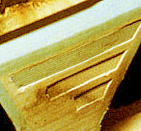
You can see nothing for nearly three more minutes. Then, as you are almost on top of the object, a gray wall fills the viewscreen. The object is obviously much larger than anticipated.
James Morrow: Sensors are online but not very useful. I can't read far past the outer hull, and I'm not picking up any lifesigns.
Vex Xiang: Indeed, sensors cannot scan the entirety of the object at this range, and the gas interferes at a distance. However, there is an alternative. Kelvinase particles react with heat. Several phaser bursts around the outside of the hull may force the gas away from the ship for several seconds, allowing us a brief but accurate scan of the vessel.
Doug Gillard: I don't recommend it, captain. There are some minute quantities of hydrogen in the nebula. It may be ignited by our weapons.
James Morrow: Maybe we could round the outside of the ship at close range and search for a docking port.
 Fire Phasers to Clear the Gas
 Search for a Docking Port

