|
Team SCALE have through internet gotten in contact with the 5th grade at Frankfurt International School in Germany. They are learning about Expeditions around the world through different times. SCALE is helping them with information and their thoughts about the SCALE Expedition.
Julia and Malin think it’s great that the students have an interest in their expedition. Both Julia and Malin wished that they had the same opportunity to learn about things like this when they were in school.
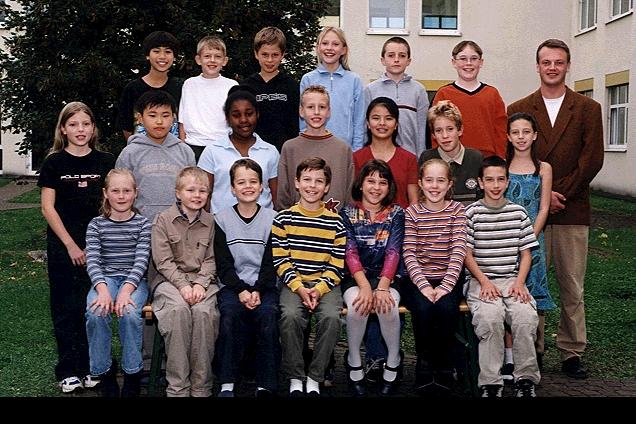
(Back, from left) Justin, Alexander, Vincent, Monique, Michael, Aaron.
(Middle, from left)Maike, Woo-Sik,Brook, Dorian, Naila, Paul, Sarah
(Front, from left) Tylar, Nikke, Zachary, Stefan, Sara, Haley, Jacob. (Kiri is missing in this photo)
The students have put together some questions for Team SCALE. Here are what they wanted to know, and what Julia and Malin answered.
Dear:
Lars, Aaron, Alex, Brooke, Dorian, Haley, Jacob, Justin, Kiri, Maike, Michael, Monique, Naila, Niklas, Paul, Sara, Sarah, Stefan, Tylar, Vincent, Woo-Sik, and Zachary!
Thank you so much for all your wonderful questions! I hope that our answers will help you understand more about expeditions, or at least why we chose to do our expedition!
1. Why do people that go on expeditions or explorations want to do more than others?
Malin:
It’s sometimes hard to explain why you chose to do these things. I guess adventure is a natural and more obvious thing for young people, and maybe when we grow older our spontaneity and that “go for it” feeling disappears. Not for me though, so I guess I’m just a big child with a restless mind. I keep dreaming of unclimbed mountains, untamed wilderness, seeing different cultures and meeting new people. It’s a sense of discovery; the land I see for the first time, or a new challenge for my body and mind.
Julia:
I think that it might seem like explorers are more motivated than other people because of their lifestyle. Maybe this is because exploring and expeditions take a lot of energy, so people who do this are used to using a lot of energy, and then apply this energy to everything else they do in life. It also may seem that explorers always want to do more than others, because they have seen how much is out in the world to experience, and just want to keep exploring more and finding new places! You don’t know what you are missing until you try it!
2. How do you pick where you want to go on an expedition?
Malin:
It depends on what your interests are. I love to do hiking and exploring and I think it’s a nice goal to finally reach a peak at the end of that hike. Then it depends on if you are interested in that country and culture. I feel an urge to climb mountains and it is what constantly draws me to different countries. Why we chose Aconcagua is because it is a good trekking mountain and the altitude will be a new challenge for me. My highest peak has so for been 6000 meters and this is just bellow 7000 meters.
There is a notion today that, since the highest mountains have all been climbed, the Poles have both been reached, that there is no more adventure to be had. I think that is a sad thought. In fact I couldn’t disagree more. Adventure to me is in the individual. Aconcagua has been climbed many times before, but I’ve never climbed it, so for me this is a big challenge. To me adventure is all in the experiencing, and maybe that should be my answer to the question.
Julia:
I think this depends on your interests, your abilities, and your personal goals. I chose to do Aconcagua because it is interesting to be in a different part of the world, and I want to push my physical abilities. When choosing an expedition, I think it is important to find one that tests your limits, without being too difficult for you. Good research is necessary to know what type of expedition suits you. It is important to ask yourself questions like “Who should I travel with? An organized tour group, or a small group of close friends? Do we need guides? What type of experience do I need for this expedition? Where do I want to go? What do I want to do there? What do I want to accomplish by doing this? When should I go? What type of weather or season will that be? When can my friends go? What do I want to experience?” Malin and I have been researching and asking many questions since June!
3. To go on an expedition is probably fun, but why do you do those hard things if you don't get paid for it?
Malin:
To do an expedition is absolutely a lot of fun, though you are right it’s a lot of hard work too. You don’t do an expedition for someone else. You do it for yourself, because you want to. It’s not about money. After all the hard work and struggling no money in the world could be a greater tribute than reaching a peak or what ever goal you have set out. In only a few seconds all those hours of struggling pays off. It can be standing on a peak, or seeing the stars withdraw and the sun makes it’s appearance behind the clouds, or just meeting a really interesting person. Sometimes those moments are so strong for me that I can’t quite grasp that I’m actually there to be a part of it.
Julia:
This reminds me of the quote “money isn’t everything”! You could ask this same question to people who play video games-it’s fun-but you don’t get paid for it-you just do it to get to the next level of the game. Expeditions are sort of like a real video game-I am the main character playing the game, and each new adventure I go on is my next level! As much as I love video games, the thrill of being the winner on a mountain peak is much more rewarding. Being on top of a mountain after so much hard work brings the largest smile to my face, and that is better than money!
4. How do you expect it to be when you come up there, and what do you think your feelings will be when you are on the top of the mountain?
Malin:
When doing an expedition it is important to prepare yourself both mentally and physically. You have to be prepared for cold weather, pain, and a lot of tough work. While there, you are usually so focused and determined that the rest of the world doesn’t exist. It’s only you, your team members and the mountain in front of you. For 20 days Aconcagua will be our lives. Up on the mountain we are alone against our own choices and we are the authors of our own destinies.
To reach a peak, or whatever goal you have set out, is always a tremendous feeling. Sometimes it is hard to describe, because words can’t really do it justice. For me, standing on a mountain peak, is a place where the world feels infinite and you are only a small brick in something much greater; it is a place of vast solitude, where human society, through present, seems irrelevant.
We can’t really stay up on the peak very long. The high altitude, the cold air and the harsh wind will force us to stay up there only for a few seconds. We are also going to be pushed by time and have to start climbing down so we don’t get caught in the darkness of the night. It’s important to remember that you haven’t climbed the mountain until you are safe back down again. The way down can in many cases be more challenging than up, since you will be tired and feel hungry! It’s important to not get careless on the way down.
Julia:
It’s hard to know what to expect. When I visualize the summit, I see a beautiful sunny day, with hardly any clouds in the sky so that I can see forever, and the temperature is just right for hiking. In actuality, I think we’ll be lucky to have much sun when we reach the top, depending on what time of day we get there, and it will most likely be colder than – 20’C and very windy! I don’t think it matters what type of weather it is at the top though-my feelings will still be the same, and I will be so excited to have made it! The difficulties we will have to go through to get to the summit will make our moment there so wonderful!
5. What do you enjoy most when you go on an expedition or a long trip?
Malin:
What I appreciate the most is learning about new cultures, seeing a new landscape and meeting new and interesting people; both the inhabitants of the country and all the other climbers in basecamp. You make a lot of new friends this way.
Julia:
Wherever you go in the world, things are so different. It is these differences that make me love travelling. I love having the chance to meet new people, experience new cultures, visit new landscapes, see wild animals and try new foods! Our expedition to Aconcagua has me excited for all these reasons. This will be my first time below the Equator, and that has me very excited too!
6. Why do you try to do hard things and not something easier?
Malin:
To test my limits is a very important part of who I am. After doing that for a while you constantly want to push yourself harder, and that is why I chose to things that aren’t so easy. Though I enjoy more easy and relaxed things too, as taking a walk at the beach at home in Sweden or reading a good book.
Julia:
Hard and easy is all relative to how you feel. Instead of thinking of something as harder or easier, it’s sometimes better to think of it as more or less challenging. I think it is important to start with easier levels of hiking, and eventually this will give you enough confidence in yourself to try something harder. After a while, you do harder things because you want to test yourself to see what your limits are.
7. How important is it for you to explore new places, or stretch your limits?
Malin:
For me it’s important to test my limits. It’s very much what makes me grow as a person and I constantly feel an urge to do so. However when stretching your own limits you also need to be careful. The maximum responsibility to be the owner of your own actions and to know and respect your own limits. We chose to come here, and on the mountain we are responsible for those choices. Only you alone can know when it’s time to stop and return down. When passing your own limits it can imply grave consequences, not only for yourselves.
However testing my limits doesn’t have to involve adventures. I like to test my limits in every aspect of my life.
To explore new places is a must for me. I guess I always had that sense of discovery inside of me. It started already when I was a child and from there it only has grown stronger and stronger. I think it’s important to live in the moment, something I think comes as you travel more. I always get so relaxed and in peace with myself when I’m allowed to do things like this. Because when I’m out on my trips all I see is beauty everywhere. Stormy oceans, quiet valleys, eternal glaciers or dry deserts. It’s all I need.
Julia:
I think everyone has an urge to explore. Exploring doesn’t have to mean you are testing your limits either. For me a little bit of exploring has always been a part of my life. When I was growing up, my brother and I would go out and explore our farm every summer. We would draw maps and record areas that we had never been to before and name them names. I guess this shows that exploring has always been important to me, even if it is something easy! I love to learn about new things and visit places that are new to me. Sometimes when I visit these places, if they offer a way for me to test my limits, I will. Other times, it’s nice to just explore without having to test my limits. I think if I was always testing my limits, I’d get tired very fast!
8. How do you estimate how long it will take to do the expedition?
Malin:
The expedition actually started in June when we decided to go. An expedition takes a lot of planning and training. You have to think on technique, training, equipment, choice of companions, strategy, tactic, knowledge, freedom, and responsibility.
The estimated time up on Aconcagua is about 20 days. We will have to hike really slowly to adjust to the altitude. Otherwise you can get sick. Then you have to add some extra days, because you can never know how the weather will be.
Julia:
Before going on an expedition, it is really important to research where you are planning to go. So many people have explored all aspects of the world before us, which makes it easy to find information from someone who has done a similar expedition already. It is best to read as many different accounts of what is involved in the expedition you plan to do. This is because everyone has a different style of hiking, and will recommend different things. Some people will say it takes longer than others. From this information, you can get a rough idea of how long it should take you. Also, you should look at the previous year’s weather records, so you have an idea of how stormy it could be.
9. How do you decide what to bring; food, clothes, etc.?
Malin:
When you are in an extreme climate you have to be able to rely on your gear and clothes. If something breaks or lacks the ability to keep you warm enough, the consequence could become fatal. For this very reason you can never let you gear become too old or worn out until it can’t be used any more. We spend many hours doing research about different sort of clothes and gear. You have to find things that works for you.
We have to keep the weight down because otherwise it will be too heavy to carry. Things that are too heavy therefore have to stay home. The food needs to be dried so it is not too heavy and so it wont go bad. We will live on dried food for 22 days.
Julia:
For me, the first thing I make sure I realize is that I have to carry whatever I bring every day. This helps me understand that I have only enough room in my bag to bring what is necessary. I find that when you get more experienced with this type of travelling, you have a better idea of what to bring and not to bring. I’ve made lots of mistakes in the past (by bringing unnecessary items, or not bringing proper clothing) that I have a better idea now how to pack for an expedition.
A great way to start packing is to make a list. If you are unsure of what to put on your list, someone else who has done this type of travelling may be able to help you. www.backpacker.com has a great section on packing lists. Once you have your list, get all the gear together in a room so that you can go over all the items before they end up in your bag. This way you can check to make sure you aren’t bringing too much of one item, and not enough of another! When packing for 22 days, you have to realize that 1 or 2 changes of clothes and a bottle of soap is all you need!
With food, it should be able to give you the nutrition you need, while being light to carry and fast to cook.
10. If you run out of food, what would you do?
Malin:
We are planning how much food we will bring very carefully and of course we will bring some extra food. If we for any reason run out of food, we will have to return down to basecamp to buy more.
Julia:
When planning an expedition it is always important to bring emergency food in case things don’t go exactly as planned, and you run out. If we notice that our food supply is getting low, we will have to descend the mountain to get more. It is important that in any type of expedition, you never jeopardize your safety.
Thank you so much for all of your questions. If you have any more, please email us!
Here are some drawings from the class. Wishing us good luck and a safe trip.

Thank's so much!!!
Love,
Julia and Malin


|