This brief article is in response to Dale R.
Broadhurst’s recent series of exhibits John Carter and the Sword of
Theosophy - Revisited published on the internet by Bill Hillman at
ERBzin-e. I believe that many of the questions raised in his interesting
pages may be answered at least in part by a reference to Edgar Rice Burroughs’
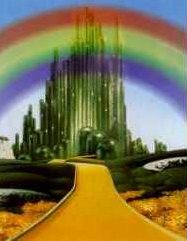
connection with L. Frank Baum of The Wonderful Wizard of Oz
fame.

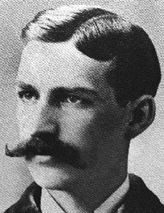
Baum was a practicing theosophist and a close friend of Edgar Rice Burroughs
-- at least close enough to recommend him in 1917 to membership in the
Uplifters, a club of California businessman founded by Baum in 1914. It
had been the practice of the Burroughs family to winter in California,
usually starting in September, from at least the year 1913. Ed most likely
met Baum during one of these extended periods*
because by 1917 he felt that he knew him well enough to recommend his membership
in the Uplifters, even though the Burroughs did not move to Tarzana until
January 1919. That Ed was already a long-time a fan of the Oz series is
proven from his early Minidoka,
which includes a nod to Baum in the introduction as well as in the whimsical
contents of this children’s story.
Perhaps the most thorough documentation of Baum’s connection with theosophy
was given in David B. Parker’s "Oz: L. Frank Baum’s Theosophical Utopia,"
a paper delivered at the Kennesaw Academic forum, April 1996. In his study,
Parker presents a brief history of the various critical treatments of Oz
over the years and cites Baum’s friendly theosophical musings as the editor
of the Aberdeen (South Dakota) Saturday Pioneer newspaper in 1890-91. An
article by John Algeo, titled "A Notable Theosophist: L. Frank Baum" was
published in the journal of the Theosophical Society in America announcing
Baum and his wife’s admission into the membership of the Chicago branch
of the Theosophical Society on September 4, 1892.
Robert R. Barrett notes that the manuscript of Minidoka was written
during the 1901-1904 period when Burroughs and his wife were involved with
his brother’s gold mining enterprise in Idaho. Barrett writes, "Burroughs
may well have been inspired by L. Frank Baum’s introduction to The
Wonderful Wizard of Oz (1900); why else would he have subtitled
this story "An Historical Fairy Tale?" (Burroughs, 8).
Actually, Baum’s introduction to the Wizard of Oz means to contrast
his own "modernized fairy tale" with the older "historical" fairy tale.
He gives examples of the later as Grimm and Anderson and goes on to write:
"Yet the old-time fairy tale, having serves for generations, may now
be classed as "historical" in the children’s library; for the time has
come for a series of newer "wonder tales" in which the stereotyped genie,
dwarf and fairy are eliminated, together with all the horrible and blood-curdling
incidents devised by their authors to paint a fearsome moral to each tale.
Modern education includes morality; therefore the modern child seeks only
entertainment in its wonder-tales and gladly dispenses with all disagreeable
incidents.
Having this thought in mind, the story of The Wonderful Wizard of
Oz was written solely to pleasure children of today. It aspires to
being a modernized fairy tale, in which the wonderment and joy are retained
and the heart-aches and nightmares are left out." (Baum, 5).
Thus, it’s not exactly certain what Burroughs meant by "historical"
unless he intended that he was writing in that older form which Baum clearly
rejects in his introduction. Even more confusing is the fact that Baum
does indeed include a host of dwarf-like characters and blood-curdling
incidents in his Oz series, in fact, his pantheon of strange peoples and
monsters is very similar to those later created by Burroughs. About the
only "modern" elements one may find in Baum is the fact that his fantasies
refer to American sites as does Burroughs in his Minidoka as well
as in many later adventures on strange worlds.
One need not go so far afield as the confusing tomes of Madame Blavatsky
to find a theosophical connection in the writing of Burroughs -- even though
a perusal of the chapter titles of her works alone read like the themes
of ERB stories. The wide-read Burroughs no doubt was familiar with her
work since it was so popular in his early years, but, true to his nature,
if he was influenced by her writing at all, it would have been to reverse
her fanciful findings rather than be directly inspired by them. No one
would ever suggest that his general disinterest in any kind of organized
religion would be followed by his being taken by the mumbo jumbo of such
a strange cult as the theosophists.
However, friend Baum was an ardent theosophist, and no doubt bent Ed’s
ear with many of these flights of fancy and outlandish theories about the
origins of mankind and the ancient history of the world. He also must have
explained to him how theosophy was embedded in his own Oz series, which
I imagine Ed would have found highly amusing but hardly a model to follow
in his own work. Most of ERB’s mystical flights tend to be tongue-in-cheek
-- increasingly so in his later work, especially in the Venus series. A
careful reading of his entire oeuvre demonstrates only a thin scaffolding
of mystery and mystification before he cuts to the chase of love and adventure.
His infrequent long digressions into explanations of mythic origins of
a certain race or world are never meant to be taken seriously as the tenets
of a theosophical system but are merely structures to weave a entertaining
yarn.
It’s fun to speculate on ERB’s influences because there are so many.
Yet, the man himself was a great inventor with one of the most fertile
minds in imaginative literature. Burroughs is more than a synthesis of
his wide reading. He himself is the magician of his realm, pulling peoples,
creatures, and entire worlds out of his hat before our amazed eyes. He
did this for over forty years, traveling through the normal three periods
of artistic creation: Early Works (influenced by others, yet marked by
the originality of his personal style); a Middle Period of maturity in
which he refined his particular characteristics and wrote his masterpieces;
and Late Works in which he moved away from his easy success to try his
hand at new ideas and invented new worlds to conquer.
Having written all this -- the usual disavowal of any overwhelming influence
on The Master -- let me say that Baum was a charming man who was genuinely
interested in writing children’s literature. Burroughs was without question
charmed by both the man and by his writing and would have felt honored
to be his friend. I would guess that Ed was fascinated with Baum’s success
in publishing and probably picked his mind more about practical matters
of selling and expanding his writing empire rather than getting into serious
theosophical discussions. Yet everything seemed to rub off on Burroughs;
he was able to take in a great amount of information and turn it over in
his imagination to come up with new twists that have delighted readers
for nearly a hundred years.
Ed’s personal relationship with Baum was probably friendly but not profound.
As early as 1917, the very year that Burroughs came into the Uplifters,
Baum was already seriously ill with a series of operations to follow, and
he became bedridden for the rest of his life. Baum died on May 6, 1919,
and the funeral was held at Forest Lawn Memorial Park in nearby Glendale.
Ed was writing Under the Red Star at the time, an anticommunist
satire set in the distant future of America. The views presented in this
piece are overtly patriotic, which was typical of his Republican politics,
but also graphically Christian, which is definitely atypical of his writing.
There is even a sympathetic mention of a figure of Jesus Christ on the
cross carved on ivory from an elephant tusk! It’s not theosophy, but it
does show that Burroughs was still experimenting with personal philosophy
in his writing, which quickly returned to a more typical satirical view
of religion in general.
There is, to be sure, a definite Baum-Burroughs connection but with
only the most tenuous link to theosophy. The difficulty with Burroughs,
which does provide us with an intriguing series of questions, is related
to his fecundity of creation. He wrote so very much and did have syncretic
inclinations -- even linking his own multiple series at times -- yet the
problem of coming up with a logical system to explain all the details of
his many inventive worlds must always be met with, to quote Winston Churchill,
"a riddle wrapped in a mystery inside an enigma." His only partly systematic
worlds have rambling mixtures of fact and fantasy like theosophical meanderings,
yet these tangles are related to the flashes of his inventive imagination
rather than some template of an secret, philosophical complex. He was willing
to throw out something new and speculative rather than confining himself
to a hard logic that tied up every loose string of conception. Thus we
wonder about the intriguing, undisclosed details, such as the use or non-use
of telepathy on Barsoom, the hatching of a combination of Martian and human
eggs, the exact taxonomy of plant men -- among a host of other conundrums.
At times, Burroughs sounds like a theosophist, and thus gives rise to
speculation. I believe that the link with Baum is a valid one, but not
the only one which may have led him into the thickets of theosophy. It
is certain that Burroughs was not stuck in there, no matter what sticky
goo may have rubbed off from either Baum or Blavatsky. Ed was too protean
for that. He created systems of his own, and theosophy had to wait in line
for his subconscious to process and decant a portion of its brew according
to his need in his next novel. Again, I must say, that it seems that nothing
ever came out of Ed’s imagination from his reading or conversations with
others that was not set on its head, topsy-turvy, to be given a Burroughsian
twist into not Oz but Otz. Heaven is hell for travelers down the river
Iss. Dante is conjured as often as Blavatsky, but the mixture is always
pure Burroughs.
Burroughs’ inventive output over his 40 years as an author is remarkable
enough with his 80 plus novels and stories, yet the vast (there is no other
word for it) number of his characters, creatures, and worlds have given
rise to entire dictionaries just to keep track of the enormous wealth of
names and places, most of which are extremely inventive, employing the
use of a host of languages from both East and West. These titles, names,
locations, etc. are as extensive as the Hindu pantheon of gods, and are
so suggestive of a familiarity with nearly every world religion, that speculation
easily arises about some sort of theosophical link, yet every indication
from his biographers tells us that Ed was not a deep thinker, just an amazing
storyteller and word crafter who found the name or title that sounded right
for each man, woman, or denizen of his worlds. It was not so much the matter
of a philosophical system as having an exceptionally good ear for the precise
sound and effect of words.
Of course, that does not mean that one could not easily construct a
theosophical system out of ERB’s writings. They are certainly complex enough
in the multitude of details, and most of his characters can bear the weight
of archetypal assimilation. In fact, his most famous character, Tarzan,
has become a symbol for the wild man of nature known around the entire
world. The main problem with constructing such a pantheon is not diversity
but depth, for, like Baum, Burroughs is considered to be a writer of literature
for children or adolescents, so his work today is considered as examples
of dated and blushingly romantic sword and sorcery or proto-science fiction.
Like Baum, Burroughs still has his adepts -- his fans -- or I would
not be writing this article. His writing is still engaging to me, and part
of the fun is playing with the great wealth of possibilities contained
in his fantastic characters and images from many worlds beyond this familiar
one.
*
Taliaferro indicates the winter of 1916 for this meeting
.
Bibliography
Baum, L. Frank, The Wonderful Wizard of Oz, Harper/Collins, 1987
Burroughs, Edgar Rice, Minidoka, 937th Earl of One Mile Series M,
Dark Horse Comics, Inc., 1998
Taliaferro, John, Tarzan Forever: The Life of Edgar Rice Burroughs,
Creator of Tarzan, Scribner, 1999.
Internet Resources
Dale R. Broadhurst's Sword
of Theosophy Series
 Part I: John Carter: Sword of Theosophy Revisited
Part II: Lupoff of Mars: The Quest for Gullivar Jones Carter
Part III: ERB: Search for Ultimate Answers
From the Broadhurst Library:
A Source for ERB?
William Scott-Elliot's The Story of Atlantis The Lost Lemuria ~ Part
1
William Scott-Elliot's The Story of Atlantis The Lost Lemuria ~ Part
2
Edgar Rice Burroughs
The Nkima Chattering from the Shoulder Articles by David Adams
Religious Themes in the Novels of Edgar Rice Burroughs by Robert
B. Zeuschner
ERB & LFB: THE WIZARDS OF CALIFORNIA by David Adams
Minidoka: ERB C.H.A.S.E.R. Encyclopedia
Edgar Rice Burroughs Bio Timeline by Bill Hillman
L. Frank Baum and Oz
E-Text Editions of Books by L. Frank Baum
Jim's Wizard of Oz Criticims Page
Oz: L. Frank Baum's Theosophical Utopia by David B. Parker
A Faculty Colloquium Speech given at Kennesaw State University, 1996.
Eric's Wonderful Wizard of Oz Website
Jim's Ozzy Links Page
Nate Barlow's Wonderful Wizard of Oz FAQ List
Piglet Press Tour Guide to The Wonderful Wizard of Oz
Wendy's Wonderful Wizard of Oz Complete Directory
"The Wonderful Wizard of Oz: Parable on Populism," by Henry M. Littlefield
The Spirituality of Oz
The Rise and Fall of Oz as a "Parable on Populism" by David B. Parker
Oz Reference Library
Wizard of Allegory








 WEBJED:
BILL HILLMAN
WEBJED:
BILL HILLMAN