Site hosted by Angelfire.com: Build your free website today!

Safety

Up
NFPA Label

SAFETY RESOURCES

Select a topic:
 
bullet

CPR - June 3, 2002

bullet

Hazard Communication - May 8, 2002

bullet

Hydrogen Sulfide (H2S) Safety - April 9, 2002


CPR - June 3, 2002


Facts about CPR

Sudden cardiac arrest is the leading cause of death in adults. Most arrests occur in persons with underlying heart disease.

CPR doubles a person's chance of survival from sudden cardiac arrest.

75% of all cardiac arrests happen in people's homes.

The typical victim of cardiac arrest is a man in his early 60's and a woman in her late 60's.

Cardiac arrest occurs twice as frequently in men compared to women.

CPR IN THREE SIMPLE STEPS

CALL  :  BLOW  :  PUMP

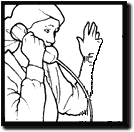
1.  Call:  check the victim for unresponsiveness.  If there is not response, Call 911 and return to the victim.  in mot locations the emergency dispatcher can assist you with CPR instructions.
2.  Blow:  Tile the head back and listen for breathing.  if not breathing normally, pinch nose and cover the mouth with yours and blow until you see the chest rise.  give 2 breaths.  Each breath should take 2 seconds.

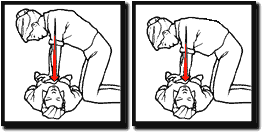
3.  Pump:  If the victim is still not breathing normally, coughing or moving, begin chest compressions.  Push down on the hest 1 1/2 to 2 inches 15 times right between the nipples.  Pump at the rate of 100/minutes, faster than once per second.
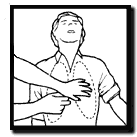
handposition.gif (3169 bytes)
bullet

Click here for instructions for CPR to carry in your billfold.

bullet

CPR instructions for adults are different than the instructions for children and animals click here for special instructions.

bullet

Local hero uses his CPR training to save a child


additional resources


Hazard Communication - May 8, 2002


The Community "Right To Know" Law requires that the public be informed of (1) "what" the material is; (2) any potential hazard; and (3) remedies for exposure.

bullet

All Hazardous material should be labeled

bullet

Material Safety Data Sheets (MSDS) are required

bullet

Special procedures should be followed for receiving and shipping

bullet

Managers and supervisors have  the responsibility to train their employees to recognize and handle hazardous material

bullet

Employees are responsible for recognizing hazardous materials and knowing proper handling procedures.

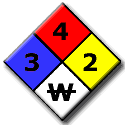
The NFPA Diamond  symbol provides information  on the four main hazards of materials.  To find out more information on how to read the symbol, click on the NFPA Button on the Navigation Bar at the left.

bullet

Health               

bullet

Flammability

bullet

Reactivity

bullet

Special Hazards

Check this link out for more info: http://www.ilpi.com/msds/ref/nfpa.html


additional resources


Hydrogen Sulfide (H2S) Safety - April 9, 2002


Hydrogen Sulfide is .........

bullet

H2S

bullet Heavier than air
bullet Rotten Egg Odor
bullet Colorless
bullet Corrosive
bullet Flammable
bullet Toxic
bullet Irritating to skin
bullet Threshold limit - 10 ppm is the concentration which all workers may be repeatedly exposed without adverse effects


additional resources