|
|
Powerful and Versatile
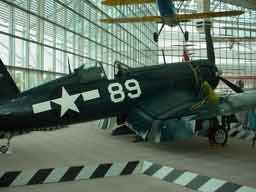
The Chance Vought F4U Corsair (this example was built under license
by the Goodyear Company) was the premier Navy and Marine fighter of
World War II. The Corsair, along with the Grumman Hellcat, are
credited with turning the tide of the Pacific air war by
overwhelming the once-fearsome Japanese Zero fighter. Besides its
role in air-to-air combat, Corsairs were used as fighter-bombers
near the end of WWII and throughout the Korean War. The Corsair had
an unusually long production run for a WWII-era aircraft with 12,571
examples, the last in 1952. |
|
|
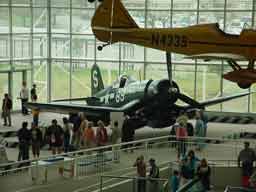
The Museum's Corsair was built in April 1945 and served aboard the USS
Intrepid. After the war, it was transferred to the Naval Reserve,
eventually stationed at Naval Air Station, Sand Point, Seattle in 1950.
That July, Commander Ralph Milleson made a water landing on Lake
Washington following a non-fatal midair collision with another Corsair.
The aircraft was recovered from the lake in 1983 and restored.
"Baa Baa Black Sheep"
One of the most famous squadrons to fly the Corsair was the Marine Corps
Black Sheep squadron (VMF-214), commanded by Major Gregory
"Pappy" Boyington. Boyington attended the University of
Washington and flew with the American Volunteer Group in China, where he
is unoffically credited with six victories. When America entered WWII,
"Pappy" scored 22 more victories over the Pacific in his Marine
Corps Corsair. In early 1944, he was shot down and spent the final twenty
months of WWII as a prisoner of war. The NBC series Baa Baa Black Sheep
presented Boyington’s exploits to a new generation in the mid-1970s.
"Bent Wing Bird"
Chance Vought designer Rex B. Beisel, a graduate of Seattle's Queen Anne
High School and the University of Washington, designed the Corsair around
a large engine and massive propeller. Instead of building long, awkward
landing gear needed for propeller clearance, Beisel's bent-wing design
allowed for shorter, stronger gear for carrier landings. The unusual wing
not only gave the Corsair its distinctive shape, but also reduced drag,
allowing the "Bent Wing Bird" even greater speed.
Flight Fact: The Corsair's propeller measures over
13 feet 4 inches (4 m)! |